
How to Start a Custom Silicone Baby Product Project with a Manufacturer
Starting a custom silicone baby product project is not only about sending a product photo and asking for a price.
For baby brands, importers, distributors and e-commerce sellers, a custom project usually involves product idea review, material selection, size confirmation, mold development, sampling, testing support, packaging and mass production planning.
The more clearly buyers prepare their project information, the faster a manufacturer can check feasibility, MOQ, sample plan, lead time and production solution.
This guide explains what buyers should prepare before starting a custom silicone baby product project with an OEM/ODM manufacturer.
What Is a Custom Silicone Baby Product Project?
A custom silicone baby product project means the buyer needs a product made or adjusted based on specific business requirements.
It may be a completely new product idea, or it may be based on an existing product with changes in color, size, logo, packaging, structure or material.
Common custom silicone baby products include:
- Silicone baby bottles
- Baby bottle nipples
- Silicone teethers
- Pacifiers
- Pacifier clips
- Fruit feeders
- Baby feeding sets
- Silicone bibs
- Baby cups and spoons
- Milk powder containers
- Other silicone baby care products
For some buyers, customization may be simple, such as changing product color or packaging. For others, the project may require new mold development, structure adjustment, sample testing and private label packaging.
This is why custom silicone baby product development should start with clear project communication.
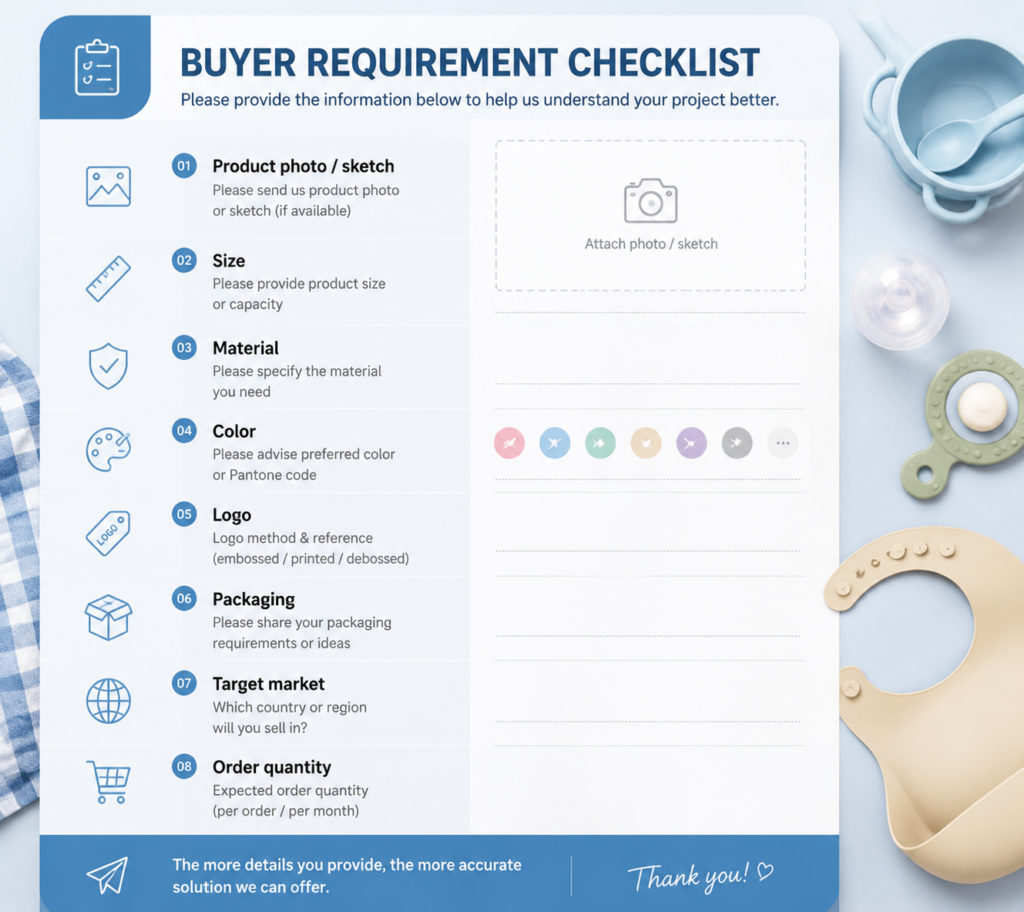
What Information Should Buyers Prepare?
Before contacting a manufacturer, buyers do not need to prepare everything perfectly. But some basic information can make the project review much faster.
Useful information includes:
- Product photos or reference samples
- Product function
- Target market
- Product size
- Material requirement
- Color requirement
- Logo requirement
- Packaging requirement
- Expected order quantity
- Testing or certification needs
- Launch timeline
For example, if you want to develop a silicone baby teether, the manufacturer needs to know the shape, size, hardness, chewing area, color, packaging and target market.
If you want to develop a silicone baby feeding set, the manufacturer needs to know the set combination, material, product size, packaging style, testing direction and estimated quantity.
A clear requirement list helps the factory understand whether the project is suitable for stock customization, existing mold adjustment or new mold development.
Product Photos, Samples or Drawings
Product photos, samples or drawings are very useful when starting a custom project.
A buyer can provide:
- A photo of a similar product
- A physical sample
- A rough sketch
- A 3D file
- A product idea description
- A competitor product reference
- A packaging reference
These references help the manufacturer understand the product direction.
However, buyers should remember that a reference photo does not mean the product can be copied directly. A professional manufacturer should still review the product structure, material, mold feasibility and safety-related details.
For baby products, structure review is especially important because the product may be used for feeding, teething, soothing or daily baby care.
A product that looks simple from the outside may still involve many manufacturing details.
Material, Size and Function Requirements
Material selection is an important part of a custom silicone baby product project.
Most baby product buyers care about food-grade silicone, BPA-free material, soft touch, easy cleaning and safe daily use. But different products may need different material properties.
For example, a silicone teether may need a soft chewing feel. A baby bowl may need better shape stability. A bottle nipple may need careful review of softness, flow and structure.
Buyers should prepare basic material and product function requirements, such as:
- Food-contact use
- Teething use
- Feeding use
- Soothing use
- Baby care use
- Required softness or hardness
- Heat resistance requirement
- Dishwasher-safe requirement
- Product size or capacity
- Product weight requirement
Size information is also important.
If the buyer already has exact measurements, they should provide them. If not, the factory can help review the approximate size based on product function and target age group.
MOQ, Sampling and Lead Time Questions
MOQ, sampling and lead time are usually the first things buyers want to know.
But for custom silicone baby products, these answers depend on the project type.
A stock product with custom color or packaging may have a lower MOQ and faster delivery.
A new custom mold project usually needs more time because it involves design review, mold development, sample testing and production confirmation.
Before asking for final pricing, buyers should first help the manufacturer understand:
- Is this a stock item or new design?
- Does it need a new mold?
- Is custom color required?
- Is custom logo required?
- Is private label packaging required?
- How many pieces are needed for the first order?
- Is testing support needed before mass production?
- What is the expected launch time?
This information helps the manufacturer provide a more realistic project plan.
For custom projects, buyers should not only ask, “What is the lowest price?”
A better question is:
“What is the suitable development plan for this product based on MOQ, mold cost, sample time, testing support and production lead time?”
Testing and Target Market Information
Testing support depends on product type and target market.
This is very important for silicone baby products because different markets may have different requirements.
For example:
- Baby feeding products may need food-contact material testing.
- Silicone teethers may need CPC, EN71 or market-specific testing support.
- Baby bottles or drinking products may need EN14350-related support.
- Pacifier clips may need EN12586 testing support.
- Silicone feeding sets may need FDA or LFGB food-contact testing support.
Not every silicone baby product needs the same testing.
A teether, pacifier clip, baby bottle and feeding spoon may all be baby products, but they may involve different testing directions.
Before starting a project, buyers should tell the manufacturer where the product will be sold.
Useful target market information includes:
- United States
- European Union
- United Kingdom
- Canada
- Australia
- Amazon marketplace
- Retail stores
- Brand website
- Distributor channel
With this information, the manufacturer can help review possible testing preparation more clearly.
The final testing plan should be confirmed based on product design, material, function and target market.
For more details, you can read our guide on silicone baby product testing and certifications.
Packaging and Private Label Requirements
Packaging is also part of a custom silicone baby product project.
For baby brands, packaging is not only about appearance. It also affects brand image, product protection, shelf presentation, customer trust and market communication.
Common packaging options include:
- OPP bag
- Color box
- Kraft box
- Window box
- Blister packaging
- Gift box
- Custom label
- Instruction card
- Barcode sticker
- Private label packaging
Buyers should prepare packaging requirements as early as possible.
For example, a baby feeding set may need a color box with product information. A silicone teether may need packaging that protects the product and clearly shows the product use. A pacifier clip may need warning information depending on the target market.
If the buyer already has brand artwork, the factory can help review packaging size and product fit.
If the buyer does not have final artwork yet, the factory can still help discuss packaging structure and basic packaging direction.
How Baiya Silicone Reviews a New Project
Dongguan Baiya Silicone Products Co., Ltd. is a silicone OEM/ODM manufacturer based in Dongguan, China.
Through our baby product division Baiya Baby, we support global baby brands, importers, distributors and e-commerce sellers with custom silicone baby product development.
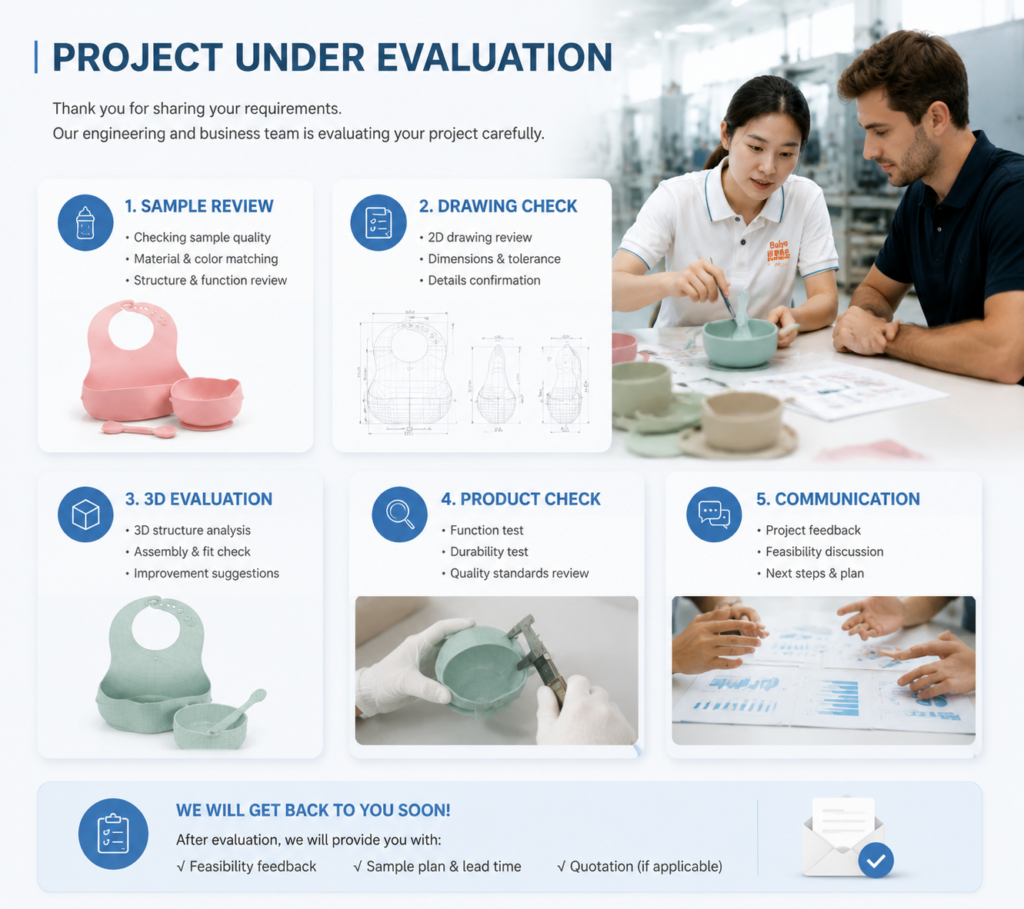
When we receive a new custom silicone baby product project, we usually review:
- Product type
- Product function
- Reference photos or samples
- Material requirement
- Product structure
- Color requirement
- Logo requirement
- Packaging requirement
- Target market
- Testing support needs
- Estimated order quantity
- Sample and delivery expectations
This review helps us check whether the project is suitable for existing mold customization, new mold development or further design discussion.
For buyers who already have a design, we can help review manufacturing feasibility.
For buyers who only have a product idea or reference sample, we can help discuss possible development directions before mold opening.
Our goal is to help buyers understand MOQ, sample plan, lead time, production solution and possible testing support before moving forward.
Common Mistakes Buyers Should Avoid
Many buyers make similar mistakes when starting a custom silicone baby product project.
One common mistake is only sending a product photo and asking for the lowest price. Without size, material, quantity, packaging and target market information, the factory cannot provide an accurate development plan.
Another mistake is opening a mold too quickly before confirming product structure and function. For baby products, this can create problems later if the structure is not practical or testing direction is not considered early.
Buyers should also avoid using one testing requirement for all products. A baby bottle, teether, feeding set and pacifier clip may need different testing support.
Common mistakes include:
- Asking for price without clear product details
- Ignoring target market requirements
- Not confirming material and hardness
- Not checking mold development feasibility
- Treating all baby products as the same testing category
- Waiting until mass production to consider testing
- Ignoring packaging and labeling needs
- Choosing a supplier only based on low price
- Not confirming sample details before bulk production
A custom baby product project works better when both buyer and manufacturer communicate clearly from the beginning.
Final Thoughts
A custom silicone baby product project needs more than a product idea.
Buyers should prepare product photos, samples, drawings, target market, material requirements, size, color, logo, packaging, testing needs and estimated order quantity before contacting a manufacturer.
For baby brands, a clear project brief helps reduce misunderstanding, save development time and improve production efficiency.
Baiya Silicone supports OEM/ODM silicone baby product development, including product idea review, mold development, sampling, material selection, custom color, logo, packaging, testing preparation, mass production and quality control.
If you are developing a new silicone baby product project, send us your product idea, reference samples, drawings, packaging requirements or target market information.
Baiya Silicone can help review product feasibility, MOQ, sample plan, lead time, production solution and possible testing support based on your project needs.
 English
13 Responses
[…] is needed next.For a more detailed preparation checklist, buyers can read our guide on how to start a custom silicone baby product project with a […]
[…] a more detailed preparation checklist, buyers can read our guide on how to start a custom silicone baby product project with a […]
[…] buyers are still preparing their project information, they can first review how to start a custom silicone baby product project with a […]
[…] this reason, buyers starting a custom silicone baby product project should prepare product photos, samples, drawings, target market, material requirements, packaging […]
[…] buyers are still preparing product information, it is helpful to review how to start a custom silicone baby product project before requesting a final […]
[…] Buyers who are still organizing their requirements can first read How to Start a Custom Silicone Baby Product Project with a Manufacturer. […]
[…] who only have an initial idea can use How to Start a Custom Silicone Baby Product Project with a Manufacturer as a project-preparation […]
[…] is why buyers should provide clear product requirements before production begins. The article How to Start a Custom Silicone Baby Product Project with a Manufacturer explains what information helps a factory prepare a more practical development and quality […]
[…] How to Start a Custom Silicone Baby Product Project with a Manufacturer […]
[…] Buyers who are still defining the project can first read How to Start a Custom Silicone Baby Product Project with a Manufacturer. […]
[…] preparing their first project can review How to Start a Custom Silicone Baby Product Project with a Manufacturer before requesting a final […]
[…] Buyers who are still preparing their product brief can also read How to Start a Custom Silicone Baby Product Project with a Manufacturer. […]
[…] preparing a new product brief can read How to Start a Custom Silicone Baby Product Project with a Manufacturer before requesting a final material […]