
Silicone Baby Product Packaging & Branding Customization Guide for OEM Buyers
For baby brands, importers, distributors and private label sellers, silicone baby product packaging is not only a box placed around a finished product. It is part of product protection, brand recognition, labeling preparation, logistics and the final customer experience.
A strong packaging project should connect product size, sales channel, brand identity, target market, required information, packaging materials, printing method, MOQ and shipment efficiency. A package may look attractive on screen but still fail if the product does not fit securely, the artwork cannot be printed clearly or the carton volume becomes too high.
This guide explains how OEM buyers can plan silicone baby product packaging and branding customization from the first brief to printed samples, mass production and shipment.
Why Packaging and Branding Should Be Planned Early
Packaging decisions affect more than appearance. They can influence:
- Product protection
- Packaging MOQ
- Printing lead time
- Carton size
- Shipping cost
- Retail presentation
- E-commerce photography
- Barcode and label placement
- Instructions and warnings
- Repeat-order consistency
If packaging is discussed only after the product is finished, the buyer may need to redesign the box, change the product arrangement or delay production while printed materials are prepared.
For private label projects, packaging should be reviewed together with product color, logo, set combination and launch channel. Buyers planning a broader brand program can first read Private Label Silicone Baby Products OEM/ODM Solutions for Brands.
What Should Silicone Baby Product Packaging Achieve?
Good silicone baby product packaging should balance five objectives:
- Protect the product during storage and transportation
- Present the product clearly to the target customer
- Carry the required brand and product information
- Fit the sales channel and logistics plan
- Remain practical for repeat production
The best package is not always the largest or most expensive option.
A compact paper band may work well for a simple silicone bib. A feeding set may need a structured color box. A teether may use a backing card or small retail box. A baby bottle set may need internal support to keep several components organized.
The packaging direction should follow the product rather than forcing every SKU into the same box style.
Step 1: Define the Sales Channel and Target Market
Before selecting a package, buyers should confirm where the product will be sold.
Common channels include:
- Amazon and other marketplaces
- Brand websites
- Baby specialty stores
- Supermarkets
- Distributors
- Gift channels
- Subscription boxes
- Trade-show samples
Each channel creates different priorities.
An e-commerce seller may need compact dimensions, clear product photography and protection during parcel delivery. A retail buyer may care more about shelf visibility, hanging options and front-panel communication. A distributor may need multilingual artwork, carton labels and several SKU variations.
Target-market information is also important because product information, warnings, traceability details and responsible-party information may vary by product and jurisdiction.
Brands should confirm the applicable packaging and labeling requirements with their laboratory, importer or compliance professional before final printing.
Buyers who are still preparing their product brief can also read How to Start a Custom Silicone Baby Product Project with a Manufacturer.
Step 2: Choose the Right Packaging Structure
Different products require different packaging structures.
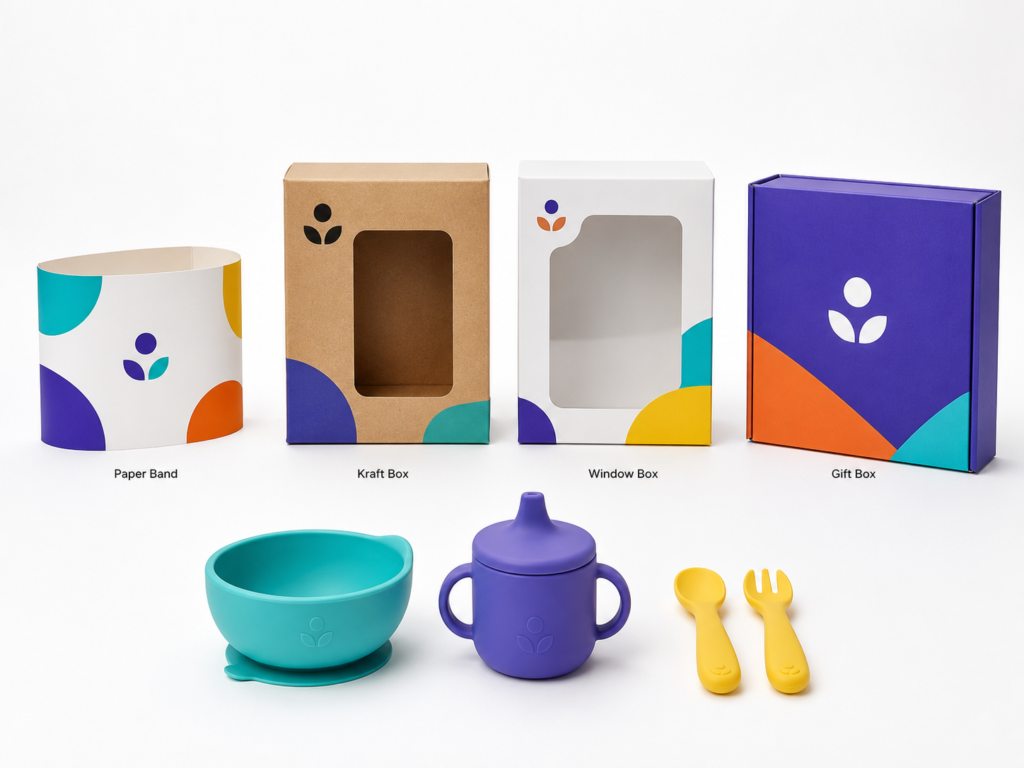
| Packaging Option | Suitable Uses | Main Considerations |
|---|---|---|
| OPP or protective bag | Bulk orders, inner protection and simple sampling | Low presentation value; labeling may still be needed |
| Paper band or belly band | Bibs, placemats and simple feeding accessories | Compact and visually clean, but offers limited protection |
| Kraft or color box | Bowls, cups, teethers, feeding accessories and sets | Supports branding and printed information |
| Window box | Retail products that benefit from product visibility | Window structure, dust protection and box strength |
| Gift box | Premium sets and coordinated collections | Higher cost, larger shipping volume and packaging MOQ |
| Backing card | Clips, small accessories and lightweight products | Hanging structure, attachment method and warning space |
| Blister packaging | Some retail accessories and products requiring visibility | Tooling, sealing method and market suitability |
| E-commerce mailer | Direct-to-consumer sets and parcel delivery | Protection, unboxing experience and shipping efficiency |
A professional supplier should check the physical product before recommending the final structure.
For a coordinated feeding collection, the package also needs to control the position of each item. The article Custom Silicone Baby Feeding Set Development: From Concept to Market Product explains how product combination, packaging fit and market launch should be reviewed as one project.
Product Fit Comes Before Artwork
Many buyers begin with the artwork, but the packaging structure should be confirmed first.
The manufacturer or packaging supplier may need:
- Product dimensions
- Product weight
- Set combination
- Folding direction
- Internal arrangement
- Accessory quantity
- Protection requirements
- Display orientation
- Shipping method
Silicone baby product packaging should be sized around the real product rather than an estimated product rendering.
Silicone products can be flexible, but this does not mean they should be compressed without review. A bib may fold easily, while a structured bowl or cup may deform if the box is too tight. Multi-component sets need enough control to prevent parts from moving or being omitted during packing.
A physical packaging fit test should be completed before bulk printing.
Step 3: Build a Consistent Brand System
Brand customization should create recognition across the product and packaging.
The buyer should prepare:
- Brand logo
- Logo-use rules
- Brand colors
- Typography
- Product naming system
- Product photography direction
- Icon style
- Tone of voice
- Packaging hierarchy
The packaging does not need to repeat every brand element at the same size. A clear hierarchy is more effective.
For example:
- Front panel: brand, product name and main product image
- Side panel: key product information or set contents
- Back panel: instructions, care information and required details
- Bottom panel: barcode, batch or traceability area and carton references
For silicone baby product packaging, consistency across several SKUs is especially important. A bib, bowl, cup and spoon set may use different box dimensions, but the logo position, color system, typography and information order should still feel like one brand family.
Product Logo and Packaging Branding Are Different Decisions
A logo on the product and a logo on the package serve different purposes.
Product branding may use:
- Molded or debossed logo
- Raised logo
- Printed logo
- Laser marking on suitable components
- Branded accessory parts
Packaging branding may use:
- Offset printing
- Digital printing
- Screen or spot-color printing
- Foil stamping
- Embossing
- Spot UV
- Printed labels or sleeves
The best method depends on the product, packaging material, order quantity and desired appearance.
A large decorative logo may look attractive in a rendering but become unclear after printing or interfere with product information. The buyer should request a realistic artwork review rather than approving only a 3D mockup.
Step 4: Organize Packaging Information Clearly
OEM buyers should prepare packaging content before artwork approval.
Information may include:
- Brand name
- Product name
- Set contents
- Material
- Intended use
- Age guidance where applicable
- Care and cleaning instructions
- Warnings where applicable
- Barcode
- SKU or model number
- Batch or traceability information
- Manufacturer, importer or responsible-party information where applicable
- Country-of-origin information
- Website or customer-service contact
- Recycling or disposal symbols where applicable
Not every item belongs on the front panel. Information should be organized by priority and legal relevance.
The factory can review packaging size and print feasibility, but the brand or importer remains responsible for confirming the final claims, warnings and market-specific content.
For U.S. children’s products, buyers can review the official CPSC Tracking Label Business Guidance.
For products placed on the EU market, buyers can review the official General Product Safety Regulation summary and confirm the exact obligations for their product and sales model.
Step 5: Prepare the Dieline and Artwork
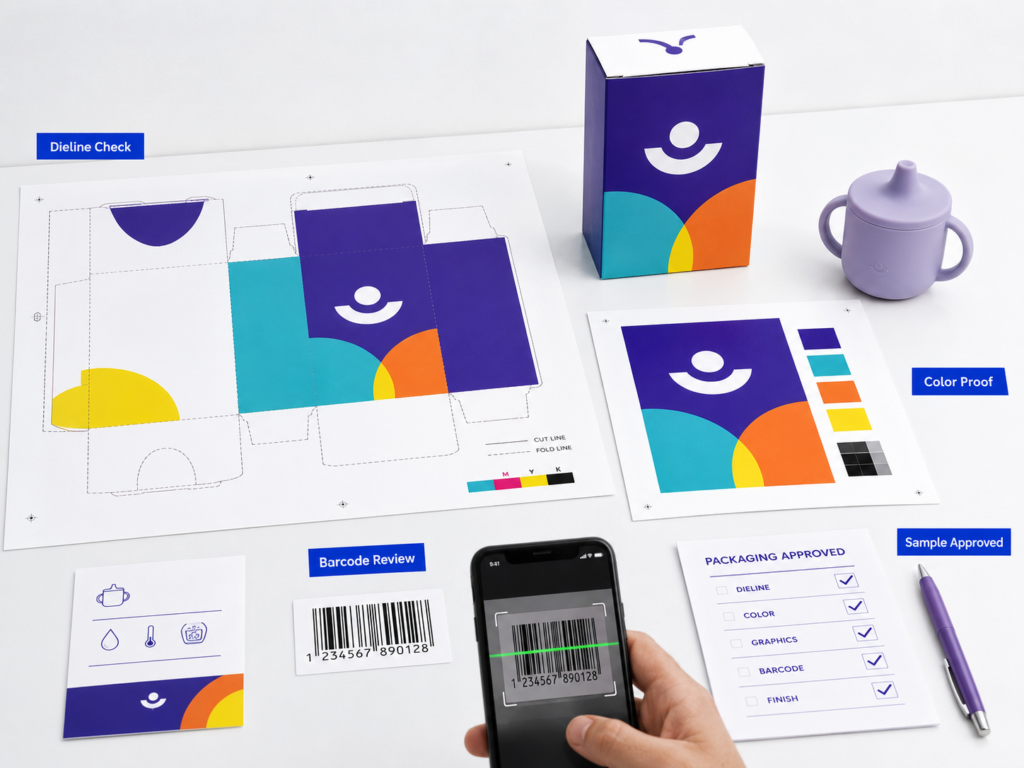
A dieline is the flat technical layout used to produce the box, sleeve, card or label.
The dieline should show:
- Cut lines
- Fold lines
- Glue areas
- Bleed
- Safe text areas
- Window position
- Barcode area
- Label area
- Product orientation
Artwork should be placed on the approved dieline, not on an estimated box shape.
Before releasing the file for printing, buyers should check:
- Correct dimensions
- Image resolution
- Font outlining or embedding
- Color mode
- Bleed
- Spelling
- Barcode readability
- Panel orientation
- Logo size
- Required information
- Multilingual text
- Version number
A simple version-control system is valuable. The buyer and supplier should identify the final approved file clearly so that an older artwork version is not printed by mistake.
Step 6: Review Color and Print Samples
Screen colors do not always match printed colors.
Differences may come from:
- Paper material
- Coating
- Printing process
- Ink
- Lighting
- Surface texture
- Lamination
- Spot-color or process-color conversion
Brands with strict color requirements should confirm a physical print sample or approved color standard.
The packaging color should also be reviewed beside the actual silicone product. A coral product may look different next to a warm-orange box than next to a cool-white package. The purpose is not always to make the box and product identical, but they should feel intentionally coordinated.
For silicone baby product packaging, buyers should also check whether printed colors remain consistent across boxes, sleeves, labels and instruction cards supplied by different vendors.
Step 7: Confirm Packaging Samples Before Mass Production
A final packaging sample should be reviewed with the real product inside.
The approval checklist may include:
- Box dimensions
- Product fit
- Opening and closing
- Internal support
- Product visibility
- Print color
- Logo position
- Text accuracy
- Barcode scan
- Label adhesion
- Instruction-card size
- Set contents
- Carton quantity
- Shipping protection
Photography mockups are helpful, but they cannot replace a physical packaging sample.
If the project uses several SKUs, buyers should approve each structure rather than assume one box size will work for every product.
The Silicone Baby Product OEM Process Explained: From Idea to Mass Production shows why product, sample, packaging and production approvals should follow a controlled sequence.
Packaging MOQ, Lead Time and Cost
Printed packaging usually has its own MOQ and lead time.
Silicone baby product packaging cost may depend on:
- Packaging structure
- Dimensions
- Paper or plastic material
- Number of printed colors
- Surface treatment
- Window or internal tray
- Print quantity
- Number of artwork versions
- Manual assembly
- Labels and inserts
- Carton requirements
Using the same box structure across several product colors may improve efficiency, but separate artwork versions can still create additional setup or inventory requirements.
Brands should ask suppliers to separate product and packaging costs in the quotation.
For a broader cost explanation, read MOQ, Lead Time & Pricing Structure for Silicone Baby Product Manufacturing and How Much Does It Cost to Manufacture Custom Silicone Baby Products in China?.
How Packaging Affects Shipping Cost
Packaging size affects carton volume and freight cost.
A visually impressive gift box may increase:
- Carton dimensions
- Chargeable volume
- Storage space
- Packaging material
- Internal support
- Shipping cost per set
Buyers should compare the retail value created by the package with its logistics impact.
For e-commerce products, a compact box with good internal protection may be more practical than a large presentation box. For premium retail, the larger package may be justified.
Before bulk production, the supplier can help estimate:
- Units per carton
- Carton dimensions
- Gross and net weight
- Pallet arrangement where applicable
- Product-to-packaging ratio
This information helps the buyer calculate the landed cost more accurately.
Quality Control for Printed Packaging
Packaging QC should be part of the production plan.
Checks may include:
- Correct artwork version
- Correct SKU
- Print color
- Text clarity
- Barcode readability
- Surface finish
- Cutting and folding
- Glue strength
- Window position
- Label placement
- Box damage
- Product fit
- Set combination
- Carton marks
For silicone baby product packaging, the final inspection should confirm both the printed material and the packed product.
A correct box with the wrong product color is still a packing error. A correct product with an outdated warning or barcode is also a problem.
The article How We Ensure Quality Control in Silicone Baby Product Production explains how packaging, quantity, labels and carton condition can be included in final inspection.
Common Packaging and Branding Mistakes
Common mistakes include:
- Designing artwork before confirming box dimensions
- Using a package that is too large or too tight
- Adding too much text to the front panel
- Confirming colors only on a screen
- Forgetting packaging MOQ
- Planning multilingual versions too late
- Using low-resolution product images
- Approving a mockup without a physical sample
- Failing to scan the final barcode
- Printing an outdated artwork version
- Ignoring carton volume
- Treating labels as a last-minute task
- Assuming one package works for every SKU
- Making claims without market-specific review
- Failing to plan repeat-order consistency
A strong packaging workflow reduces these risks before bulk printing.
OEM Buyer Packaging Brief Checklist
A clear silicone baby product packaging brief should include:
- Product name and reference
- Product dimensions and weight
- Set contents
- Target market
- Sales channel
- Packaging structure preference
- Brand logo
- Brand colors
- Artwork files
- Required languages
- Barcode
- Instructions and warnings
- Estimated quantity
- Launch date
- Shipping destination
- Special surface treatments
- Carton or pallet requirements
If some information is not ready, the project can begin with a product sample, target market and packaging reference. The supplier can then explain which details are needed next.
How Baiya Silicone Supports Packaging and Branding Customization
Dongguan Baiya Silicone Products Co., Ltd. is a silicone OEM and ODM manufacturer based in Dongguan, China.
Through Baiya Baby, we support global brands, importers, distributors, wholesalers and e-commerce sellers with product development and silicone baby product packaging customization.
Our support may include:
- Product and set-combination review
- Packaging-structure discussion
- Product measurement and fit review
- Custom color coordination
- Logo customization
- Packaging dieline coordination
- Packaging sample preparation
- Printed box, card, label and insert coordination
- Product and packaging QC
- Carton and shipment preparation
Packaging support depends on the product, quantity, artwork status and target market. Buyers should provide final compliance content or obtain confirmation from their importer, laboratory or professional adviser before printing.
Brands can review our OEM and ODM silicone baby product manufacturing services and silicone manufacturing capability before starting a project.
Final Thoughts
Effective silicone baby product packaging connects product protection, branding, information, compliance planning, logistics and the final customer experience.
OEM buyers should confirm the sales channel, package structure, product fit, artwork, labels, print sample, packaging MOQ and carton plan before mass production.
A reliable manufacturer should help identify practical production and packing issues early, while the brand or importer confirms the final market-specific content and compliance requirements.
VIf you are developing new packaging for a silicone baby product or private label collection, contact Baiya Silicone with your product list, packaging reference, target market, artwork status and estimated quantity.
Our team can help review packaging structure, product fit, sample planning, MOQ, lead time, production coordination and shipment preparation based on your project requirements.
 English
Comments are closed