
Custom Silicone Baby Feeding Set Development: From Concept to Market Product
For baby brands, importers, distributors and private label sellers, custom silicone baby feeding set development is not simply a matter of choosing several products from a catalog. A market-ready feeding set must bring together product function, material selection, set combination, mold feasibility, color consistency, packaging, testing preparation, production quality and launch planning.
A feeding set may include a bib, bowl, plate, cup, spoon, fork, placemat or snack container. Each item has a different structure and function, but the final collection still needs to look consistent and work as one product line.
A reliable manufacturer should help the buyer move from an initial idea to a product that can be sampled, tested, produced, packed and prepared for sale. This guide explains the complete custom silicone baby feeding set development process from concept review to market launch.
Why Custom Silicone Baby Feeding Set Development Needs a Complete Plan
A feeding set project becomes more complex as more items are added.
A simple three-piece set may include a bowl, spoon and bib. A larger collection may include a divided plate, suction bowl, cup, spoon, fork, bib, placemat and custom gift box. The buyer must confirm not only each product but also how the products work together.
The development plan should review:
- Target market
- Target age group
- Product combination
- Product sizes and capacities
- Silicone hardness
- Food-contact areas
- Suction and assembly functions
- Color system
- Logo method
- Packaging format
- Testing direction
- MOQ and lead time
- Quality-control points
- Launch schedule
Without a structured plan, buyers may approve products individually but later discover that the colors do not match, the set does not fit the packaging, the product sizes feel inconsistent or the testing plan was considered too late.
Buyers who are still defining the project can first read How to Start a Custom Silicone Baby Product Project with a Manufacturer.
Custom Silicone Baby Feeding Set Development: 8 Key Stages
The exact process depends on the project, but most feeding-set programs move through eight connected stages:
- Market and product brief
- Product combination planning
- Design and structure review
- Material, color and function confirmation
- Mold development and sample approval
- Testing and packaging preparation
- Mass production and quality control
- Market launch and repeat-order planning
The buyer does not need to finalize every detail on the first day. However, decisions made early in custom silicone baby feeding set development affect mold cost, sample time, production efficiency, packaging and launch risk.
Stage 1: Define the Target Market and Product Brief
The first stage is to explain what the brand wants to sell and who will buy it.
Useful project information includes:
- Target country or region
- Retail, e-commerce or distributor channel
- Intended age group
- Product positioning
- Target retail price range
- Reference products or samples
- Expected set combination
- Brand color direction
- Packaging style
- Estimated first-order quantity
- Launch date
- Testing expectations
A feeding set designed for an Amazon seller may prioritize compact packaging and shipping efficiency. A retail gift set may need stronger shelf presentation. A distributor may need multilingual packaging or several set combinations for different channels.
A clear brief allows the factory to evaluate whether the project should use existing molds, modified products or new mold development.
Stage 2: Decide the Feeding Set Combination
The product combination is one of the most important commercial decisions.
Common items include:
- Silicone baby bib
- Suction bowl
- Divided suction plate
- Open cup
- Straw cup
- Snack cup
- Silicone spoon
- Spoon and fork set
- Placemat
- Food storage container
- Fruit feeder
- Milk powder container
The buyer should avoid adding products only to make the set look larger. Each item should support the target market, retail price and packaging plan.
For example:
Three-Piece Starter Set
- Bowl
- Spoon
- Bib
This combination may suit entry-level pricing and compact e-commerce packaging.
Five-Piece Feeding Set
- Divided plate
- Bowl
- Cup
- Spoon
- Bib
This provides a more complete product story without creating an oversized package.
Full Private Label Collection
- Plate
- Bowl
- Cup
- Spoon
- Fork
- Bib
- Placemat
- Snack cup
- Gift box
This type of project needs stronger coordination across product color, dimensions, packaging and production schedule.
For broader supplier-selection guidance, read How to Find a Reliable Silicone Baby Feeding Set Manufacturer in China.
Stage 3: Review Product Design and Structure
A product may look attractive in a rendering but still need manufacturing review.
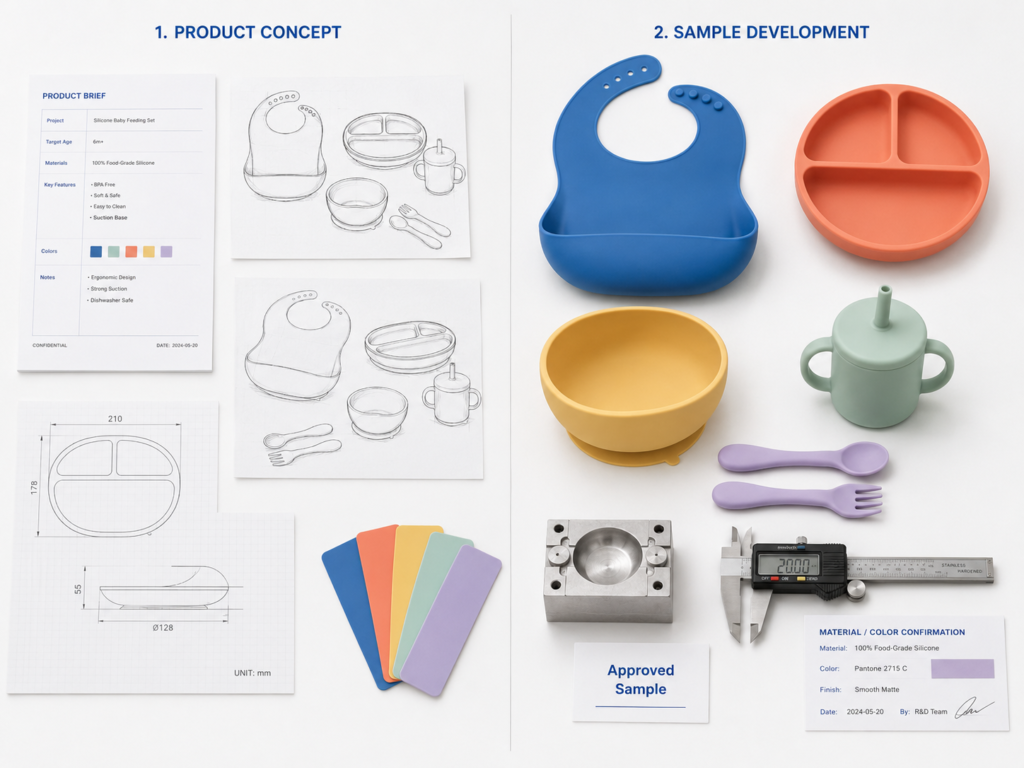
During custom silicone baby feeding set development, the factory should evaluate each item separately and then review the collection as a whole.
Important checks may include:
- Product dimensions
- Wall thickness
- Silicone hardness
- Suction-base structure
- Bowl and plate capacity
- Cup rim and handle design
- Lid or straw fit
- Spoon head size
- Edge smoothness
- Bib pocket and neck closure
- Demolding direction
- Mold parting line
- Cleaning accessibility
- Packaging fit
A suction plate should have enough structural stability. A bib should remain flexible. A spoon should balance softness and control. A cup should match the intended use and target age group.
Design review also helps identify whether different products in the set feel visually related. Rounded corners, handle shapes, logo placement and surface details can create a consistent collection even when the products use separate molds.
Stage 4: Confirm Material, Color and Product Function
Material and color decisions affect both product performance and brand presentation.
Buyers commonly request:
- Food-contact silicone
- BPA-free materials
- Suitable hardness
- Heat resistance
- Odor control
- Easy cleaning
- Stable color performance
- Soft surface feel
Different products may need different hardness levels. A bib usually needs more flexibility, while a bowl or plate may need greater shape stability. A spoon may use a softer feeding area with a firmer handle structure, depending on the design.
Color development should be reviewed across the complete set. The same color formula may appear slightly different on thin and thick products, so buyers should compare real samples rather than relying only on screen colors.
A practical color plan may include:
- One signature brand color
- Two or three coordinated seasonal colors
- Neutral packaging colors
- A defined tolerance for bulk production
The supplier should confirm material, hardness, color references and functional expectations before mold trials or bulk production.
Stage 5: Mold Development and Sample Approval
Some feeding sets can be created entirely from existing molds. Others require one or more new molds.
New mold development may be needed for:
- A unique plate shape
- A custom suction base
- A new cup capacity
- A proprietary spoon handle
- A new bib pocket or closure
- A coordinated branded product family
Mold review may include:
- Mold structure
- Cavity arrangement
- Parting line
- Surface texture
- Logo position
- Venting
- Demolding
- Trial production
- Sample adjustment
After the first samples are made, the buyer should check:
- Product appearance
- Dimensions
- Color
- Hardness
- Suction or assembly function
- Surface finish
- Logo
- Set coordination
- Packaging fit
Sample approval should be documented with photos, measurements, color references and packaging requirements.
The complete Silicone Baby Product OEM Process Explained: From Idea to Mass Production shows how mold development, sampling and mass production connect.
Existing Molds vs New Mold Development
Existing molds and new molds support different business goals.
| Project Direction | Main Advantages | Important Limits |
|---|---|---|
| Existing molds | Faster samples, lower development investment, more flexible market testing | Less product exclusivity and limited structural changes |
| Existing-mold customization | Custom colors, logo, packaging and set combination | Product shape generally remains unchanged |
| New mold development | Unique structure, stronger brand differentiation and proprietary product line | Higher initial investment and longer development timeline |
A brand testing a new category may start with existing molds and custom packaging. A brand building a long-term proprietary collection may invest in new molds.
The right decision depends on budget, launch timing, expected sales volume and brand strategy—not only the lowest unit price.
Stage 6: Prepare Testing, Labels and Packaging
Testing and packaging should be discussed before mass production, not after products are finished.
For feeding products, testing direction may depend on:
- Product function
- Food-contact area
- Material
- Target market
- Drinking components
- Age group
- Packaging claims
For U.S. food-contact projects, buyers can review the FDA’s official information about food contact substances. For European projects, buyers can review the European Commission’s food contact materials legislation.
The final testing plan should be confirmed according to the actual product and target market. A plate, spoon, open cup and straw cup may not all follow the same testing direction.
For a broader overview, read Are Certifications Required for Silicone Baby Products? FDA, LFGB, CPC and EN14350 Explained.
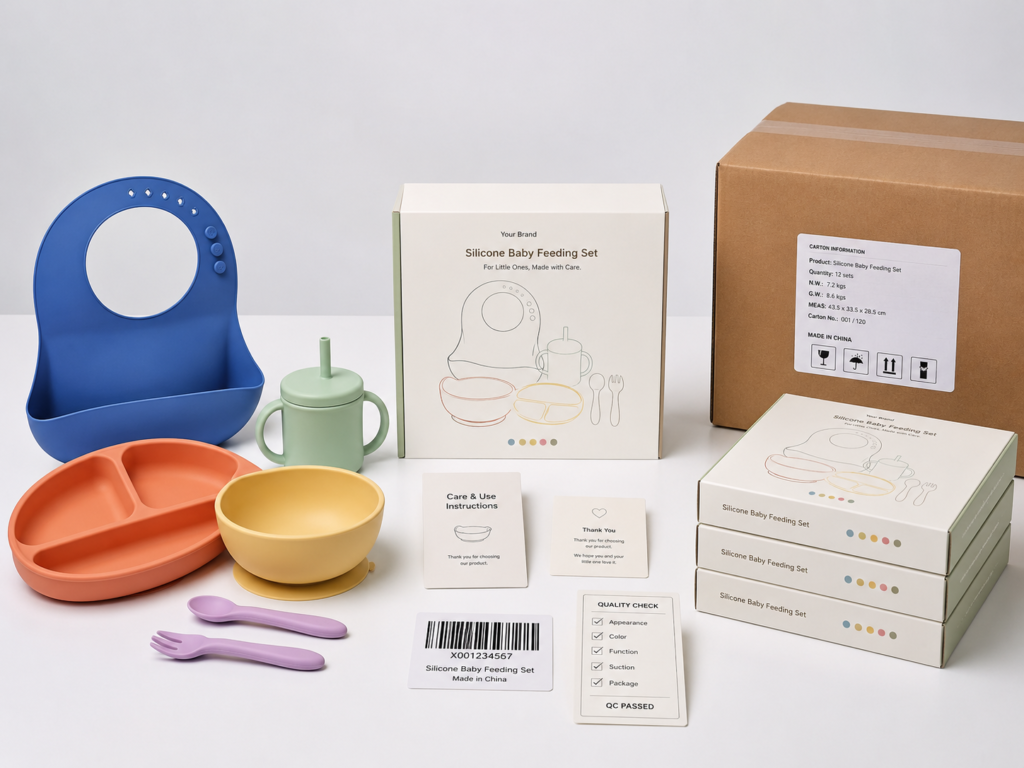
Packaging preparation may include:
- Color box
- Kraft box
- Window box
- Gift box
- Paper band
- Instruction card
- Barcode
- Warning information
- Multilingual labels
- Master-carton marks
The factory should confirm product arrangement, box dimensions and carton quantity before packaging artwork is finalized. A beautiful box is not useful if the full set does not fit securely or creates unnecessary shipping volume.
Stage 7: Mass Production and Quality Control
Once samples, colors, packaging and production details are approved, custom silicone baby feeding set development moves into mass production.
The production workflow may include:
- Material preparation
- Color matching
- Silicone molding
- Trimming
- Assembly
- In-process inspection
- Product-specific function checks
- Set-combination checks
- Packaging
- Final inspection
Quality-control points should match each product.
Bib Checks
- Neck closure
- Pocket shape
- Edge finish
- Flexibility
- Logo and color
Bowl and Plate Checks
- Dimensions and capacity
- Shape stability
- Suction-base condition
- Surface finish
- Color consistency
Cup Checks
- Rim and handle condition
- Lid or straw fit
- Assembly
- Capacity
- Packaging fit
Spoon and Fork Checks
- Head dimensions
- Edge smoothness
- Handle shape
- Core position, if applicable
- Straightness and finish
The supplier should also check that every retail package contains the correct products, colors and accessories.
Buyers can review Baiya Silicone’s silicone manufacturing capability to understand the relationship between molding, trimming, quality control, packing and shipment preparation.
Stage 8: Turn the Approved Set Into a Market-Ready Product
A technically acceptable sample is not automatically a market-ready product.
Before launch, the buyer should confirm:
- Final SKU names
- Product and packaging photos
- Barcode information
- Packaging copy
- Instructions and warnings
- Set contents
- Carton quantities
- Delivery schedule
- Inspection plan
- Reorder lead time
- Color expansion plan
The launch channel also affects final preparation.
An Amazon seller may need compact packaging, strong product images and clear set-content information. A retail buyer may care more about shelf presentation. A distributor may need several packaging languages or separate master cartons.
This is where product development becomes commercial execution. Successful custom silicone baby feeding set development connects engineering, manufacturing, packaging and market planning rather than treating them as separate tasks.
MOQ, Lead Time and Budget Planning
MOQ and lead time depend on the number of products, mold status, colors, packaging and order quantity.
The project may include separate minimum quantities for:
- Silicone products
- Custom colors
- Printed logos
- Retail boxes
- Labels
- Instruction cards
- Accessory components
A feeding set with four existing-mold items and a standard box may move faster than a proprietary set requiring several new molds and custom packaging.
Buyers should ask the supplier to separate:
- Mold cost
- Sample cost
- Unit price
- Packaging cost
- Logo cost
- Testing-sample support
- Production lead time
- Shipping terms
For a detailed explanation, read MOQ, Lead Time & Pricing Structure for Silicone Baby Product Manufacturing.
Early planning helps the buyer balance launch speed, product uniqueness and inventory risk.
Common Development Mistakes
Common mistakes in custom silicone baby feeding set development include:
- Choosing the set combination before defining the target market
- Adding too many products without a clear retail-price plan
- Opening molds before structure review
- Confirming colors only from a screen
- Treating every product as if it needs the same hardness
- Waiting until mass production to discuss testing
- Finalizing packaging before checking product fit
- Comparing suppliers only by unit price
- Ignoring carton size and shipping volume
- Approving individual products without checking the complete set
- Failing to document the approved sample
- Not planning repeat-order lead time
A structured process helps buyers identify these risks before they become expensive changes.
Buyers comparing supplier models can also read Silicone Baby Products Factory vs Trading Company: Key Differences Explained.
How Baiya Silicone Supports Feeding Set Development
Dongguan Baiya Silicone Products Co., Ltd. is a silicone OEM and ODM manufacturer based in Dongguan, China.
Through Baiya Baby, we support brands, importers, distributors, wholesalers and e-commerce sellers with custom silicone baby feeding set development.
Our feeding product range includes:
- Silicone bibs
- Bowls and suction bowls
- Divided plates
- Baby cups and snack cups
- Spoons and fork sets
- Placemats
- Fruit feeders
- Food storage accessories
- Custom feeding collections
Our support may include:
- Project requirement review
- Product-combination planning
- Existing-mold selection
- New mold development
- Material and hardness review
- Custom color matching
- Logo customization
- Sample preparation
- Testing preparation
- Private label packaging
- Mass production
- Quality control
- Packing and shipment preparation
We support OEM and ODM silicone baby product manufacturing from concept review to market-ready production.
Final Thoughts
Custom silicone baby feeding set development is a complete process that connects product strategy, design, material, molds, samples, testing, packaging, production and market launch.
A strong project does not begin by asking only for the lowest unit price. It begins with a clear target market, practical set combination and realistic development plan.
When the buyer and manufacturer review each stage early, the project is more likely to achieve consistent products, suitable packaging, predictable production and smoother repeat orders.
If you are planning a new feeding collection, contact Baiya Silicone with your product idea, reference samples, target market, packaging direction and estimated quantity.
Our team can help review product combination, mold options, sample plan, MOQ, lead time, production solution and possible testing support based on your project requirements.
 English
Comments are closed