
Are Certifications Required for Silicone Baby Products? FDA, LFGB, CPC and EN14350 Explained
Silicone baby product certifications are one of the most common questions buyers ask before starting an OEM or ODM project.
For baby brands, importers, distributors and e-commerce sellers, certifications are not just documents. They are related to product safety, target market access, customer trust, Amazon or retail requirements, and long-term brand protection.
However, not every silicone baby product needs the same certifications.
A silicone baby feeding set, baby bottle, teether, pacifier clip and silicone bib may all be baby products, but they may involve different testing directions.
This guide explains how buyers can understand silicone baby product certifications such as FDA, LFGB, CPC and EN14350 based on product type, function and target market.
What Certifications May Be Needed for Silicone Baby Products?
Silicone baby product certifications depend on three main factors:
- Product type
- Product function
- Target market
For example, silicone feeding products may focus more on food-contact material testing. Silicone teethers may need children’s product safety testing. Baby bottles or drinking cups may involve drinking equipment-related requirements. Pacifier clips may need a different safety standard from feeding sets.
This is why buyers should not ask only one question:
“Do you have FDA, LFGB, CPC and EN14350?”
A better question is:
“Which testing support may be needed for this product type and target market?”
For a broader overview, buyers can also read our guide on silicone baby product testing and certifications.
Do All Silicone Baby Products Need the Same Certifications?
No. Different silicone baby products may need different testing support.
This is one of the most important points for global buyers to understand.
A silicone baby spoon and a silicone teether are both baby products, but their use scenarios are different. A baby spoon may contact food. A teether may be chewed by a baby. A baby bottle may be used for drinking. A pacifier clip may include attachment parts and length requirements.
Because of this, silicone baby product certifications should be reviewed based on the actual product design, material, function, age group and sales market.
A professional silicone baby products manufacturer should help buyers review testing direction before mold development or mass production.
FDA: When Is It Relevant for Silicone Baby Products?
FDA is commonly discussed for silicone baby products that may contact food, milk, formula or feeding materials.
For silicone baby products, FDA-related food-contact testing support may be relevant to:
- Silicone baby feeding sets
- Silicone bowls and plates
- Baby spoons
- Baby cups
- Fruit feeders
- Milk powder containers
- Food storage items
- Some baby bottle components
For the U.S. market, buyers can review FDA’s official information about food contact substances when preparing silicone baby products for food-contact use.
It is more accurate to say “FDA food-contact testing support” instead of saying every silicone baby product is “FDA certified.”
Buyers should first confirm whether the product is intended for food-contact use. If the product does not contact food, milk or formula, FDA food-contact testing may not be the main testing direction.
LFGB: When Is It Requested by European Buyers?
LFGB is commonly requested by buyers selling silicone food-contact products in Germany or European markets.
For silicone baby products, LFGB-related testing support may be relevant to:
- Silicone feeding sets
- Silicone bowls and plates
- Baby spoons
- Baby cups
- Fruit feeders
- Food storage products
- Milk powder containers
European food-contact material requirements are often reviewed together with market-specific expectations. Buyers can review EU food contact materials legislation and BfR recommendations on food contact materials when preparing products for European sales channels.
In many B2B sourcing projects, LFGB is requested when the buyer wants stronger food-contact testing support for Germany or Europe.
However, LFGB is not automatically required for every silicone baby product. It depends on product use, food-contact function and sales market.
CPC: When Is It Needed for the U.S. Market?
CPC means Children’s Product Certificate.
For children’s products sold in the United States, CPC may be required when the product is subject to applicable children’s product safety rules. The certificate is based on relevant testing and compliance requirements.
For silicone baby products, CPC-related support may be relevant to:
- Silicone teethers
- Baby toys
- Toy-like baby products
- Some baby care accessories
- Products intended for children
Buyers can review CPSC Children’s Product Certificate guidance when preparing U.S. children’s product compliance documentation.
It is important to understand that CPC is not just a logo or simple certificate template. It is connected with applicable product safety rules and test results.
For U.S. buyers, the product type should be reviewed carefully before confirming CPC-related testing needs.
EN14350: Which Silicone Baby Products May Need It?
EN14350 is commonly related to children’s drinking equipment.
For silicone baby products, EN14350-related support may be relevant to:
- Baby bottles
- Drinking cups
- Feeding bottles
- Certain drinking or feeding components
This standard is not for every silicone baby product.
For example, a silicone bib or basic teether may not follow the same testing direction as a baby bottle or drinking cup.
If the product is used for drinking, feeding liquid, milk or formula, buyers should discuss whether EN14350-related testing support may be needed based on the product design and target market.
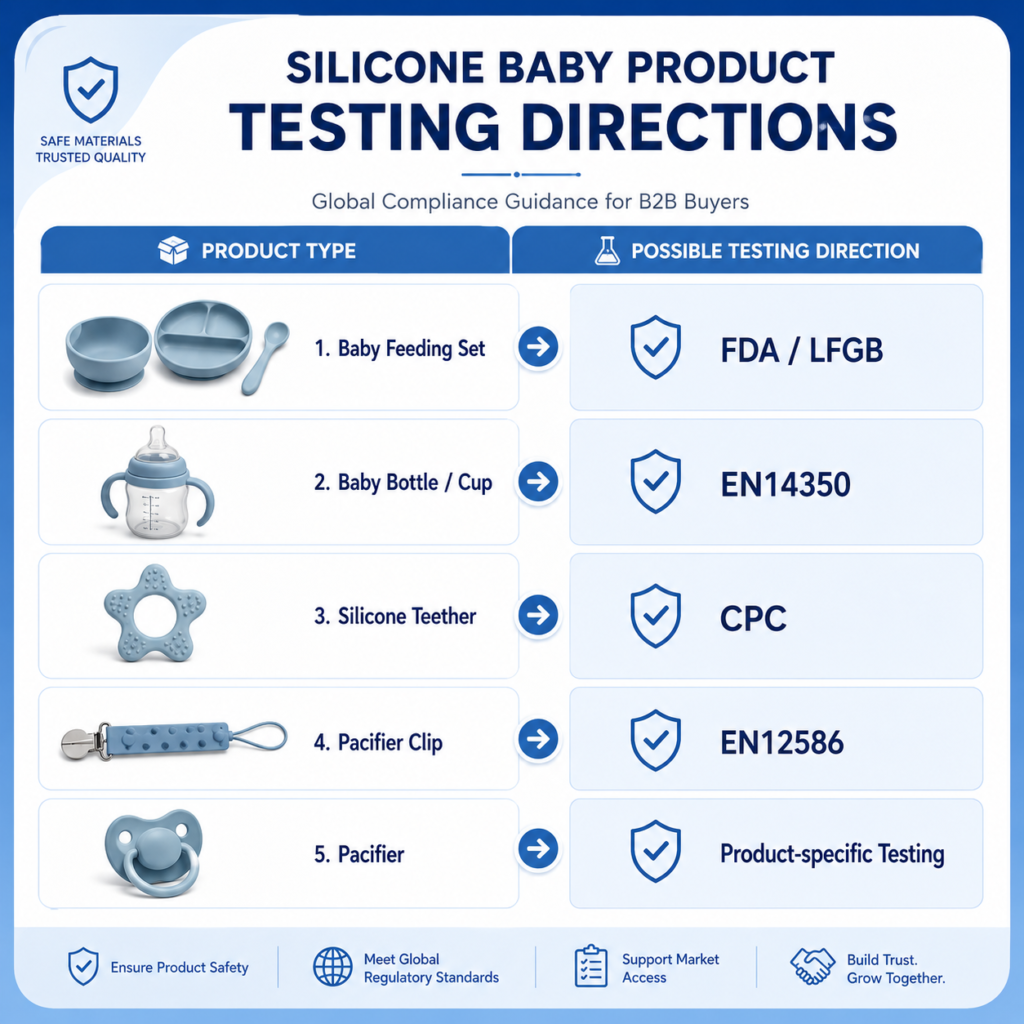
Product Type vs Possible Testing Support
The table below gives a general reference for silicone baby product certifications and testing support.
| Product Type | Possible Testing Support |
|---|---|
| Silicone baby feeding sets | FDA or LFGB food-contact testing support |
| Silicone bowls, plates and spoons | Food-contact material testing support |
| Baby bottles and drinking cups | EN14350-related testing support based on market needs |
| Silicone teethers | CPC, EN71 or children’s product testing support |
| Pacifier clips | EN12586-related testing support |
| Pacifiers | Product-specific safety and material testing support |
| Silicone bibs | Food-contact or material testing support depending on use |
| Fruit feeders | Food-contact material testing support |
| Milk powder containers | Food-contact material testing support |
This table is only a general reference. Final testing requirements should be reviewed based on product type, material, function, age group and target market.
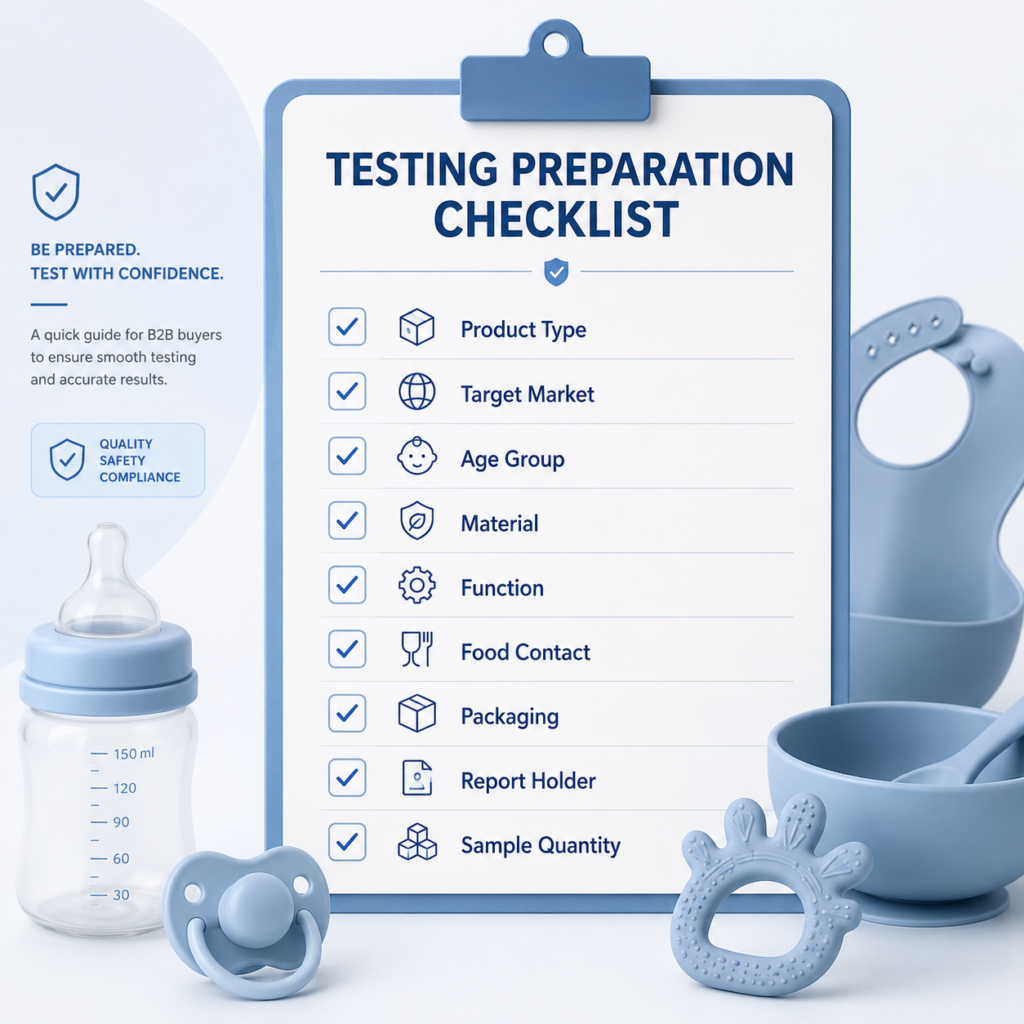
What Buyers Should Prepare Before Arranging Testing
Before arranging silicone baby product certifications or testing support, buyers should prepare enough product information.
Useful information includes:
- Product name
- Product type
- Product function
- Target market
- Intended age group
- Product material
- Food-contact use
- Product size and structure
- Packaging requirements
- Labeling requirements
- Report holder name
- Required sample quantity
- Expected sales channel
For example, an Amazon seller in the United States may need a different documentation plan from a distributor selling food-contact products in Germany.
A baby bottle project may also need a different testing direction from a silicone feeding set or pacifier clip.
If buyers are not sure where to start, they can first review the silicone baby product OEM process to understand how testing preparation fits into product development.
Common Mistakes Buyers Should Avoid
Many buyers make similar mistakes when asking about silicone baby product certifications.
One common mistake is asking for all certificates before confirming the actual product type.
Another mistake is assuming that one test report can cover every baby product in a product line.
Buyers should avoid:
- Asking for FDA, LFGB, CPC and EN14350 without defining the product
- Treating feeding products, teethers, pacifiers and pacifier clips as the same category
- Waiting until mass production to consider testing
- Ignoring the target market
- Using one report for different materials or different product structures
- Forgetting packaging and labeling requirements
- Assuming the factory should decide everything without buyer market information
A better approach is to confirm product type, function, material and target market before arranging testing.
How Baiya Silicone Supports Testing Preparation
Dongguan Baiya Silicone Products Co., Ltd. is a silicone OEM and ODM manufacturer based in Dongguan, China.
Through our baby product division Baiya Baby, we support baby brands, importers, distributors and e-commerce sellers with custom silicone baby product development.
For silicone baby product certifications and testing preparation, we can help buyers review:
- Product type
- Product function
- Target market
- Material selection
- Food-contact use
- Product structure
- Sample preparation
- Packaging requirements
- Possible testing direction
We can help prepare samples for testing based on product design, material, function and buyer requirements.
For buyers who are still comparing suppliers, choosing a reliable silicone baby products manufacturer can help reduce development risks before mold opening, sample confirmation and bulk production.
Final Thoughts
Silicone baby product certifications are not one-size-fits-all.
FDA, LFGB, CPC and EN14350 may be relevant to different products and different markets, but not every silicone baby product needs the same certification or testing plan.
For global buyers, the right approach is to review product type, function, food-contact use, age group, material and target market before arranging testing.
If you are developing a new silicone baby product project, contact Baiya Silicone and send us your product idea, reference sample, target market, packaging requirements and expected testing needs.
Our team can help review product feasibility, sample preparation, production solution and possible testing support based on your project needs.
 English
Comments are closed