
Silicone Baby Product Testing and Certifications: What Buyers Should Know
Silicone baby product testing is one of the most important parts of developing safe and market-ready baby products.
For baby brands, importers, distributors and e-commerce sellers, testing is not only a document issue. It is related to material safety, product function, target market requirements, packaging, labeling and long-term brand trust.
However, many buyers are confused by terms such as FDA, LFGB, CPC, EN71, EN14350 and EN12586.
The most important thing to understand is this:
Not every silicone baby product needs the same testing.
Testing requirements depend on the product type, material, intended use, age group and target market.
This guide explains common testing support for silicone baby products and what buyers should prepare before starting an OEM/ODM baby product project.
Why Silicone Baby Product Testing Matters
Silicone baby products are used by babies and young children. Many products may touch the mouth, food, skin or hands.
For example, a baby may chew a teether, suck a pacifier, drink from a bottle, use a feeding spoon or wear a silicone bib during feeding.
Because of this, buyers should not only check product appearance. They should also review:
- Material safety
- Food-contact requirements
- Product structure
- Small parts risk
- Pull strength
- Bite resistance
- Cleaning structure
- Packaging and warning information
- Target market requirements
A reliable silicone baby product manufacturer should understand that safety and testing support are part of product development, not something added at the last minute.
Common Testing Standards for Silicone Baby Products
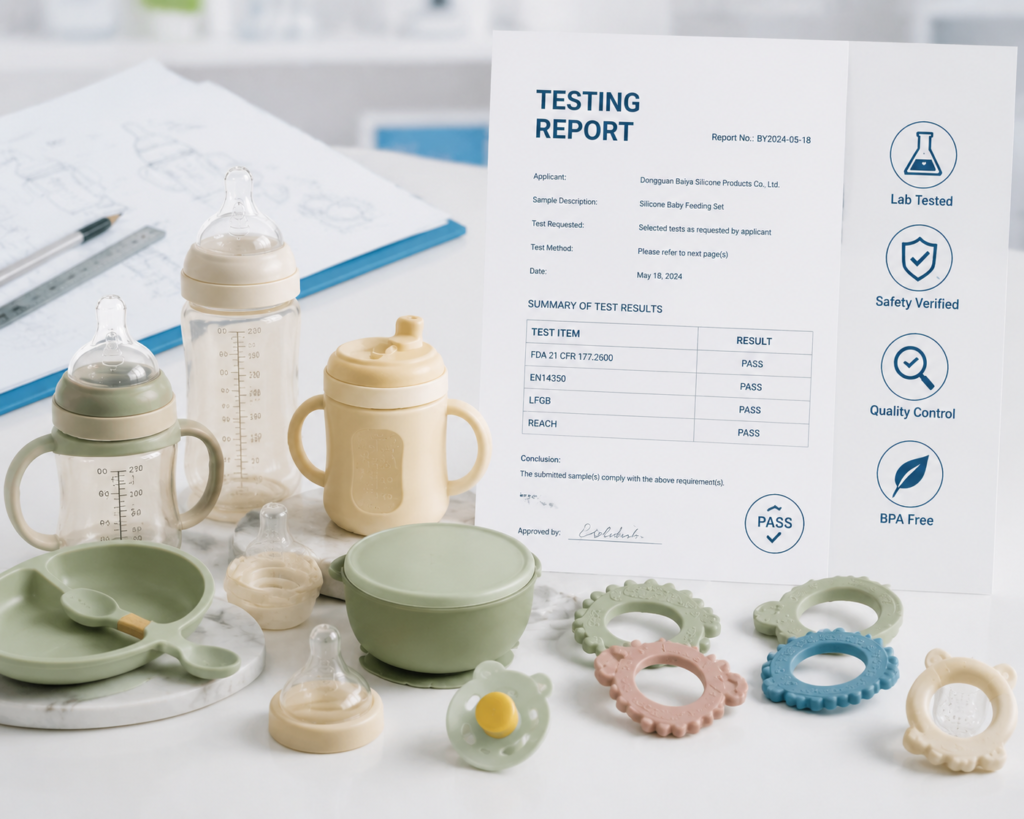
There are several common testing directions for silicone baby products. The exact requirement depends on the product and target market.
FDA Food-Contact Testing Support
FDA-related food-contact testing is often discussed for silicone products used in feeding, storage or food-contact applications.
For silicone baby products, this may be relevant to:
- Baby feeding sets
- Silicone bowls and plates
- Baby spoons
- Baby cups
- Fruit feeders
- Milk powder containers
- Baby bottle components
It is more professional to say “FDA food-contact testing support” instead of saying “FDA certified product” for every item.
Buyers should check whether the product is intended to contact food, milk, formula or other feeding materials.
LFGB Food-Contact Testing Support
LFGB is commonly mentioned for products sold in Germany or European markets.
For silicone baby feeding products, LFGB testing support may be requested by buyers who sell food-contact products in Europe.
This can be relevant to:
- Silicone feeding sets
- Bowls and plates
- Baby spoons
- Silicone cups
- Fruit feeders
- Food storage products
For many baby brands, LFGB testing can be an important part of building trust in the European market.
CPC Testing Support for the United States
CPC means Children’s Product Certificate.
For children’s products sold in the United States, importers and manufacturers may need to certify that the product complies with applicable children’s product safety rules.
CPC is not just a logo. It is based on applicable rules and test results.
For silicone baby products, CPC-related support may be relevant to:
- Silicone teethers
- Pacifiers
- Baby toys
- Baby care accessories
- Products intended for children
Buyers should confirm which CPSC rules apply to their product type before arranging testing.
EN71 Testing Support for Toy-Related Baby Products
EN71 is commonly related to toy safety in the European market.
For silicone baby products, EN71 may be relevant when the product has play value or is considered a toy-related baby product.
Examples may include:
- Silicone teethers
- Rattle teethers
- Soft baby toys
- Toy-like baby accessories
Not every feeding product is a toy. But if a baby product is designed for play, chewing or interaction, buyers should review whether toy safety testing is needed.
EN14350 Testing Support for Baby Feeding Products
EN14350 is commonly related to drinking equipment and feeding products for young children.
It may be relevant to:
- Baby bottles
- Drinking cups
- Feeding bottles
- Certain baby feeding components
For baby bottle projects, buyers should discuss product structure, material, nipple design, bottle components and target market before confirming testing needs.
EN12586 Testing Support for Pacifier Clips and Soother Holders
EN12586 is commonly related to soother holders, pacifier clips and similar products.
This may be relevant to:
- Pacifier clips
- Soother holders
- Pacifier straps
- Certain baby accessory products connected to pacifiers
For these products, structure, length, attachment strength, small parts risk and labeling can be very important.
Buyers should not treat pacifier clips the same as general silicone products. They should be reviewed as baby safety accessories.
Common Testing Support by Product Type
| Product Type | Possible Testing Support |
|---|---|
| Baby feeding products | Food-contact material testing, EN14350 support |
| Silicone teethers | CPC, EN71 or market-specific testing support |
| Pacifiers | Product safety and material testing support |
| Pacifier clips | EN12586 testing support |
| Silicone bibs and feeding sets | Food-contact material testing support |
| Baby cups and spoons | Food-contact material testing support |
| Milk powder containers | Food-contact material testing support |
| Toy-like silicone baby products | EN71 or market-specific toy safety testing support |
This table is only a general reference. The final testing plan should be reviewed based on the actual product design, material, structure and target market.
Do All Silicone Baby Products Need the Same Tests?
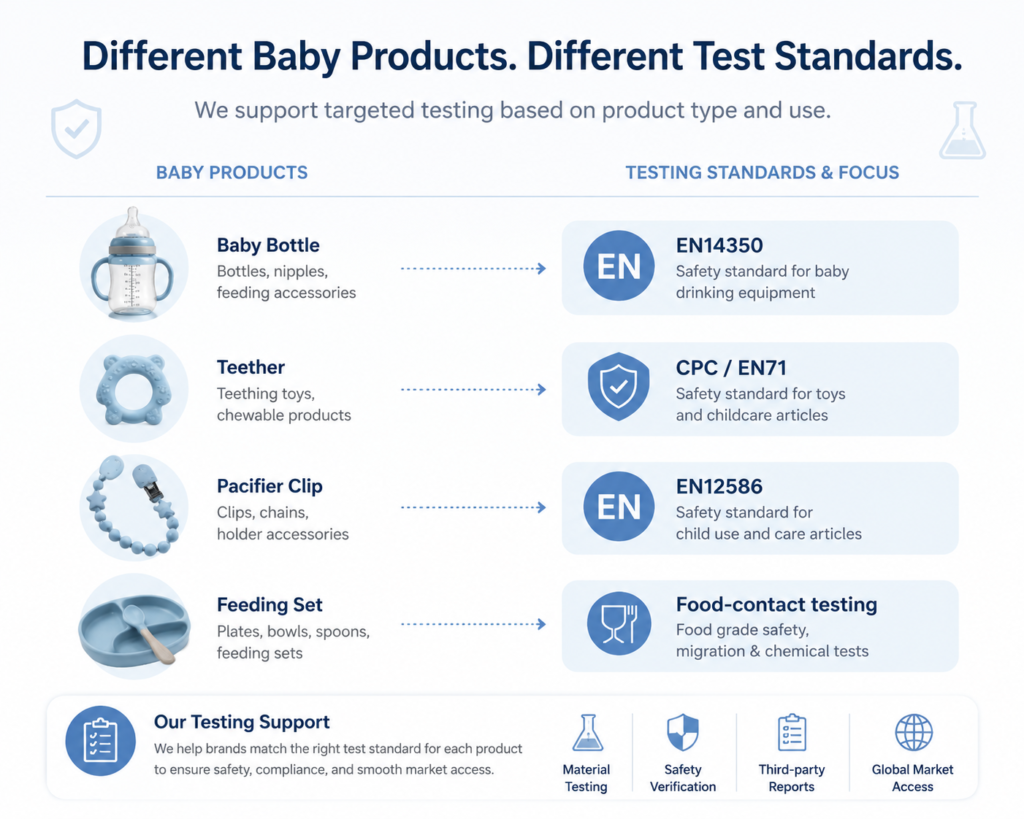
This is one of the biggest misunderstandings in silicone baby product sourcing.
A silicone baby spoon, a teether, a pacifier clip and a baby bottle may all be baby products, but they may not follow the same testing path.
The testing requirement depends on several questions:
- Is the product used for feeding?
- Does it contact food, milk or formula?
- Is it designed for chewing?
- Is it considered a toy?
- Is it used as a pacifier accessory?
- Which market will the product be sold in?
- What age group is the product designed for?
- Does the product include small parts, straps, clips or assembled components?
A professional manufacturer should not simply say that every product has the same certificates.
A better answer is:
Testing support can be arranged based on the product type, material, function and target market.
This is more accurate and more useful for real OEM/ODM baby product development.
What Buyers Should Prepare Before Testing
Before arranging testing, buyers should prepare enough product information.
Useful information includes:
- Product name
- Product function
- Target market
- Intended age group
- Product material
- Product size and structure
- Whether the product contacts food
- Whether the product is intended for chewing
- Whether the product includes small parts or clips
- Packaging and labeling requirements
- Quantity needed for test samples
- Required report holder name
If the buyer already knows the target market, the manufacturer can help review the possible testing direction more efficiently.
If the buyer is not sure, the manufacturer can first review the product type and suggest what may need to be checked with a testing laboratory.
Testing Support During OEM/ODM Development
Testing should not be treated as the last step only.
For custom silicone baby products, testing preparation should start early in the development process.
A better OEM/ODM development flow is:
- Review the product idea and target market
- Check material and product function
- Review structure and safety risks
- Develop 3D samples or prototypes
- Confirm mold development plan
- Prepare test samples
- Arrange testing based on target market
- Adjust product details if needed
- Confirm packaging and labeling
- Move to mass production
This process helps reduce the risk of opening a mold first and finding problems later.
For baby products, early review can save time, cost and development mistakes.
Why Packaging and Labeling Also Matter
Testing is not only about the product itself.
For some baby products, packaging, warning labels, instructions and traceability information may also matter.
For example:
- Baby feeding products may need clear material and use instructions.
- Pacifier clips may need warning information.
- Toy-like baby products may need age labeling.
- Food-contact products may need proper material information.
- Some markets may require importer information or traceability details.
Packaging should not be designed only for beauty.
For baby product brands, packaging should also support market requirements, consumer trust and safe use instructions.
How Baiya Silicone Supports Testing Preparation
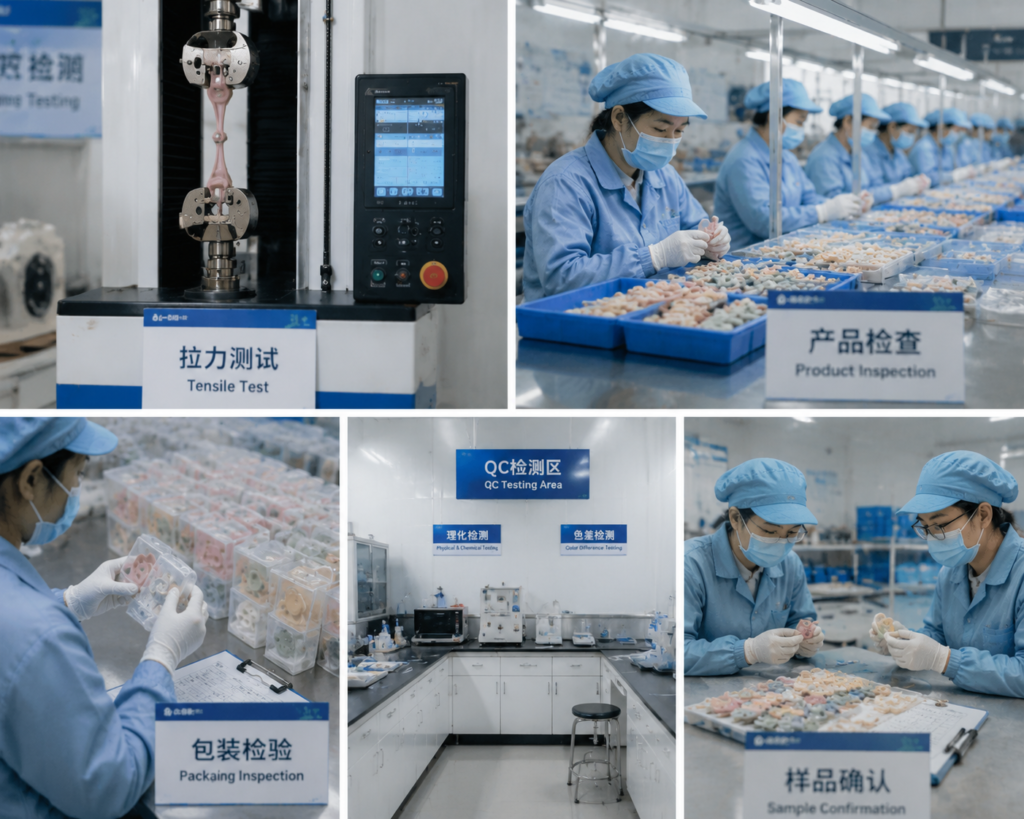
Dongguan Baiya Silicone Products Co., Ltd. is a silicone OEM/ODM manufacturer based in Dongguan, China.
Through our baby product division Baiya Baby, we support global baby brands, importers, distributors and e-commerce sellers with custom silicone baby product development.
Our product range includes silicone baby bottles, nipples, teethers, pacifiers, fruit feeders, baby feeding sets, silicone bibs, milk powder containers and other custom silicone baby products.
For testing preparation, we can help buyers review:
- Product type
- Product function
- Target market
- Material selection
- Product structure
- Sample preparation
- Packaging requirements
- Possible testing direction
We can also help prepare samples for testing based on product design and market requirements.
The exact testing plan should be confirmed according to the product type and the buyer’s target market.
Questions to Ask Before Starting a Baby Product Project
Before starting a custom silicone baby product project, buyers can ask:
- What testing may be needed for this product type?
- Is the product food-contact or toy-related?
- Does the product need CPC, EN71, EN14350 or EN12586 support?
- Can the factory prepare samples for testing?
- Can the report be issued under our company name if needed?
- Will packaging or labeling need to be reviewed?
- Should testing be considered before mold development?
- What sample quantity is needed for testing?
These questions help both the buyer and manufacturer understand the project more clearly before production.
Final Thoughts
Silicone baby product testing is not a one-size-fits-all process.
Different products may need different testing support depending on material, function, structure, age group and target market.
For baby brands, choosing a manufacturer that understands testing preparation can help reduce development risks and improve project efficiency.
If you are developing a new silicone baby product, send us your product idea, reference samples, drawings, packaging requirements and target market information.
Baiya Silicone can help review product feasibility, sample plan, MOQ, lead time, production solution and possible testing support based on your project needs.
 English
Comments are closed