
MOQ, Lead Time & Pricing Structure for Silicone Baby Product Manufacturing
MOQ, lead time and pricing are three of the most common questions buyers ask before starting a silicone baby product manufacturing project.
For baby brands, importers, distributors, wholesalers and private label sellers, these questions are important because they affect product launch planning, budget control, packaging preparation and market testing.
However, there is no single fixed MOQ or price for every silicone baby product.
A silicone baby bottle, teether, pacifier, feeding set, bib, cup, fruit feeder or custom silicone baby accessory may have different mold requirements, material usage, production steps, packaging needs and testing preparation.
This guide explains how MOQ, lead time and pricing structure are usually reviewed in silicone baby product manufacturing, and what information buyers should prepare before asking for a quotation.
In silicone baby product manufacturing, MOQ, lead time and pricing should be reviewed together rather than compared as separate numbers.
Why MOQ, Lead Time and Pricing Are Not Always Fixed
Many buyers want a quick answer:
How much is the product?
What is the MOQ?
How long does production take?
These are reasonable questions. But for silicone baby product manufacturing, the answer depends on several project details.
For example, the factory needs to know:
- Product type
- Product size
- Product weight
- Existing mold or new mold
- Material requirement
- Silicone hardness
- Custom color
- Logo requirement
- Packaging style
- Testing sample needs
- Estimated order quantity
- Target market
- Delivery plan
Without this information, a quotation may only be a rough estimate.
A professional manufacturer should not only give a low price. The factory should help buyers understand what affects cost, MOQ and timeline so the project can move forward more smoothly.
If buyers are still preparing product information, it is helpful to review how to start a custom silicone baby product project before requesting a final quotation.
What Does MOQ Mean in Silicone Baby Product Manufacturing?
MOQ means Minimum Order Quantity.
In silicone baby product manufacturing, MOQ is the minimum quantity required for a production order.
MOQ is not only a sales rule. It is connected to production efficiency, material preparation, color mixing, machine setup, labor arrangement, packaging preparation and quality control.
For standard products with existing molds, MOQ may be more flexible.
For custom silicone baby products with new molds, special colors, logo customization or private label packaging, MOQ may be higher because the factory needs to prepare more production resources.
MOQ may be affected by:
- Mold status
- Product size
- Product weight
- Product color
- Material requirement
- Custom logo
- Packaging style
- Production process
- Testing sample quantity
- Order schedule
- Factory production arrangement
This is why buyers should not compare MOQ without checking the full project details.
Existing Mold MOQ vs Custom Mold MOQ
One of the biggest factors affecting MOQ is mold status.
For silicone baby product manufacturing, existing molds usually support a faster start, while custom molds require a separate development schedule.
Existing Mold Products
Existing mold products are products that the factory already has molds for.
These products may be suitable for buyers who want to test the market, build a small product line or start with private label packaging.
Existing mold projects may support:
- Lower development cost
- Faster sampling
- Shorter lead time
- More flexible MOQ
- Custom color options
- Logo or packaging customization
However, buyers should still confirm whether the existing mold product matches their target market, packaging plan and testing direction.
Custom Mold Products
Custom mold products require new mold development.
This is common when buyers want a new shape, new structure, new texture, new size or unique product design.
Custom mold projects may involve:
- Product structure review
- 3D drawing or prototype
- Mold design
- Mold cost
- Sample trial
- Sample adjustment
- Testing sample preparation
- Higher initial MOQ
- Longer development timeline
For new mold projects, MOQ is usually reviewed together with mold investment, production efficiency and long-term order plan.
Buyers who want to develop new products should review the silicone baby product OEM process before confirming mold development.
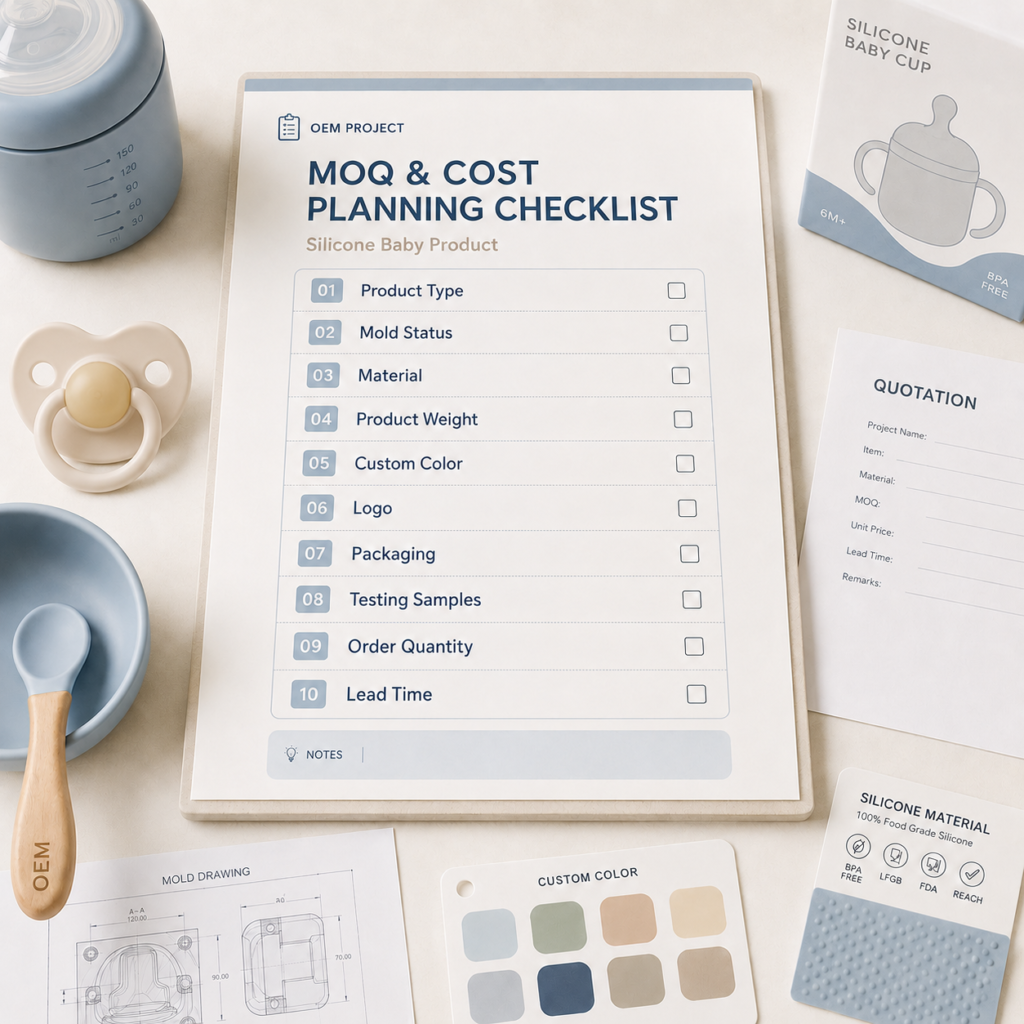
What Factors Affect MOQ?
MOQ can change from project to project.
A silicone baby product manufacturer may review the following factors before confirming MOQ.
| MOQ Factor | Why It Matters |
|---|---|
| Product Type | A baby bottle, teether, feeding set and bib may require different molds and production steps. |
| Product Weight | Heavier products use more silicone material and may affect unit cost. |
| Mold Status | Existing molds are usually easier to start than new mold projects. |
| Custom Color | Special colors may require material preparation and color matching. |
| Logo Customization | Mold logo, printed logo or packaging logo may affect setup requirements. |
| Packaging | Custom boxes, labels, cards or retail packaging may have separate MOQ. |
| Testing Samples | Testing may require extra sample quantity and preparation time. |
| Order Quantity | Higher quantities usually support better production efficiency. |
| Production Schedule | Urgent orders may depend on factory capacity and material readiness. |
| Product Complexity | Multi-part products or assembled products may require more labor and QC. |
MOQ should be discussed based on the full project, not only one product photo.
Lead Time: What Buyers Should Understand
Lead time in silicone baby product manufacturing should include sampling, material preparation, production, inspection and packing.
In silicone baby product manufacturing, lead time may include more than mass production time.
A full project timeline may include:
- Requirement review
- Quotation
- Sample preparation
- Mold development
- Sample adjustment
- Testing sample preparation
- Packaging confirmation
- Material preparation
- Bulk production
- Quality inspection
- Packing
- Shipment preparation
For simple existing mold products, the timeline may be shorter.
For custom mold projects, buyers should allow more time for design review, mold opening, sample confirmation and possible adjustments.
Lead time should be confirmed based on product complexity, factory schedule and order details.
Sample Lead Time vs Production Lead Time
Buyers should separate sample lead time from production lead time.
Sample Lead Time
Sample lead time refers to the time needed to prepare samples before bulk order confirmation.
Samples may include:
- Existing mold samples
- Custom color samples
- Logo samples
- Packaging samples
- 3D samples
- New mold samples
- Testing samples
Sample time depends on whether the product uses an existing mold or requires new development.
A simple existing mold sample is usually easier to prepare than a new mold sample.
If the buyer needs a custom color, logo or packaging sample, extra preparation time may be needed.
Production Lead Time
Production lead time refers to the time needed for bulk production after order details are confirmed.
Production lead time may be affected by:
- Material preparation
- Product quantity
- Color quantity
- Machine schedule
- Molding time
- Trimming and assembly
- Quality inspection
- Packaging
- Carton preparation
- Shipment plan
A professional factory should confirm lead time after reviewing order quantity, product details and packaging requirements.
Why Packaging Can Affect Lead Time
Packaging is often underestimated by buyers.
For silicone baby products, packaging may include:
- Color box
- Kraft box
- Window box
- Blister packaging
- Hang tag
- Barcode label
- Instruction card
- Warning label
- Polybag
- Carton mark
- Retail display packaging
Custom packaging may have its own MOQ and lead time.
If buyers confirm product samples but delay packaging artwork, the whole order may be delayed.
This is why packaging should be discussed early in the project, not only before shipment.
For private label baby product projects, packaging is part of the product plan.
It affects brand presentation, labeling, shipment volume and customer trust.
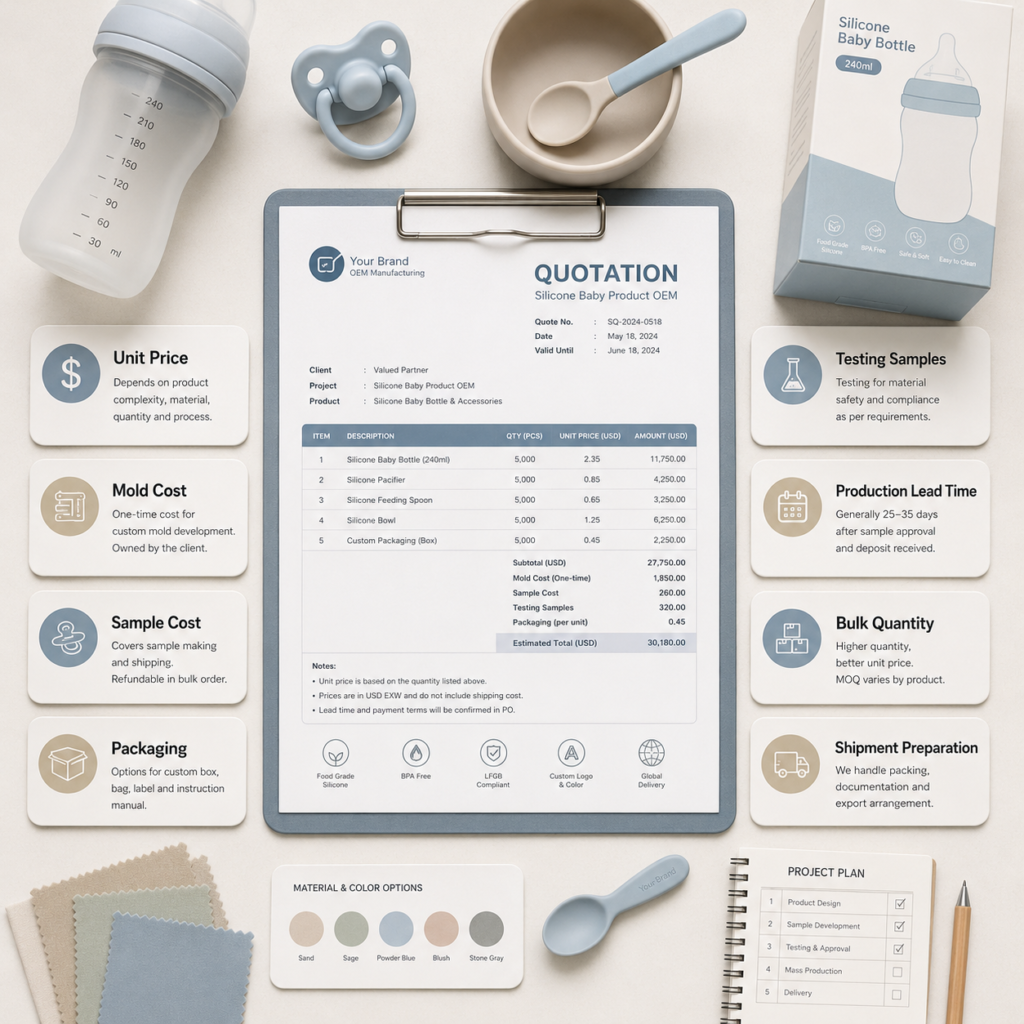
What Is Usually Included in a Silicone Baby Product Quotation?
A silicone baby product quotation may include several parts.
The quotation is not only one unit price.
Depending on the project, the quotation may include:
| Quotation Item | Meaning |
|---|---|
| Unit Price | Cost per product based on quantity, material, weight and production process. |
| Mold Cost | Cost for new mold development if a custom mold is needed. |
| Sample Cost | Cost for preparing samples before bulk order. |
| Packaging Cost | Cost for retail box, label, card, bag, carton or custom packaging. |
| Logo Cost | Cost for mold logo, printed logo, engraved logo or packaging logo. |
| Testing Sample Cost | Cost related to preparing samples for testing if needed. |
| Production Cost | Cost related to molding, trimming, assembly and QC. |
| Shipment Cost | Freight cost based on weight, volume, destination and shipping method. |
Not every quotation includes all of these items.
For example, an existing mold project may not need mold cost.
A standard packaging order may not need custom packaging cost.
A buyer who arranges testing independently may only need sample support.
The key is to confirm what is included and what is not included before comparing prices.
Why Unit Price Changes with Order Quantity
Unit price often changes when order quantity changes.
This is because production efficiency, material preparation and packaging cost may be different at different quantities.
For small orders, the unit price may be higher because the factory still needs to arrange setup, material preparation, production labor, inspection and packing.
For larger orders, the factory may achieve better efficiency and more stable production planning.
However, buyers should not only chase the lowest unit price.
They should compare:
- Material quality
- Product weight
- Mold quality
- Production process
- QC process
- Packaging quality
- Testing support
- Delivery reliability
- Long-term cooperation value
A lower price may not be better if it comes from lighter material, weaker packaging, unclear QC or unstable production.
Why Product Weight Matters in Pricing
Silicone material cost is an important part of silicone baby product manufacturing.
Product weight can directly affect unit price.
For example, two silicone teethers may look similar in photos, but if one is thicker and heavier, the material cost may be different.
Product weight may be affected by:
- Product size
- Wall thickness
- Solid or hollow structure
- Grip area
- Product shape
- Silicone hardness
- Added parts
- Functional design
For baby products, reducing weight should not affect safety, structure or product feel.
Buyers should review product weight together with function, quality and market positioning.
A reliable manufacturer should explain pricing based on real product details, not only send a simple number.
How Mold Cost Is Reviewed
Mold cost depends on the product design and mold complexity.
For silicone baby products, mold cost may be affected by:
- Product size
- Product structure
- Cavity number
- Surface texture
- Logo position
- Parting line
- Demolding difficulty
- Assembly structure
- Precision requirement
- Sample adjustment needs
A simple silicone bib mold and a complex baby bottle component mold may have very different mold costs.
A teether with detailed texture or complicated shape may also require more careful mold review.
Before opening a mold, buyers should confirm:
- Product drawing
- Product size
- Product material
- Hardness
- Texture
- Logo position
- Expected quantity
- Sample approval process
- Testing direction
- Packaging plan
Mold cost should be reviewed as part of the long-term product plan.
If the product is expected to become a long-term SKU, mold investment may be worthwhile.
If the buyer only wants a quick market test, an existing mold product may be more suitable.
How Testing Preparation Affects Cost and Timeline
Testing can affect both cost and lead time.
Different silicone baby products may need different testing support depending on product type, function, material, age group and target market.
For example:
- Feeding sets may need food-contact testing support.
- Baby bottles or cups may need market-specific drinking product testing support.
- Silicone teethers may need children’s product or toy-related testing support.
- Pacifier clips may need structure and safety testing support.
- Packaging and labeling may also need review depending on market requirements.
Testing should be discussed before mass production.
If buyers wait until the order is ready to ship before asking about testing, delays may happen.
For more details, buyers can review our guide on silicone baby product testing and certifications.
How to Compare Quotations from Different Suppliers
When comparing quotations, buyers should avoid comparing only unit price.
A better comparison should include:
- Is the product using the same material?
- Is the product weight the same?
- Is the mold the same quality?
- Is the color customized?
- Is logo included?
- Is packaging included?
- Is inspection included?
- Is testing sample support included?
- Is the lead time realistic?
- Is the MOQ clear?
- Is the shipment term clear?
- Is the supplier a real manufacturer or only a reseller?
A lower quotation may look attractive at first, but it may not include mold adjustment, packaging, QC, testing sample support or stable production control.
Buyers should ask suppliers to explain the quotation structure clearly.
This makes it easier to compare real value instead of only comparing the lowest number.
Common Reasons Why Prices Are Different
Prices may be different between suppliers because of many reasons.
Common reasons include:
- Different product weight
- Different silicone material
- Different mold quality
- Different packaging
- Different order quantity
- Different QC process
- Different logo method
- Different production efficiency
- Different sample policy
- Different testing support
- Different shipment method
- Factory vs trading company business model
Buyers should ask what is included in the price before making a decision.
For silicone baby products, price should be reviewed together with safety, consistency and long-term supply stability.
What Buyers Should Prepare Before Asking for MOQ and Price
To get a more accurate quotation, buyers should prepare basic project information.
Useful information includes:
- Product name
- Product photo or reference sample
- Product drawing or 3D file if available
- Product size
- Product weight if known
- Material requirement
- Silicone hardness
- Color requirement
- Logo requirement
- Packaging requirement
- Target market
- Testing needs
- Estimated order quantity
- Expected delivery time
- Shipping destination
If buyers do not have all information, they can still start with product photos or reference samples.
The manufacturer can help review what information is needed next.
For buyers who are still comparing factories, it is also useful to read how to choose a silicone baby products manufacturer before confirming cooperation.
How Factory Capability Affects MOQ, Lead Time and Pricing
Factory capability can affect the whole project.
A factory with silicone baby product experience can usually review mold feasibility, material preparation, sample planning, QC steps, packaging and shipment more clearly.
Buyers can check a supplier’s silicone manufacturing capability before placing an order.
Important factory factors include:
- Molding equipment
- Mold development support
- Sample support
- Material preparation
- Production management
- QC process
- Packing support
- Shipment preparation
- OEM and ODM experience
For silicone baby product manufacturing, factory capability is not only about machines.
It is also about whether the supplier can help buyers reduce development risk and communicate clearly from quotation to delivery.
Stable silicone baby product manufacturing depends on molding capacity, mold support, quality control and packing coordination.
How Baiya Silicone Reviews MOQ, Lead Time and Pricing
Dongguan Baiya Silicone Products Co., Ltd. is a silicone OEM and ODM manufacturer based in Dongguan, China.
Through our baby product division Baiya Baby, we support global baby brands, importers, distributors, wholesalers and e-commerce sellers with silicone baby product manufacturing.
Our product range includes silicone baby bottles, nipples, teethers, pacifiers, fruit feeders, feeding sets, silicone bibs, baby cups, milk powder containers, pacifier clips and other custom silicone baby products.
For MOQ, lead time and pricing review, we usually check:
- Product type
- Existing mold or new mold
- Product size and weight
- Material requirement
- Silicone hardness
- Custom color
- Logo requirement
- Packaging style
- Estimated quantity
- Testing sample needs
- Target market
- Delivery plan
We support OEM and ODM silicone baby product manufacturing, including product idea review, mold development, sample preparation, testing support, mass production, quality control, packaging and shipment preparation.
If buyers already have drawings or samples, we can review project feasibility more quickly.
If buyers only have product ideas or market references, we can help discuss possible development directions before mold opening.
For buyers looking for a silicone baby products manufacturer in China, Baiya Silicone can help review MOQ, sample plan, lead time, pricing structure and production solution based on real project requirements.
Final Thoughts
MOQ, lead time and pricing for silicone baby product manufacturing are not fixed numbers for every product.
They depend on product type, mold status, material, weight, customization, packaging, testing preparation, order quantity and factory schedule.
Before comparing prices, buyers should first confirm what is included in the quotation.
A reliable manufacturer should help buyers understand the full project structure, not only provide the lowest unit price.
If you are developing a new silicone baby product project, contact Baiya Silicone and send us your product idea, reference sample, drawing, packaging requirement, target market, estimated quantity and delivery plan.
Our team can help review product feasibility, MOQ, sample plan, lead time, pricing structure, production solution and possible testing support based on your project needs.
 English
Comments are closed