
Silicone Baby Products Factory vs Trading Company: Key Differences Explained
When sourcing silicone baby products, many buyers face the same question:
Should I work with a silicone baby products factory or a trading company?
At first, both options may look similar. Both can send product photos, quote prices, arrange samples and communicate with buyers. But for baby brands, importers, distributors and private label sellers, the difference can become very important once the project involves custom colors, mold development, testing preparation, packaging, quality control or stable bulk production.
This guide explains the key differences between a silicone baby products factory and a trading company, and what buyers should check before starting an OEM or ODM baby product project.
A silicone baby products factory can give buyers more direct support for product development, mold review, quality control and bulk production.Why This Difference Matters for Silicone Baby Products
Silicone baby products are not ordinary promotional items.
Products such as silicone baby bottles, nipples, teethers, pacifiers, fruit feeders, feeding sets, bibs, cups and baby care accessories may contact a baby’s mouth, food, milk, skin or hands.
Because of this, buyers usually need to review more than the product price.
Important project details may include:
- Material selection
- Silicone hardness
- Product structure
- Mold design
- Sample confirmation
- Testing preparation
- Packaging requirements
- Production consistency
- Quality control
- Shipment preparation
A supplier that only provides a product catalog may not be enough for a custom baby product project.
If your project needs new mold development, private label packaging, testing support or long-term product line planning, it is important to understand whether your supplier is a real factory, a trading company or a mixed business model.
What Is a Silicone Baby Products Factory?
A silicone baby products factory is a manufacturer that directly produces silicone baby products.
A real factory usually has production equipment, workers, mold development support, material preparation, quality inspection, packing areas and production management.
For silicone baby products, factory support may include:
- Product idea review
- Product structure review
- Material selection
- Silicone molding
- Mold development
- Sample preparation
- Custom color
- Logo customization
- Testing preparation
- Quality control
- Private label packaging
- Packing and shipment preparation
A factory is usually more suitable when buyers need custom development, OEM production, ODM product support, new molds or stable long-term cooperation.
Buyers can review a supplier’s silicone manufacturing capability to understand its production process, equipment, quality control and factory support.
What Is a Trading Company?
A trading company usually acts as a sourcing and coordination partner between buyers and factories.
Some trading companies are very professional. They may help buyers find products, compare suppliers, communicate with different factories and manage order details.
Trading companies may be useful when buyers need:
- Many different product categories
- Small trial orders
- Quick catalog sourcing
- Mixed product consolidation
- Supplier comparison
- Market sample collection
- Simple ready-made products
However, a trading company may not directly control production.
If a buyer needs mold design, product structure adjustment, direct QC control, material confirmation or fast technical feedback, the trading company may need to communicate with the actual factory first.
This can make the project communication longer and less direct.
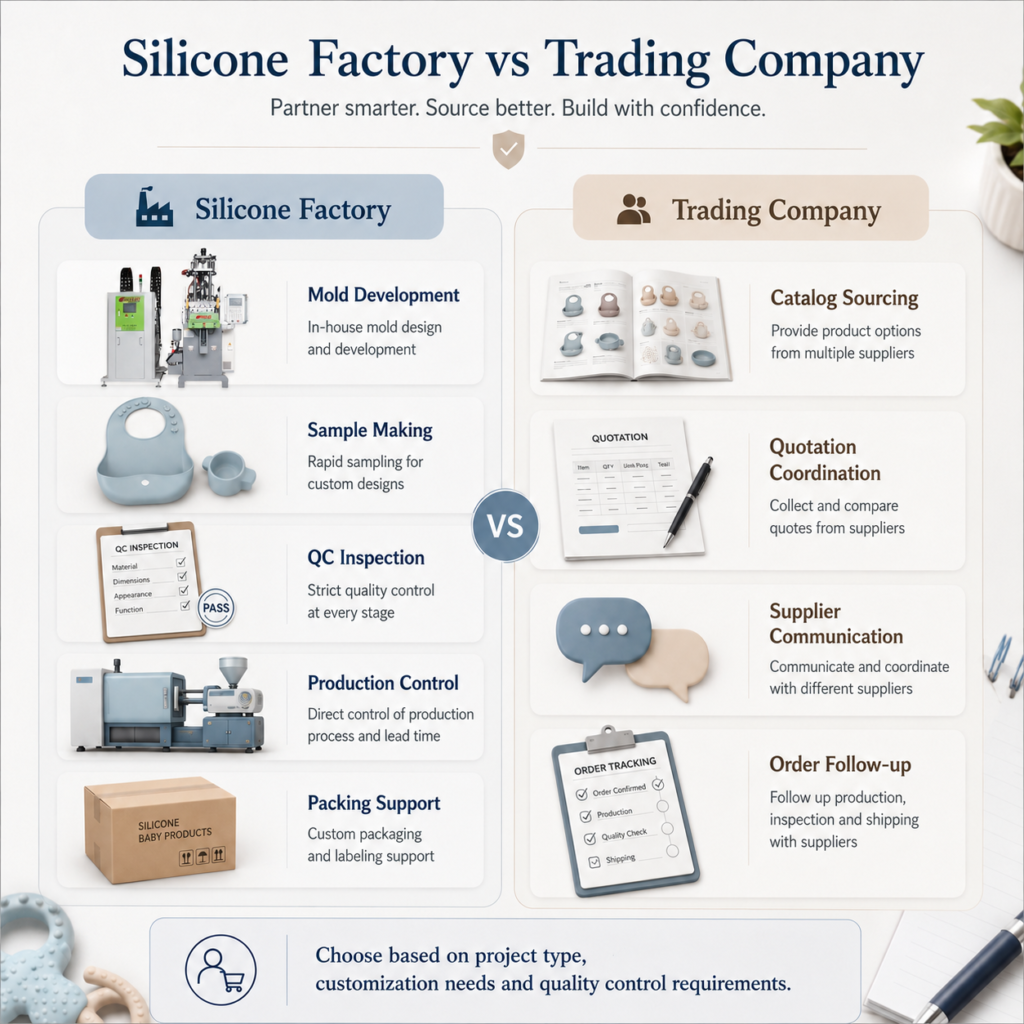
Factory vs Trading Company: Key Differences
The table below shows the main differences buyers should understand.
| Comparison Point | Silicone Baby Products Factory | Trading Company |
|---|---|---|
| Production Control | Directly controls production process | Usually coordinates with factories |
| Mold Development | Can review mold feasibility directly | Often needs to ask the factory |
| Sample Adjustment | Faster technical feedback from production team | May need extra communication steps |
| Material Selection | Can review silicone material, hardness and color with production team | May depend on factory information |
| Quality Control | Can inspect during production and before shipment | Usually relies on factory QC or third-party checks |
| Custom Projects | Better for OEM, ODM, new mold and private label projects | Better for ready-made or mixed sourcing |
| Pricing | More direct production-based quotation | May include service or coordination margin |
| Communication | Buyer communicates closer to production source | Buyer communicates through a middle partner |
| Delivery Control | Factory manages production schedule directly | Trading company follows up with factory schedule |
| Long-Term Development | Suitable for product line planning and repeated development | Suitable for sourcing and supplier coordination |
This does not mean a factory is always better for every buyer.
The right choice depends on project type, customization level, target market, order quantity and quality control requirements.
When Should Buyers Choose a Factory?
Buyers should consider working directly with a silicone baby products factory when the project involves more than simple product sourcing.
For custom OEM projects, choosing a silicone baby products factory can help buyers reduce communication layers and review technical details earlier.
A factory is usually more suitable when buyers need:
- Custom silicone baby products
- New mold development
- Product structure review
- Custom colors
- Custom logo
- Private label packaging
- Stable bulk production
- Direct sample adjustment
- Testing preparation
- Production quality control
- Long-term product development
For example, if a buyer wants to develop a silicone baby teether with a new shape, custom texture, soft chewing feel and private label packaging, factory support is very important.
The factory needs to review shape, size, edge smoothness, silicone hardness, mold feasibility, sample performance and production consistency.
If the buyer only works through a trading company, every technical question may need to go through another communication layer.
For buyers planning a full development project, it is useful to review the silicone baby product OEM process before opening a mold or confirming samples.
When Can a Trading Company Be Useful?
A trading company is not always a bad choice.
For some buyers, a trading company may be helpful.
For example, buyers may choose a trading company when they need:
- Many different product categories from different factories
- A mixed container with unrelated products
- Ready-made catalog products
- Very small trial orders
- Market research samples
- Simple procurement coordination
- Supplier comparison before choosing a factory
If the buyer does not need custom mold development, technical product review or direct production control, a trading company may save sourcing time.
However, for silicone baby products, buyers should be careful when the project involves safety, testing, product structure, material or long-term quality control.
A trading company can coordinate, but it may not always control the production details directly.
Why Factory Control Matters for OEM Baby Products
OEM silicone baby product projects usually need more technical communication.
A buyer may send a product idea, reference sample, drawing, packaging requirement or target market information. The factory then needs to review whether the product can be produced safely and consistently.
For silicone baby products, the factory may need to check:
- Product function
- Baby age group
- Product size
- Silicone hardness
- Wall thickness
- Grip area
- Bite area
- Surface texture
- Assembly relationship
- Mold parting line
- Demolding feasibility
- Packaging fit
- Testing direction
These details affect the whole project.
If the supplier cannot discuss production feasibility clearly, the buyer may face problems later during mold development, sample confirmation or mass production.
For this reason, buyers starting a custom silicone baby product project should prepare product photos, samples, drawings, target market, material requirements, packaging ideas and estimated order quantity as early as possible.
Mold Development: A Major Difference
Mold development is one of the biggest differences between a real factory and a trading company.
For custom silicone baby products, the mold affects:
- Product shape
- Surface finish
- Texture detail
- Logo position
- Edge smoothness
- Product consistency
- Production efficiency
- Sample adjustment
- Bulk order quality
A real factory can usually review mold details directly with engineers or production staff.
This is important because a product may look simple in a photo, but the real production process may involve hidden issues.
For example:
- A silicone teether may need rounded edges and suitable texture.
- A baby bottle nipple may need careful structure and softness review.
- A feeding bowl may need stable shape and suction function.
- A pacifier clip may need attention to attachment structure and strength.
- A fruit feeder may need assembly and cleaning structure review.
If mold feasibility is not reviewed early, buyers may spend time and money on samples that need repeated changes.
This is why factory-level communication is valuable for OEM and ODM silicone baby product manufacturing.
Quality Control: Direct Factory vs Indirect Control
Quality control is another key difference.
A silicone baby products factory can usually check products during different stages of production.
Quality control may include:
- Raw material checking
- Color checking
- Size inspection
- Appearance inspection
- Surface defect checking
- Function checking
- Assembly checking
- Packaging inspection
- Random sampling before shipment
For baby products, small quality issues may affect customer trust.
A teether with rough edges, a feeding set with color inconsistency, a baby bottle component with poor fit or packaging with incorrect information can all create problems for the buyer.
A trading company may also arrange QC checks, but the inspection is often separated from daily production management.
When quality problems appear, the trading company may need to contact the factory again to confirm the cause, solution and production adjustment.
With a direct factory, buyers can often get faster feedback from the production side.
Testing and Certification Support
Testing support should be discussed before mass production.
Different silicone baby products may need different testing support depending on product type, material, function, age group and target market.
For example:
- Silicone feeding products may need food-contact material testing.
- Baby bottles or drinking products may need EN14350-related support based on market needs.
- Silicone teethers may need CPC, EN71 or children’s product testing support.
- Pacifier clips may need EN12586-related testing support.
- Silicone feeding sets may need FDA or LFGB food-contact testing support depending on the sales market.
For U.S. children’s product projects, buyers can review CPSC Children’s Product Certificate guidance when preparing compliance documentation.
For food-contact silicone products, buyers may also review FDA’s official information about food contact substances when preparing material and testing requirements.
A factory that understands baby product development can help buyers prepare samples and review possible testing direction earlier in the project.
For more details, buyers can read our guide on silicone baby product certifications.
Pricing: Why the Lowest Price Is Not Always the Best Choice
Many buyers compare factories and trading companies mainly by price.
Price is important, but for silicone baby products, the lowest price may not always mean the best sourcing decision.
Buyers should check what is included in the price:
- Material grade
- Product weight
- Silicone hardness
- Mold cost
- Sample cost
- Color customization
- Logo customization
- Packaging
- Inspection
- Testing sample support
- Production lead time
- Shipment preparation
A very low price may come from lower material cost, lighter product weight, less inspection, simpler packaging or unclear production responsibility.
This does not mean buyers should always choose the highest price.
It means buyers should compare price together with material, product structure, mold quality, QC process and long-term cooperation value.
A real silicone baby products factory should be able to explain the quotation based on product details, not only give a number.
Communication Efficiency
Communication can also be different.
When buyers work directly with a factory, questions about material, mold, samples, production and packaging can often be answered closer to the production source.
When buyers work with a trading company, communication may go through more steps.
For example:
Buyer → Trading Company → Factory → Trading Company → Buyer
This may be acceptable for simple sourcing.
But for custom baby product development, too many communication layers may create delays or misunderstanding.
Common issues include:
- Product structure not explained clearly
- Mold adjustment feedback delayed
- Sample changes misunderstood
- Packaging details missed
- Testing information not prepared early
- Delivery schedule not updated quickly
For OEM baby products, clear communication helps reduce project risk.
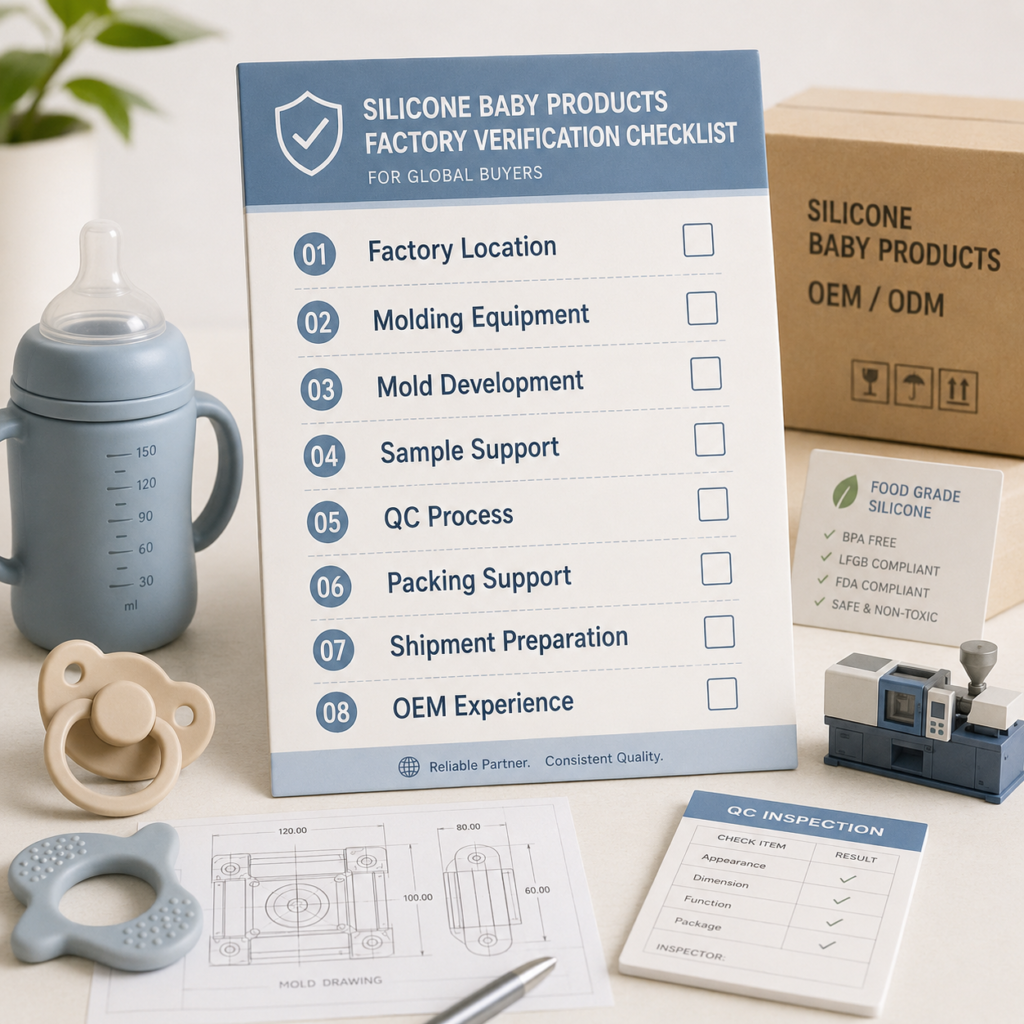
How to Check Whether a Supplier Is a Real Factory
Buyers can ask practical questions before choosing a supplier.
Useful questions include:
- Are you a real factory or trading company?
- Where is your factory located?
- What silicone baby products do you produce?
- Do you have molding machines?
- Can you support new mold development?
- Can you make samples before bulk production?
- Can you customize color, logo and packaging?
- How do you control quality during production?
- Do you have a packing and shipment process?
- Can you show factory photos or production process information?
- Can you explain material and testing support based on product type?
- Can you review product feasibility before mold opening?
A real factory should be able to explain its production process clearly.
Buyers can also review the supplier’s Factory page, production photos, process explanation, QC details, packaging support and project cases.
If the supplier only sends product photos and prices, but cannot explain production details, buyers should ask more questions before placing an order.
Red Flags Buyers Should Watch For
Be careful if a supplier:
- Avoids answering whether they are a factory or trading company
- Cannot explain where the products are produced
- Only sends catalog photos without production information
- Cannot discuss mold development
- Cannot explain material or hardness
- Cannot describe quality control steps
- Gives very low prices without reviewing product details
- Says all products have all certificates without checking product type
- Cannot provide clear sample time or production lead time
- Does not ask about the buyer’s target market
- Does not discuss packaging or labeling requirements
These signs do not always mean the supplier is unreliable, but they show that buyers should verify more information before moving forward.
For baby product sourcing, unclear production responsibility can create bigger problems later.
Should Buyers Always Avoid Trading Companies?
No.
The goal is not to say every trading company is bad.
Some trading companies are experienced, responsible and useful for buyers who need broad sourcing support.
The real question is:
What does your project need?
If your project is simple catalog sourcing, a trading company may be enough.
If your project needs OEM development, mold design, product structure review, testing preparation, private label packaging and long-term production control, a direct factory is usually more suitable.
Buyers should choose based on project complexity, product risk, customization needs and communication requirements.
Factory or Trading Company: Which Is Better for Private Label Baby Brands?
For private label baby brands, a factory is usually more suitable when the brand wants to build a long-term product line.
Private label projects may involve:
- Custom product color
- Logo customization
- Packaging design
- Product set combination
- Testing preparation
- Product improvement
- Repeated orders
- New mold development
- Long-term quality control
A trading company can help source products, but a factory can usually support product development more deeply.
For example, if a brand wants to improve a silicone baby feeding set, develop a new teether shape or build a matching product line, the factory can review production feasibility, mold planning and quality control more directly.
For buyers still comparing supplier types, it is also useful to read how to choose a silicone baby products manufacturer before making a final sourcing decision.
How Baiya Silicone Supports Global Buyers
Dongguan Baiya Silicone Products Co., Ltd. is a silicone baby products factory and OEM/ODM manufacturer based in Dongguan, China.
Through our baby product division Baiya Baby, we support baby brands, importers, distributors, wholesalers and e-commerce sellers with custom silicone baby product development.
Our product range includes silicone baby bottles, nipples, teethers, pacifiers, fruit feeders, feeding sets, silicone bibs, baby cups, milk powder containers, pacifier clips and other custom silicone baby products.
We support buyers with:
- Product idea review
- Structure review
- Material selection
- Existing mold customization
- New mold development
- 3D sample support
- Custom color
- Logo customization
- Private label packaging
- Testing preparation
- Mass production
- Quality control
- Packing and shipment preparation
For buyers looking for a silicone baby products manufacturer in China, Baiya Silicone can help review product feasibility, MOQ, sample plan, lead time, production solution and possible testing support based on project requirements.
Final Thoughts
Choosing between a silicone baby products factory and a trading company is not only about price.
For simple catalog sourcing, a trading company may help buyers compare products and coordinate suppliers.
But for OEM and ODM silicone baby product projects, a direct factory can usually provide stronger support in product development, mold design, sample adjustment, quality control, packaging and production communication.
Baby products need careful review because they may involve material safety, product structure, testing support and brand trust.
Before choosing a supplier, buyers should confirm whether the supplier can support the full project, from product idea review and mold development to mass production, quality control and shipment preparation.
If you are developing a new silicone baby product project, contact Baiya Silicone and send us your product idea, reference sample, drawing, packaging requirements, target market and estimated order quantity.
Our team can help review product feasibility, MOQ, sample plan, lead time, production solution and possible testing support based on your project needs.
 English
Comments are closed