
Silicone vs PP vs TPE Baby Products: Which Material Is Better for Your Brand?
When developing a baby bottle, feeding set, teether, pacifier or baby care accessory, material selection affects far more than product appearance. It influences softness, rigidity, heat performance, mold structure, production cost, assembly, testing preparation, packaging and long-term product positioning.
For OEM buyers comparing silicone vs PP vs TPE baby products, the most important question is not simply, “Which material is safest?” or “Which material is cheapest?”
The better question is:
Which material provides the right performance for this specific product, component, target market and brand strategy?
Silicone, polypropylene—commonly abbreviated as PP—and thermoplastic elastomers, or TPEs, can all be used in baby-product development. However, they are not direct substitutes in every application.
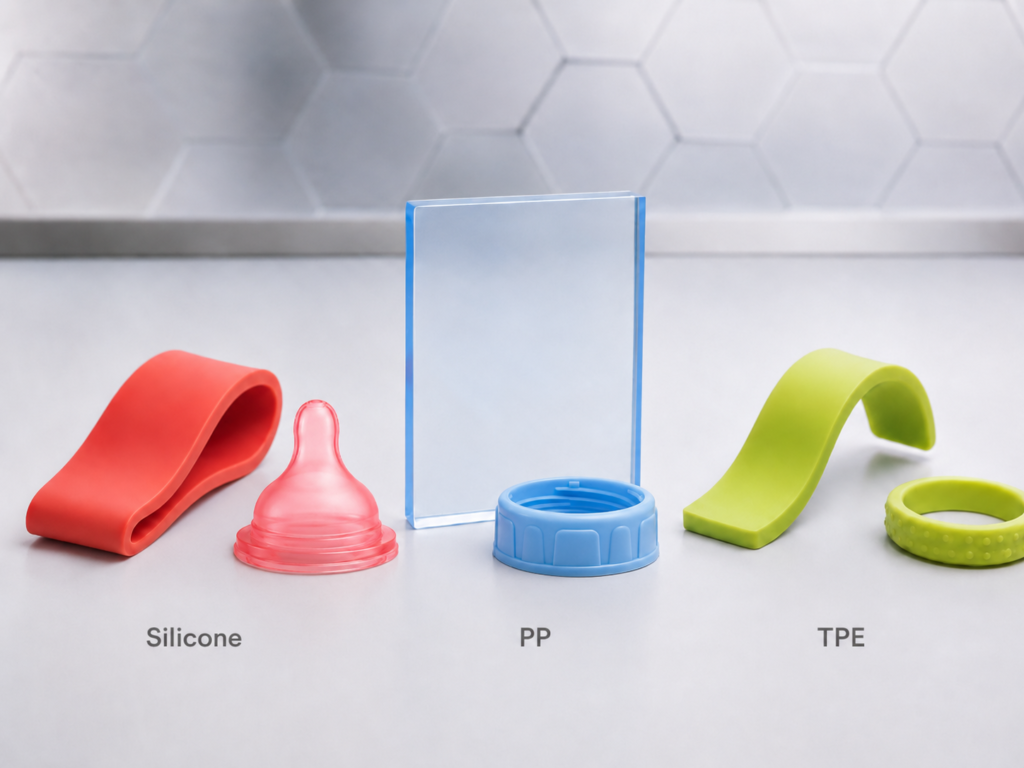
Silicone is generally selected for soft, flexible and heat-resistant parts. PP is commonly used for lightweight rigid components. TPE can provide a soft, rubber-like feel while still being processed as a thermoplastic.
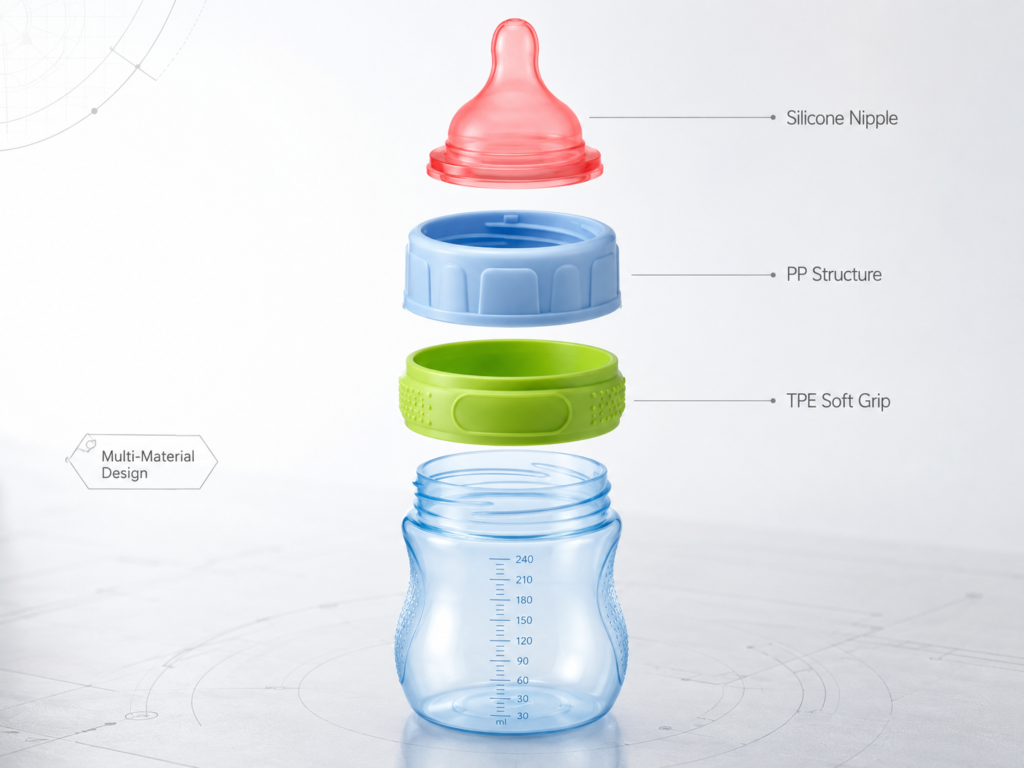
Many successful products use more than one material. A baby bottle, for example, may combine a PP bottle body, silicone nipple and soft TPE grip component.
This guide compares silicone vs PP vs TPE baby products from an OEM buyer’s perspective and explains how brands can choose the most suitable material direction before mold development and mass production.
Silicone vs PP vs TPE Baby Products: Quick Comparison
The following table provides a general comparison. Actual performance depends on the specific material grade, formulation, product design and manufacturing process.
| Factor | Silicone | PP | TPE |
|---|---|---|---|
| Basic material type | Crosslinked elastomer | Rigid thermoplastic | Flexible thermoplastic elastomer |
| Typical product feel | Soft, flexible and rubber-like | Firm, lightweight and rigid | Soft, flexible and rubber-like |
| Common molding process | Compression molding or liquid silicone injection molding | Thermoplastic injection molding | Thermoplastic injection molding and overmolding |
| Typical baby-product uses | Nipples, pacifiers, teethers, bibs, bowls, spoons, valves and seals | Bottle bodies, lids, caps, handles, containers and rigid components | Soft grips, seals, overmolded areas and selected flexible components |
| Heat performance | Generally strong, depending on grade and product design | Suitable for many daily-use applications, but grade-specific | Varies significantly by TPE family and formulation |
| Reprocessing during production | Cured material cannot normally be remelted into the same original form | Production scrap may be reprocessed where suitable | Production scrap may sometimes be reprocessed, depending on grade and requirements |
| Structural rigidity | Low to medium | High | Low to medium |
| Soft-touch performance | Excellent | Limited without modification or overmolding | Excellent |
| Typical production tendency | Longer curing process and specialized equipment | Efficient high-volume injection molding | Efficient injection molding with broad design flexibility |
| Cost tendency | Often higher for similar product weight and complexity | Often more economical for rigid high-volume parts | Highly dependent on formulation and performance requirements |
This table should be used as an initial sourcing guide rather than a final material specification.
There Is No Universally “Best” Baby Product Material
Material comparisons often become oversimplified.
Some suppliers describe silicone as the premium option, PP as the budget option and TPE as a compromise between the two. In reality, this description is incomplete.
A rigid baby bottle body should not be evaluated using the same criteria as a soft nipple. A feeding plate has different structural needs from a pacifier. A soft grip does not require the same material performance as a component that will repeatedly contact hot liquid.
The best material depends on:
- Product function
- Target age group
- Food-contact or mouth-contact use
- Desired softness or rigidity
- Product temperature exposure
- Cleaning and sterilization method
- Component assembly
- Target retail price
- Expected production quantity
- Mold budget
- Product weight
- Testing direction
- Target market
- Brand positioning
Brands preparing a new product brief can read How to Start a Custom Silicone Baby Product Project with a Manufacturer before requesting a final material recommendation.
What Is Silicone?
Silicone used for baby products is an elastomer that becomes permanently crosslinked during curing.
After silicone is molded and fully cured, it does not behave like an ordinary thermoplastic that can simply be melted and reshaped again. This curing behavior contributes to its elastic structure and temperature stability.
Baby-product silicone may be processed through:
- Compression molding
- Liquid silicone rubber injection molding
- Overmolding onto compatible rigid components
- Multi-component molding
- Extrusion for certain profiles or tubes
Common silicone baby-product applications include:
- Baby bottle nipples
- Pacifiers
- Teethers
- Feeding spoons
- Silicone bibs
- Suction bowls
- Divided plates
- Baby cups
- Sealing valves
- Soft mouth-contact parts
- Breast-pump components
- Flexible baby care accessories
Main Advantages of Silicone
Silicone may be suitable when a product needs:
- Softness and flexibility
- Elastic recovery
- Stable performance during repeated use
- Heat and steam resistance
- A smooth or soft-touch surface
- Different hardness options
- Transparent, translucent or colored designs
- One-piece flexible structures
- Mouth-contact or food-contact material options
- Durable sealing performance
Silicone is especially useful for products that need to bend, compress, stretch or recover their original shape.
For example, a silicone baby bib should remain flexible enough to fold and store. A nipple needs controlled softness and elasticity. A suction bowl needs a flexible base but sufficient wall stability.
Dow’s infant-care material information identifies silicone applications such as sippy cups, teething rings and baby bottle nipples, while also emphasizing that buyers must confirm whether the selected grade meets the regulations applicable in their region.
Limitations of Silicone
Silicone is not automatically the best choice for every component.
Possible limitations include:
- Higher material or processing cost than some rigid plastics
- Longer curing cycles than many thermoplastic processes
- Specialized molds and molding equipment
- Lower structural rigidity
- Greater product weight than thin-wall PP in some designs
- Difficulty creating very thin rigid walls
- Cured production waste cannot normally be remelted into the original material
- Dust attraction on some surface finishes
- Possible color or odor issues if formulation and processing are poorly controlled
A large rigid bottle body made entirely from silicone may be soft, heavier and more expensive than a PP alternative. The brand must decide whether the soft-touch positioning creates enough commercial value to justify that difference.
What Is PP?
PP, or polypropylene, is a thermoplastic widely used for molded consumer-product components.
It softens during processing, flows into an injection mold and becomes rigid after cooling. This makes PP suitable for high-volume production of lightweight structural parts.
Common PP baby-product applications include:
- Baby bottle bodies
- Bottle caps
- Screw rings
- Handles
- Feeding cup bodies
- Storage containers
- Milk powder containers
- Spoon or fork cores
- Lids
- Protective covers
- Packaging components
- Rigid product frames
Main Advantages of PP
PP may be suitable when the product needs:
- Lightweight construction
- Structural rigidity
- Thin-wall molding
- Efficient injection molding
- Hinges or snap-fit structures
- Screw threads
- Lids and locking components
- Lower unit cost at suitable volume
- Stable dimensions
- Easy assembly with other parts
- A broad range of molded colors
PP can be particularly useful for bottle bodies, caps and handles because these components need to maintain shape, threads and assembly tolerances.
Limitations of PP
PP does not provide the same soft and elastic feel as silicone or TPE.
Possible limitations include:
- Limited softness without blending or overmolding
- Less premium soft-touch perception
- Scratching or surface wear depending on grade and finish
- Possible stress whitening around flexible areas
- Heat performance that depends on the selected grade and product design
- Lower transparency than materials specifically chosen for glass-like clarity
- Product feel that may be perceived as more conventional or price-focused
PP may still be the correct engineering choice even when silicone has stronger marketing appeal.
For example, a bottle cap must hold its shape, maintain a thread and assemble consistently. A rigid PP cap may therefore perform better than a fully flexible silicone cap.
What Is TPE?
TPE is not one single material.
The term refers to a broad family of thermoplastic elastomers that combine rubber-like flexibility with thermoplastic processing. Different TPE families and formulations can have very different levels of softness, heat resistance, chemical resistance, transparency, compression set, odor and adhesion.
TPE materials may include:
- Styrenic TPE
- Thermoplastic polyurethane
- Thermoplastic vulcanizate
- Thermoplastic polyolefin
- Copolyester elastomer
- Polyamide elastomer
- Proprietary blends
This variation is one reason brands should never approve a product based only on the general description “TPE.”
They should confirm:
- Exact grade
- Material supplier
- Hardness
- Density
- Heat performance
- Compression set
- Tear strength
- Migration or food-contact documentation
- Odor
- Color stability
- Bonding compatibility
- Target-market testing
Common TPE Baby-Product Applications
Depending on the selected grade, TPE may be considered for:
- Soft grips
- Overmolded handles
- Sealing rings
- Flexible valves
- Soft-touch product edges
- Anti-slip bases
- Protective bumpers
- Selected nipples or mouth-contact components
- Flexible plastic accessories
Main Advantages of TPE
TPE may be suitable when a product needs:
- A soft rubber-like feel
- Injection-molding efficiency
- Fast production cycles
- A broad hardness range
- Overmolding onto compatible rigid plastics
- Soft-touch grips
- Integrated two-material designs
- Flexible coloring
- Reduced assembly through two-shot molding
- Reprocessing of suitable production scrap
Some TPE grades can bond directly to PP during overmolding, allowing a rigid component and soft-touch area to be formed as one integrated part.
Limitations of TPE
TPE performance varies more widely between formulations than many buyers expect.
Possible limitations include:
- Heat resistance that may be lower than silicone
- Greater risk of permanent deformation under compression for some grades
- Odor or surface-feel differences between formulations
- Oil migration or tackiness in unsuitable compounds
- Variable transparency
- Different aging behavior
- Bonding results that depend on both materials and processing
- A need for careful grade-specific compliance review
A TPE component should not be described as equivalent to silicone simply because both products feel soft.
The final decision must be based on measured performance and the actual use environment.
Detailed Material Comparison for OEM Buyers
When evaluating silicone vs PP vs TPE baby products, buyers should consider the complete product rather than only the raw material.
1. Softness and Flexibility
Silicone generally provides excellent softness, flexibility and elastic recovery.
PP is normally rigid and is selected when the component needs to hold its shape.
TPE can provide a wide range of soft-touch properties, but performance depends strongly on the formulation.
2. Heat and Sterilization Requirements
Silicone is commonly selected for components exposed to repeated heat or steam, subject to the selected grade and finished-product design.
PP can be suitable for many feeding and bottle applications, but the exact temperature and sterilization method should be confirmed.
TPE heat performance varies by family and grade. A TPE suitable for a grip may not be suitable for repeated high-temperature sterilization.
3. Product Rigidity
PP is generally the strongest choice when a lightweight rigid structure is required.
Silicone can be made harder or thicker, but it remains elastomeric.
TPE can range from very soft to relatively firm, although it generally does not replace PP where high dimensional rigidity is required.
4. Mold and Production Method
Silicone requires silicone-specific compression or injection-molding processes.
PP is commonly processed through thermoplastic injection molding.
TPE can also be injection molded and may support overmolding or two-shot molding with compatible plastics.
The mold design, gate, venting, shrinkage and demolding strategy differ for each material.
5. Color and Surface Appearance
All three materials can be colored, but their appearance is different.
Silicone often creates a soft matte or translucent appearance.
PP may produce solid, translucent or semi-transparent rigid parts depending on the grade.
TPE can provide matte, glossy, transparent, translucent, smooth or grippy surfaces depending on formulation.
Brands should approve physical color samples rather than screen images.
6. Weight and Shipping
PP can produce lightweight thin-wall structures.
Silicone products may be heavier when thicker walls are needed for stability.
TPE density varies by formulation.
Product weight affects unit cost, carton quantity and freight, particularly for bowls, plates and large feeding sets.
7. Recycling and Manufacturing Waste
PP and TPE are thermoplastics, so suitable clean production scrap may sometimes be reprocessed.
Cured silicone does not remelt in the same way.
However, describing a product as “recyclable” requires more than identifying the polymer. Actual recycling depends on product design, contamination, collection systems, local infrastructure and whether multiple materials can be separated.
Multi-material products may be more difficult to recycle if the parts are permanently bonded together.
Which Material Is Better for Different Baby Products?
Baby Bottle Body
PP is often suitable for brands that want:
- A lightweight rigid bottle
- Clear measurement markings
- Screw-thread accuracy
- Lower unit cost
- Familiar manufacturing processes
- Multiple rigid accessories
Silicone may suit brands that want:
- A soft squeezable bottle body
- A premium tactile experience
- Flexible handling
- A distinctive product concept
- Greater impact resistance from a flexible body
Some products combine a rigid PP body with silicone sleeves, valves or nipples.
Buyers developing bottle projects can read Silicone Baby Bottle OEM Manufacturer Guide: Materials, Safety & Production.
Bottle Nipples and Pacifiers
Silicone is widely used for nipples and pacifiers because of its softness, elastic recovery, translucency and heat performance.
TPE may be used for selected soft components, but the exact grade must be carefully reviewed for:
- Mouth-contact suitability
- Heat exposure
- Tear strength
- Compression behavior
- Aging
- Odor
- Testing requirements
The decision should never be based only on lower raw-material price.
Teethers
Silicone is commonly selected for one-piece teethers because it supports:
- Soft bite surfaces
- Raised textures
- Flexible grip structures
- Integrated colors
- One-piece molding
- Heat-resistant cleaning
TPE may suit some teether designs, but product performance and compliance depend heavily on the exact formulation.
For a complete development overview, read Silicone Baby Teether Manufacturer Guide: Safe Materials & Mold Design.
Feeding Bowls, Plates and Bibs
Silicone is useful for:
- Flexible bibs
- Suction bases
- Soft edges
- Foldable products
- One-piece feeding products
- Heat-resistant food-contact applications
PP may be more suitable for:
- Rigid plates
- Thin-wall containers
- Hard lids
- Storage boxes
- Lightweight travel products
Some feeding products combine a rigid PP body with a silicone suction base or sealing component.
Handles, Grips and Anti-Slip Parts
TPE can be particularly useful for:
- Soft grips
- Anti-slip surfaces
- Overmolded handles
- Flexible protective edges
- Integrated soft-touch areas
A TPE grip over a PP handle can provide softness without making the entire product flexible.
Multi-Material Products May Be the Better Solution
The choice between silicone vs PP vs TPE baby products does not always require selecting one material for the entire product.
A multi-material product may provide better performance.
Examples include:
- PP bottle body with silicone nipple
- PP handle with TPE soft-touch overmold
- PP cup with silicone straw and seal
- PP storage container with silicone lid or gasket
- Silicone feeding spoon with a rigid internal core
- Rigid pacifier shield with a soft silicone nipple
- PP bowl with silicone suction base
This approach allows each component to perform a different function.
However, multi-material products also require additional review of:
- Component tolerances
- Bonding
- Assembly
- Material compatibility
- Mold count
- Supplier coordination
- Incoming inspection
- Finished-product testing
- Cleaning accessibility
- End-of-life separation
A product should not use more materials than necessary. Every additional component increases development, assembly and quality-control requirements.
How Material Choice Affects OEM Cost
Material choice affects more than the quoted price per kilogram.
The total cost may include:
- Raw material
- Product weight
- Mold structure
- Number of cavities
- Molding cycle
- Production efficiency
- Trimming
- Assembly
- Defect rate
- Packaging volume
- Quality inspection
- Testing
- Tool maintenance
- Repeat-order consistency
Typical Commercial Tendency
PP is often cost-efficient for high-volume rigid components.
TPE cost varies widely because it includes many material families and specialized formulations.
Silicone may have a higher unit cost because of material price, curing time, product weight and specialized processing.
However, the lowest raw-material price does not always create the lowest finished-product cost.
A PP product with several seals and assembly steps may cost more than a one-piece silicone design. A TPE overmold may reduce assembly but require a more complex mold. A lightweight PP bottle may reduce freight compared with a heavier silicone bottle.
For broader budget planning, read How Much Does It Cost to Manufacture Custom Silicone Baby Products in China?.
How Material Choice Affects Mold Development
Each material needs a suitable mold and production process.
Silicone Mold Considerations
Silicone mold review may include:
- Compression or LSR process
- Venting
- Parting line
- Flash control
- Curing
- Demolding
- Product shrinkage
- Surface finish
- Post-curing where applicable
PP Mold Considerations
PP mold review may include:
- Gate position
- Injection flow
- Cooling
- Shrinkage
- Warpage
- Ejection
- Thin-wall structure
- Screw threads
- Snap fits
- Living hinges
TPE Mold Considerations
TPE mold review may include:
- Material flow
- Cooling
- Shrinkage
- Surface texture
- Ejection
- Soft-part deformation
- Overmolding adhesion
- Substrate compatibility
- Two-shot sequence
The factory should confirm the selected material before finalizing the mold design.
The Silicone Baby Product OEM Process Explained: From Idea to Mass Production explains how material selection, structure review, mold development and sample confirmation should be connected.
Material Safety and Compliance
No buyer should assume that every silicone, PP or TPE formulation is automatically suitable for a baby product.
Material compliance depends on:
- Exact formulation
- Additives
- Colorants
- Intended use
- Food type
- Contact time
- Contact temperature
- Product age group
- Target country
- Finished-product construction
For U.S. food-contact products, buyers can review the FDA’s official guidance on food-contact substances.
For products placed on the European market, buyers can review the European Commission’s official food-contact materials guidance.
For applicable U.S. children’s products, manufacturers and importers may need third-party testing and a Children’s Product Certificate based on the rules that apply to the finished product. Buyers can review the official CPSC testing and certification guidance.
Important points for OEM buyers include:
- “Food-grade” is not a complete finished-product test report.
- “FDA material” does not mean the FDA has approved every finished baby product.
- “BPA-free” alone does not demonstrate full product compliance.
- A supplier’s material report may not cover a new color, component or product structure.
- Changing the material source or formulation may affect existing test results.
- A bowl, bottle, teether and pacifier may follow different testing directions.
For a broader overview, read Are Certifications Required for Silicone Baby Products? FDA, LFGB, CPC and EN14350 Explained.
The final compliance plan should be confirmed according to the actual product and sales market.
Which Material Is Better for Your Brand?
Use the following decision framework.
Choose Silicone When Your Brand Prioritizes:
- Softness
- Flexibility
- Premium tactile positioning
- Heat-resistant use
- One-piece flexible designs
- Suction functions
- Mouth-contact components
- Feeding, teething or soothing products
- Long-term elastic recovery
Choose PP When Your Brand Prioritizes:
- Lightweight construction
- Structural rigidity
- Thin-wall products
- Bottle bodies and caps
- Lower unit cost at volume
- Screw threads and snap fits
- Storage products
- Efficient high-volume injection molding
Choose TPE When Your Brand Prioritizes:
- Soft-touch grip
- Flexible thermoplastic processing
- Overmolding onto rigid plastic
- Anti-slip areas
- Integrated soft and hard structures
- Fast injection-molding cycles
- Grade-specific flexibility
Choose a Material Combination When:
- Different components need different performance
- A rigid body requires a soft seal
- A hard handle needs a soft grip
- A bottle needs a flexible nipple
- Assembly can be simplified through overmolding
- Product function matters more than using one material throughout
For many brands, the best answer is not silicone, PP or TPE alone. It is a carefully engineered combination.
Common Material-Selection Mistakes
Common mistakes include:
- Choosing material only by unit price
- Treating all TPE grades as the same
- Assuming every silicone grade is suitable for babies
- Using PP where flexibility is required
- Using silicone where rigid dimensional stability is required
- Ignoring heat and sterilization conditions
- Approving material from appearance alone
- Testing raw material but not reviewing the finished product
- Changing color or material source without compliance review
- Opening a mold before confirming material shrinkage
- Ignoring product weight and shipping cost
- Using too many components without a clear function
- Making unsupported “eco-friendly” or “non-toxic” claims
- Comparing supplier quotations that use different materials or product weights
A professional comparison should review the complete specification rather than the material name alone.
Questions to Ask Your OEM Manufacturer
Before confirming silicone vs PP vs TPE baby products, buyers should ask:
- What exact material grade will be used?
- Who is the material supplier?
- Is the material virgin or recycled?
- What hardness is recommended?
- What temperature conditions can the product support?
- Is the material suitable for the intended food or mouth contact?
- What existing reports are available?
- Will a custom color affect testing?
- Does the report cover the finished product?
- Which components are produced in-house?
- Which components are sourced?
- What molding process will be used?
- Is overmolding required?
- Can the materials bond directly?
- What mold structure is recommended?
- What are the MOQ and lead time?
- How will bulk material consistency be controlled?
- What happens if the material source changes?
- Which finished-product tests should be discussed for the target market?
The answers should be documented before mold opening and bulk production.
How Baiya Silicone Supports Material Selection
Dongguan Baiya Silicone Products Co., Ltd. is an OEM and ODM manufacturer based in Dongguan, China.
Through Baiya Baby, we support brands, importers, distributors, wholesalers and e-commerce sellers developing silicone, plastic and multi-material baby products.
Our product and development support may include:
- Silicone baby products
- PP baby bottle components
- TPE soft components
- Silicone and plastic assemblies
- Existing-mold customization
- New mold development
- Material and hardness review
- Product structure review
- Custom color matching
- Sample preparation
- Testing-sample preparation
- Private label packaging
- Mass production
- Quality control
- Packing and shipment preparation
For multi-material projects, we can help buyers review which components require softness, rigidity, sealing, heat performance or structural support.
Brands can review our OEM and ODM silicone baby product manufacturing services and silicone manufacturing capability before beginning a project.
Final Thoughts
The comparison of silicone vs PP vs TPE baby products should not end with one universal winner.
Silicone is often suitable for soft, flexible and heat-resistant components. PP is valuable for lightweight rigid structures. TPE can create soft-touch and overmolded features through thermoplastic processing.
The right material depends on the product function, use environment, mold design, target price, compliance plan and brand position.
In many baby products, the strongest solution is a combination: PP for structure, silicone for mouth-contact or sealing parts and TPE for selected grips or flexible overmolded areas.
Silicone vs PP vs TPE Baby Products: Quick ComparisonIf you are developing a new baby bottle, feeding product, teether, pacifier or multi-material baby accessory, contact Baiya Silicone with your reference product, target market, desired function, material preference, estimated quantity and launch schedule.
Our team can help review product structure, material options, mold requirements, sample plans, MOQ, production solutions and possible testing support based on your actual project.
 English
Comments are closed