
Silicone Baby Feeding Accessories Supplier (Bibs, Bowls, Cups, Spoon Set)
Choosing the right silicone baby feeding accessories supplier is an important step for baby brands, importers, distributors, wholesalers and private label sellers. Products such as bibs, bowls, cups and spoon sets may look simple, but they involve different structures, food-contact requirements, mold designs, packaging methods and quality-control points.
A reliable silicone baby feeding accessories supplier should do more than send a product catalog and quote a unit price. The supplier should help buyers review product combinations, material selection, custom colors, logo methods, packaging, MOQ, lead time and testing preparation before production begins.
This guide explains what buyers should check when sourcing silicone baby feeding accessories and how to build a coordinated product line for retail, e-commerce or distributor channels.
What Does a Silicone Baby Feeding Accessories Supplier Provide?
A silicone baby feeding accessories supplier provides feeding-related silicone products for babies and toddlers. Depending on the project, the supplier may offer ready-made items, existing-mold customization, new mold development or a complete private label collection.
Common supplier services include:
- Product range and set-combination review
- Food-contact silicone material selection
- Existing-mold customization
- New mold development
- Custom color matching
- Logo customization
- Sample preparation
- Testing sample support
- Private label packaging
- Mass production
- Quality inspection
- Packing and shipment preparation
For buyers comparing complete set suppliers, How to Find a Reliable Silicone Baby Feeding Set Manufacturer in China explains the broader sourcing process for multi-item feeding collections.
Which Products Are Included in Baby Feeding Accessories?
A professional silicone baby feeding accessories supplier may support individual SKUs or coordinated product combinations.
Typical products include:
- Silicone baby bibs
- Silicone suction bowls
- Divided plates
- Baby cups
- Snack cups
- Silicone spoons
- Spoon and fork sets
- Placemats
- Food storage containers
- Fruit feeders
- Milk powder containers
- Custom feeding accessories
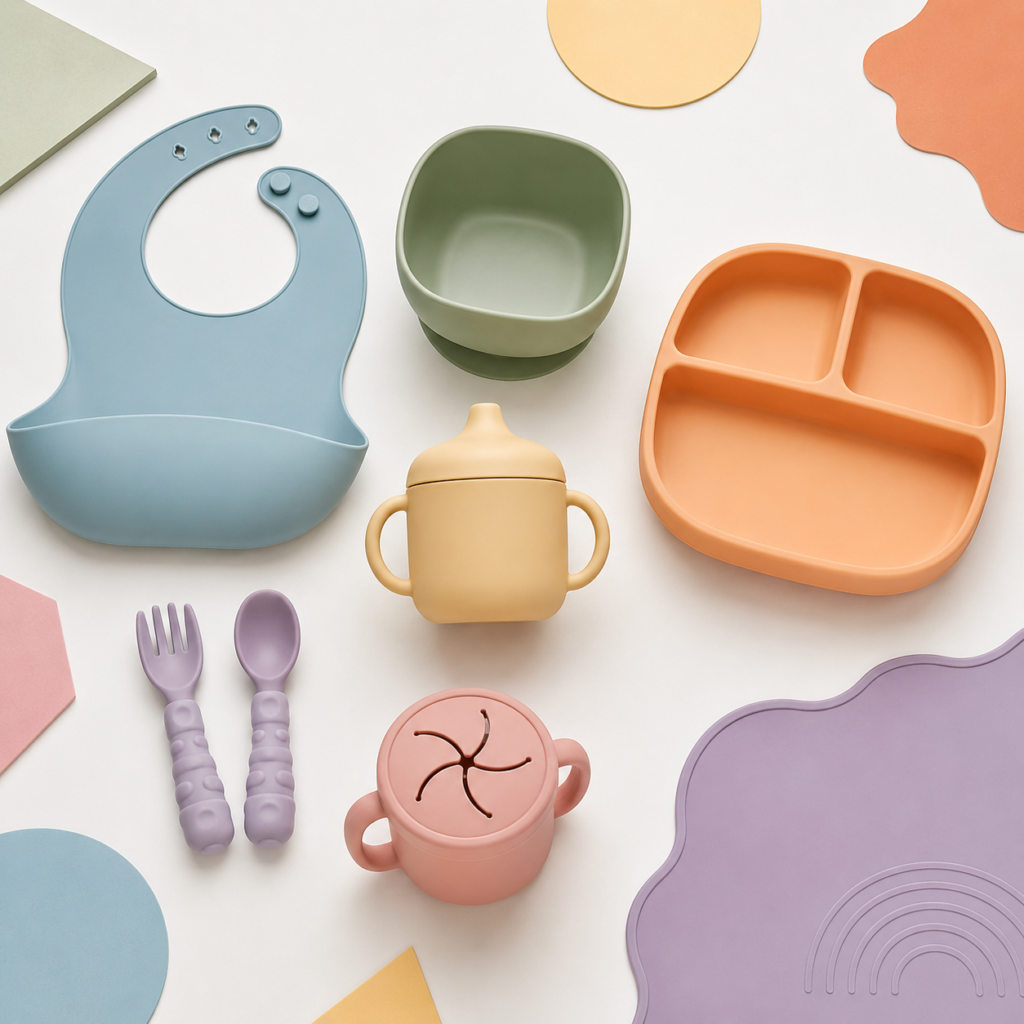
Some buyers start with one hero product, such as a silicone bib. Others need a complete color-matched collection that includes a bowl, cup, bib and spoon set.
Product combination affects pricing, packaging, testing preparation and production planning. A buyer who needs four items in one retail box should confirm the combination before requesting the final quotation.
Silicone Baby Bibs: What Buyers Should Review
Silicone bibs should be flexible, comfortable and easy to clean. Buyers should review:
- Bib size and neck adjustment
- Material softness
- Pocket depth and shape
- Edge finish
- Button or closure structure
- Product weight
- Custom logo position
- Folding and packaging method
- Color consistency
A bib that looks attractive in a product photo may still feel too stiff, fold poorly or have an uncomfortable neck area. The silicone baby feeding accessories supplier should therefore provide samples for shape, softness and packaging-fit review before bulk production.
For private label projects, bib packaging may include a hanging card, kraft box, color box, paper belly band or compact folded package.
Silicone Bowls and Suction Performance
Silicone bowls require a different type of product review. Buyers should consider:
- Bowl capacity
- Wall thickness
- Rim shape
- Suction base diameter
- Surface finish
- Shape stability
- Product weight
- Ease of cleaning
- Packaging size
Suction performance depends on the product structure and the surface on which the bowl is used. A supplier should avoid making absolute claims without checking the intended use and test method.
For custom bowl projects, the silicone baby feeding accessories supplier should review the suction-base design, wall thickness and molding feasibility before opening a new mold.
Baby Cups: Structure, Capacity and Target Age Group
Baby cups may include open cups, straw cups, snack cups or cups with lids and handles. Each type has different structure and assembly requirements.
Buyers should confirm:
- Cup capacity
- Rim and wall thickness
- Handle structure
- Lid fit
- Straw dimensions
- Assembly method
- Leak-resistance expectations
- Cleaning accessibility
- Target age group
- Packaging style
A simple open cup may use a one-piece silicone structure. A straw cup may include silicone and plastic parts, which means the supplier must also review component sourcing, fit, assembly and incoming inspection.
A capable silicone baby feeding accessories supplier should explain which parts are made in-house, which parts are sourced and how the finished product is inspected before shipment.
Spoon Sets: Size, Softness and Grip Design
A silicone spoon or spoon-and-fork set should be reviewed for both function and product feel.
Important points include:
- Spoon head size
- Handle length
- Silicone hardness
- Edge smoothness
- Grip shape
- One-piece or assembled design
- Metal or plastic core, if used
- Logo position
- Packaging method
A spoon designed for early feeding may require a softer head and smaller size, while a later-stage utensil set may need a firmer handle.
The silicone baby feeding accessories supplier should review the intended age group and use scenario before recommending an existing item or developing a new mold.
Material Safety and Food-Contact Requirements
Material selection is one of the most important parts of silicone baby feeding accessories.
Buyers commonly ask for:
- Food-contact silicone
- BPA-free materials
- Odor control
- Heat resistance
- Color stability
- Easy cleaning
- Suitable hardness
- Stable surface finish
Testing direction depends on the product type and target market. Feeding products for the United States may involve food-contact material review, while European projects may involve EU food-contact or LFGB-related testing support.
Buyers can review the FDA’s official information about food contact substances when preparing U.S. food-contact product requirements.
For a broader explanation of different baby-product testing directions, read Are Certifications Required for Silicone Baby Products? FDA, LFGB, CPC and EN14350 Explained.
A silicone baby feeding accessories supplier should ask about the target market before confirming material and testing preparation. Not every bowl, cup, bib or spoon set requires the same testing plan.
Existing Molds, Customization and New Mold Development
Buyers can usually choose between three project directions.
Existing-Mold Products
Existing-mold products are suitable for faster market testing. Buyers may customize:
- Product color
- Logo
- Packaging
- Set combination
- Order quantity
Existing-Mold Adjustments
Some projects may use an existing product with limited adjustments, depending on mold feasibility and production requirements.
Possible adjustments may include:
- Color changes
- Logo position
- Packaging style
- Set combination
- Minor accessory changes
New Mold Development
A new mold may be required for:
- A unique bib shape
- A new bowl capacity
- A special suction base
- A custom cup structure
- A new spoon or handle design
- A coordinated proprietary collection
New mold projects require drawing review, mold quotation, sample development and sample confirmation.
The article Silicone Baby Product OEM Process Explained: From Idea to Mass Production explains how product ideas move through structure review, mold development, sampling and bulk production.
A reliable silicone baby feeding accessories supplier should review manufacturing feasibility before asking the buyer to invest in a new mold.
Color, Logo and Set Combination
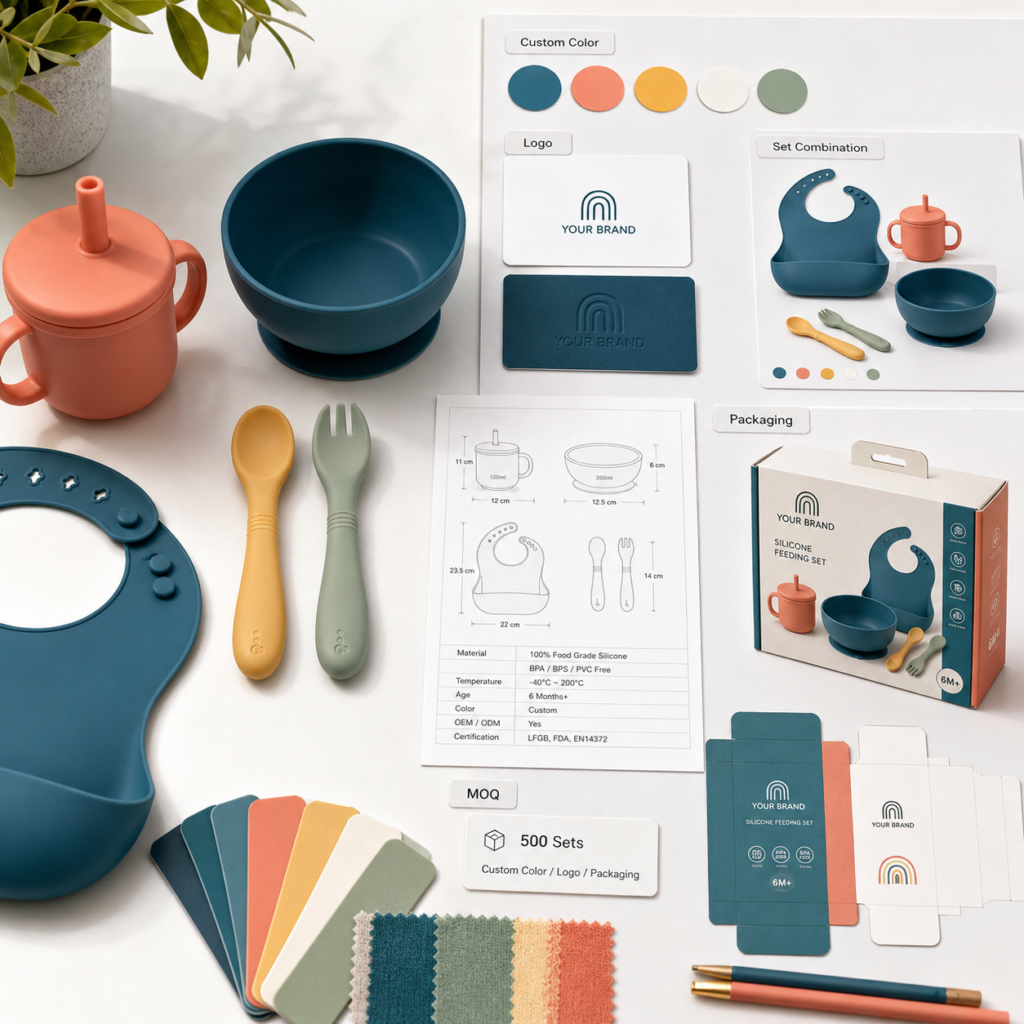
Feeding accessories are often sold as coordinated collections. Color and set combination therefore affect brand presentation.
Buyers should confirm:
- Pantone number or reference color
- Whether all items need the same color
- Acceptable color tolerance
- Logo method
- Logo position
- Set combination
- Retail-box arrangement
- Individual or set packaging
Logo options may include molded logos, printed logos, laser marking on compatible components or branding on packaging.
For a four-piece collection, buyers should confirm whether the bib, bowl, cup and spoon set are packed together or sold as separate SKUs. This decision affects packaging cost, carton size and MOQ.
A professional silicone baby feeding accessories supplier should confirm these details before preparing final samples or bulk production materials.
Packaging for Retail, E-Commerce and Distribution
Packaging should be discussed early because different sales channels need different solutions.
Common packaging options include:
- OPP bag
- Kraft box
- Color box
- Window box
- Gift box
- Paper belly band
- Hanging card
- Barcode label
- Instruction card
- Warning label
- E-commerce mailer packaging
A retail store may prefer a window box or gift box. An e-commerce seller may prioritize compact packaging and lower shipping volume. A distributor may need master-carton labels and multiple-language packaging versions.
A professional silicone baby feeding accessories supplier should check product fit, carton quantity, packaging MOQ and packaging lead time before confirming delivery.
Packaging should protect the products, support brand presentation and match the target market. It should not be treated as a last-minute step after production is already complete.
MOQ, Lead Time and Pricing Structure
MOQ and pricing depend on more than product quantity.
The silicone baby feeding accessories supplier may review:
- Existing mold or new mold
- Product size and weight
- Number of colors
- Logo method
- Product combination
- Packaging MOQ
- Testing sample quantity
- Assembly labor
- Order schedule
- Delivery destination
A single existing-mold bib may support a more flexible starting quantity. A custom four-piece set with new packaging and multiple colors may require a higher MOQ.
For a detailed breakdown, read MOQ, Lead Time & Pricing Structure for Silicone Baby Product Manufacturing.
Buyers should ask what is included in the quotation, such as:
- Unit price
- Mold cost
- Sample cost
- Logo cost
- Packaging cost
- Testing sample support
- Shipment terms
- Production lead time
A low quotation may not include the same product weight, material, packaging, inspection process or customization service. Buyers should compare the complete quotation structure rather than only the lowest unit price.
Quality Control for Feeding Accessories
Quality control should match each product’s structure and function.
Silicone Bib Quality Control
For bibs, QC may include:
- Neck-button function
- Pocket shape
- Edge finish
- Surface defects
- Product dimensions
- Color consistency
- Logo position
Silicone Bowl and Cup Quality Control
For bowls and cups, QC may include:
- Shape and capacity
- Wall thickness
- Suction-base appearance
- Lid or straw fit
- Assembly condition
- Surface finish
- Color consistency
Silicone Spoon Set Quality Control
For spoon sets, QC may include:
- Head and handle dimensions
- Edge smoothness
- Core positioning, if applicable
- Product straightness
- Logo quality
- Color consistency
- Packaging fit
All products should also be checked for packaging, order quantity and carton condition before shipment.
Buyers can review Baiya Silicone’s silicone manufacturing capability to understand the production, quality-control, packing and shipment process.
A reliable silicone baby feeding accessories supplier should maintain consistent quality during bulk production, not only provide one attractive sample.
How to Check Whether the Supplier Fits Your Project
Before choosing a silicone baby feeding accessories supplier, buyers should ask practical questions:
- Are you a direct manufacturer?
- Which feeding products do you make in-house?
- Can you support bibs, bowls, cups and spoon sets?
- Do you have existing molds?
- Can you develop new molds?
- Can you match custom colors?
- What logo methods are available?
- What packaging options can you provide?
- Can you prepare testing samples?
- How do you inspect bulk production?
- What are the MOQ and lead time?
- Can you support repeat orders and product-line expansion?
Buyers who are uncertain whether they are dealing with a factory or intermediary can read Silicone Baby Products Factory vs Trading Company: Key Differences Explained.
The right supplier should communicate clearly about production capability, material, molds, testing preparation, packaging and delivery.
What Information Should Buyers Prepare?
To receive a more accurate quotation, buyers should prepare:
- Product list
- Reference photos or physical samples
- Required sizes or capacities
- Target colors
- Logo requirements
- Packaging style
- Set combination
- Target market
- Testing requirements
- Estimated order quantity
- Expected launch date
- Delivery destination
Buyers who only have an initial idea can use How to Start a Custom Silicone Baby Product Project with a Manufacturer as a project-preparation checklist.
Clear information helps the silicone baby feeding accessories supplier review product feasibility, MOQ, sample time and production planning more efficiently.
A buyer does not need to prepare every detail perfectly before contacting the factory. However, providing a clear product direction helps reduce repeated communication and makes the quotation more useful.
Common Mistakes Buyers Should Avoid
Buyers often make similar mistakes when sourcing silicone baby feeding accessories.
Common mistakes include:
- Comparing only the lowest price
- Asking for a quotation without confirming the product list
- Ignoring packaging requirements
- Not confirming whether the supplier is a real manufacturer
- Choosing a supplier without feeding-product experience
- Ignoring testing or compliance direction
- Opening a mold before confirming design details
- Not checking sample quality carefully
- Not confirming color and logo details before production
- Treating bibs, bowls, cups and spoons as identical products
A better sourcing process should consider product function, material, manufacturing feasibility, quality control and long-term cooperation.
The silicone baby feeding accessories supplier should help buyers identify these issues before production begins.
How Baiya Silicone Supports Feeding Accessories Projects
Dongguan Baiya Silicone Products Co., Ltd. is an OEM and ODM silicone manufacturer based in Dongguan, China.
Through Baiya Baby, we support global brands, importers, distributors, wholesalers and e-commerce sellers looking for a silicone baby feeding accessories supplier.
Our feeding accessory range includes:
- Silicone baby bibs
- Silicone bowls and plates
- Baby cups and snack cups
- Silicone spoons and fork sets
- Placemats
- Fruit feeders
- Food storage accessories
- Custom feeding collections
Our support includes:
- Project requirement review
- Existing-mold customization
- New mold development
- Material selection
- Custom color matching
- Logo customization
- Sample preparation
- Testing sample support
- Private label packaging
- Mass production
- Quality inspection
- Packing and shipment preparation
We also support OEM and ODM silicone baby product manufacturing for buyers developing coordinated feeding collections or long-term product lines.
For buyers who already have drawings or reference samples, our team can help review manufacturing feasibility. For buyers who only have a market reference or initial product idea, we can help discuss possible development directions before mold opening.
Final Thoughts
Choosing the right silicone baby feeding accessories supplier requires more than comparing catalog photos and the lowest unit price.
Buyers should review product experience, materials, mold capability, custom colors, logo methods, packaging, MOQ, lead time and quality control. Bibs, bowls, cups and spoon sets belong to the same feeding category, but each product needs its own structure and function review.
A reliable silicone baby feeding accessories supplier can help buyers organize individual products into a consistent collection and reduce development risks before mass production.
If you are developing silicone baby feeding accessories, contact Baiya Silicone with your product list, reference photos, target market, packaging requirements and estimated quantity.
Our team can help review product feasibility, mold options, sample plans, MOQ, lead time, testing preparation and production solutions based on your project requirements.
 English
Comments are closed