
Private Label Silicone Baby Products OEM/ODM Solutions for Brands
For baby brands, importers, distributors and e-commerce sellers, private label silicone baby products offer a practical way to build a recognizable product line without managing every manufacturing step alone.
A successful private label project involves more than adding a logo to a ready-made item. Brands need to review product selection, material, structure, color, packaging, testing preparation, MOQ, production quality and launch timing. Depending on the project, the buyer may use existing molds, modify an existing product direction or develop a completely new design.
A reliable OEM/ODM manufacturer should help the brand turn a product idea into a consistent, market-ready collection. This guide explains how private label silicone baby products are developed, what OEM and ODM support may include and what brands should confirm before mass production.
What Are Private Label Silicone Baby Products?
Private label silicone baby products are manufactured for a brand and sold under that brand’s own name, visual identity and packaging.
The product may be based on:
- An existing factory mold
- An existing product with custom color, logo or packaging
- A modified product structure
- A completely new design with new mold development
- A coordinated collection using several product categories
Common private label categories include:
- Silicone baby feeding sets
- Bibs, bowls, plates, cups and spoon sets
- Silicone teethers
- Pacifiers and pacifier accessories
- Baby bottles and nipples
- Fruit feeders
- Milk powder containers
- Baby care accessories
- Custom silicone product collections
The depth of customization can be simple or extensive. A smaller brand may begin with existing molds and branded packaging. A more established brand may invest in proprietary molds, exclusive colors and a long-term collection strategy.
Brands preparing their first project can review How to Start a Custom Silicone Baby Product Project with a Manufacturer before requesting a final quotation.
OEM vs ODM for Private Label Baby Brands
OEM and ODM are often used together, but they describe different levels of product development.
| Project Model | Buyer Usually Provides | Manufacturer Support |
|---|---|---|
| OEM | Product requirements, drawings, samples, brand specifications or packaging direction | Manufacturing review, molds, samples, production, QC and packing |
| ODM | Product idea, target market, product direction or desired functions | Product concept support, structure suggestions, existing design options, development and production |
| Existing-Mold Private Label | Selected product, colors, logo and packaging requirements | Existing product customization, samples, production and private label packaging |
In practice, many private label silicone baby products use a combination of OEM and ODM support. The buyer may select an existing bowl or teether, request custom colors and packaging, and then develop one exclusive item to make the collection more distinctive.
The best project model depends on budget, launch timeline, product differentiation and expected order volume.
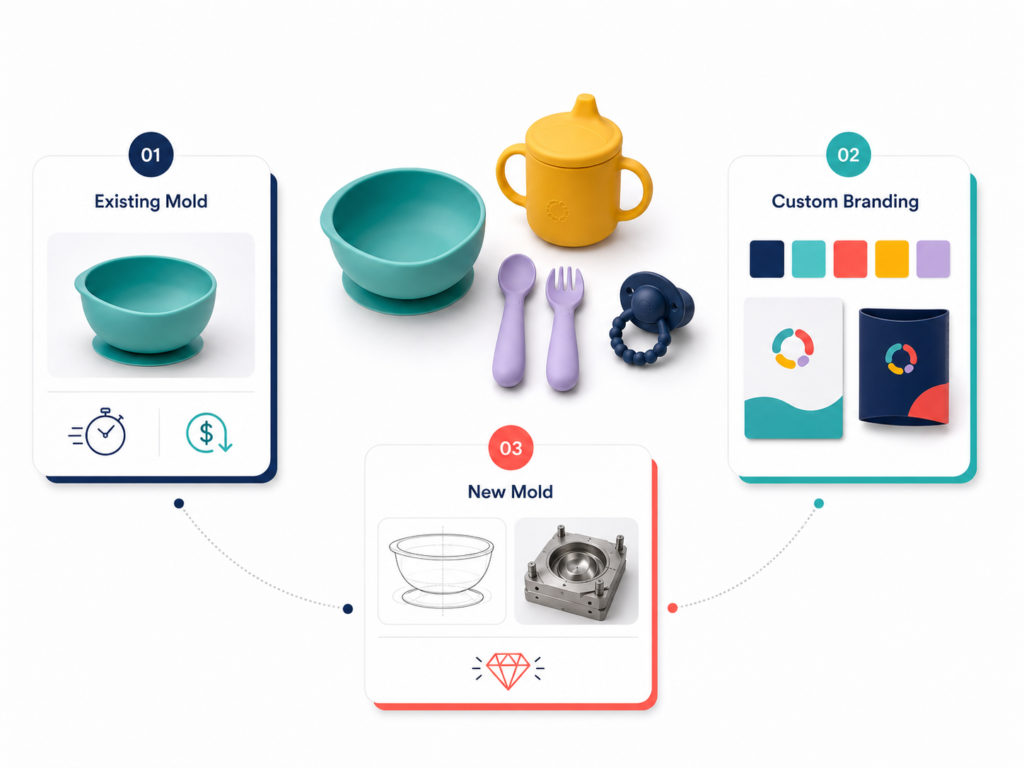
Which Private Label Solution Fits Your Brand?
Before choosing a development path, brands should define what they need from the project.
Existing-Mold Private Label
This direction is suitable when the brand needs:
- Faster samples
- Lower initial development investment
- More flexible market testing
- Custom colors
- Custom logo
- Branded retail packaging
- A shorter launch timeline
The product structure normally remains unchanged, but the brand can build differentiation through color, set combination, artwork and packaging.
Existing Product with Limited Customization
Some projects use an existing product with adjustments that do not require a completely new mold. The available changes depend on the product and manufacturing feasibility.
Possible customization may include:
- Product color
- Logo location
- Accessory combination
- Packaging structure
- Set contents
- Printed inserts
- Label information
New Mold Development
New molds are suitable when the brand needs:
- A proprietary product shape
- A new product size or capacity
- Unique surface texture
- Exclusive functional structure
- A coordinated family of products
- Stronger long-term product differentiation
New mold development requires more time and investment, but it gives the brand greater control over the final product.
The complete Silicone Baby Product OEM Process Explained: From Idea to Mass Production explains how structure review, mold development, sample confirmation and bulk production connect.
Private Label Silicone Baby Products: What Can Be Customized?
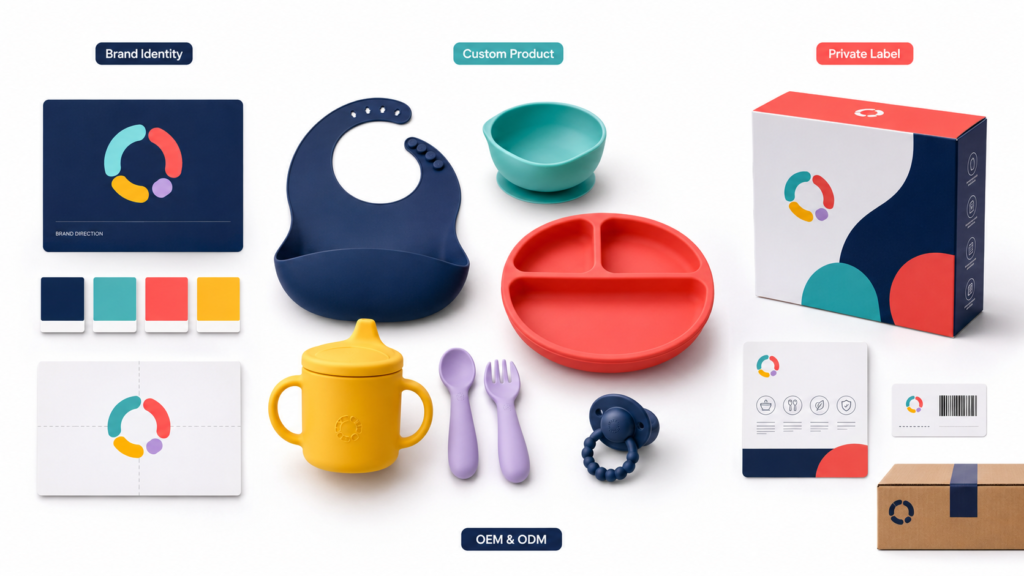
A private label silicone baby products project may include customization across the product, brand identity and final packaging.
Product Color
Brands may request:
- Pantone color matching
- Seasonal color collections
- Neutral or high-contrast palettes
- Matching colors across several products
- Two-color designs where technically suitable
- Transparent or translucent effects where feasible
Color should be confirmed on physical samples because product thickness and shape can affect how the same formula appears.
Logo and Brand Marking
Possible logo directions may include:
- Molded or debossed logo
- Raised logo
- Printed logo
- Laser marking on suitable components
- Branded packaging
- Printed product inserts
The right logo method depends on material, product structure, expected appearance and production quantity.
Product Combination
Brands can build sets around a target use or sales channel, such as:
- Three-piece starter feeding set
- Full feeding collection
- Teether and pacifier gift set
- Bottle and accessory set
- Travel feeding kit
- Retail gift box
- E-commerce bundle
Packaging
Private label packaging may include:
- Color box
- Kraft box
- Window box
- Gift box
- Blister packaging
- Backing card
- Paper band
- Instruction card
- Barcode label
- Warning information
- Multilingual packaging
- Master-carton marks
Packaging should be planned early because it can affect MOQ, lead time, carton volume and testing or labeling preparation.
Step 1: Define the Brand and Market Position
A private label project should begin with a commercial brief, not only a product photo.
Useful information includes:
- Target country or region
- Target customer
- Retail, e-commerce or distributor channel
- Product category
- Target retail price range
- Competitor references
- Brand colors
- Packaging style
- Expected quantity
- Launch schedule
- Testing expectations
The same product may need a different development plan depending on how it will be sold. An Amazon seller may prioritize compact packaging and a focused SKU. A retail brand may need stronger shelf presentation and a coordinated collection. A distributor may require multilingual packaging and several product combinations.
Clear positioning helps the manufacturer recommend a more suitable private label route.
Step 2: Select Products and Build a Collection
A strong private label collection needs a clear product logic.
Brands should decide whether they are building:
- One hero product
- A small coordinated set
- A category-focused range
- A full silicone baby product collection
- A launch collection with later product expansion
The products should support the same market position, color system and packaging direction.
For example, a feeding collection may include a bib, bowl, plate, cup and spoon set. A soothing collection may combine a pacifier, teether and matching accessory. A bottle collection may include different capacities, nipples, handles and storage components.
The article Silicone Baby Feeding Accessories Supplier (Bibs, Bowls, Cups, Spoon Set) explains how different feeding accessories can be combined into a coordinated range.
Step 3: Review Material, Structure and Function
The product needs to be reviewed from both a brand and manufacturing perspective.
Important points may include:
- Product size
- Intended age group
- Silicone hardness
- Wall thickness
- Food-contact area
- Chewing or sucking area
- Suction structure
- Assembly method
- Edge finish
- Cleaning accessibility
- Mold feasibility
- Packaging fit
Different products require different material properties. A bib needs flexibility. A bowl or plate needs enough structural stability. A bottle nipple requires careful review of softness and structure. A teether needs suitable texture, edge treatment and product shape.
A professional supplier should not use one material or hardness assumption for every product in a private label range.
Step 4: Confirm Samples and Brand Details
Samples are the bridge between the concept and mass production.
Depending on the project, the brand may need:
- Existing product samples
- Custom color samples
- Logo samples
- New mold samples
- Packaging samples
- Testing samples
- Pre-production samples
The sample review should confirm:
- Product dimensions
- Color
- Hardness
- Surface finish
- Function
- Logo
- Set combination
- Packaging fit
- Printed information
- Accessories
For private label silicone baby products, sample approval should be documented with reference photos, measurements, approved colors and packaging artwork. This helps reduce uncertainty during bulk production.
Step 5: Plan Testing and Market Compliance
Testing preparation depends on the product type, function, age group and target market.
For applicable U.S. children’s products, manufacturers and importers may need third-party testing and a Children’s Product Certificate based on the applicable CPSC rules. Buyers can review the official CPSC Children’s Product Certificate guidance.
For feeding products and other items intended for food contact, buyers can also review the FDA’s official information about food contact substances.
The final testing plan should be confirmed according to the actual product and sales market. A feeding bowl, teether, pacifier clip and baby bottle may involve different testing directions.
For a broader overview, read Are Certifications Required for Silicone Baby Products? FDA, LFGB, CPC and EN14350 Explained.
Step 6: Finalize Packaging and Retail Information
Packaging turns a manufactured item into a branded market product.
Before printing, the brand should confirm:
- Product name
- Set contents
- Product color
- Packaging dimensions
- Logo and artwork
- Barcode
- Instructions
- Warnings
- Age information
- Materials
- Country-of-origin information
- Batch or traceability information where applicable
- Carton marks
The product should be tested inside the final packaging before the bulk packaging order is confirmed.
A retail box that looks attractive on screen may still be too large, too tight or inefficient for shipping. Packaging structure should balance protection, presentation and logistics.
Step 7: Review MOQ, Lead Time and Pricing
MOQ and pricing depend on the level of customization.
The quotation may include:
- Unit price
- Mold cost
- Sample cost
- Custom color preparation
- Logo cost
- Packaging cost
- Testing sample support
- Assembly
- Quality inspection
- Carton preparation
- Shipping terms
Existing-mold projects usually move faster than new mold projects. Custom printed packaging may also have a separate MOQ and lead time.
Brands should compare the complete project scope rather than only the lowest unit price.
For a detailed explanation, read MOQ, Lead Time & Pricing Structure for Silicone Baby Product Manufacturing and How Much Does It Cost to Manufacture Custom Silicone Baby Products in China?.
A transparent quotation helps brands understand where their development and production budget is being used.
Step 8: Mass Production and Quality Control
Once the sample, color, logo, packaging and production details are approved, the project can move into mass production.
The factory workflow may include:
- Material preparation
- Color preparation
- Molding
- Trimming
- Assembly
- In-process inspection
- Product-specific function checks
- Logo inspection
- Packaging
- Quantity verification
- Final inspection
Quality control should be based on the approved sample and project requirements.
For private label silicone baby products, QC may review:
- Product dimensions
- Color consistency
- Surface finish
- Logo position
- Product function
- Component fit
- Set combination
- Packaging artwork
- Barcode and label placement
- Carton quantity
The article How We Ensure Quality Control in Silicone Baby Product Production explains how material checks, first-piece confirmation, molding inspection, function review and final packaging inspection work together.
Step 9: Prepare for Launch and Repeat Orders
A private label project should be planned beyond the first shipment.
Before launch, brands should confirm:
- Final product photography
- SKU names
- Listing information
- Set contents
- Packaging copy
- Carton quantities
- Reorder lead time
- Color expansion plan
- Future product additions
- Approved production references
For private label silicone baby products, launch planning should also include how the brand will maintain consistent colors, packaging and product specifications across repeat orders.
The manufacturer should retain clear information about the approved product, color, logo, packaging and inspection requirements. When the brand expands the range, new items should be reviewed against the existing collection so the product line remains visually and functionally consistent.
How to Choose an OEM/ODM Manufacturer
The right supplier should support both manufacturing and project communication.
Brands can ask:
- Are you a direct factory or trading company?
- Which silicone baby products do you manufacture?
- Which components are made in-house?
- Can you support existing molds and new molds?
- Can you prepare custom colors and logos?
- Can you help review product structure?
- What packaging options are available?
- How do you prepare testing samples?
- What are the MOQ and lead time?
- How do you control bulk production?
- Can you support repeat orders and range expansion?
- What information do you need before quotation?
For technical projects, direct communication with the production source can reduce additional communication layers. Brands comparing supplier types can read Silicone Baby Products Factory vs Trading Company: Key Differences Explained.
They can also review Silicone Baby Products Manufacturer: How to Choose the Right Partner for Your Brand for a broader supplier-selection checklist.
Common Private Label Mistakes
Common mistakes include:
- Choosing products before defining the target market
- Selecting too many SKUs for the first launch
- Comparing only the lowest price
- Opening molds before structure review
- Confirming colors only from a screen
- Planning packaging too late
- Using the same testing assumptions for every product
- Approving one sample without documenting details
- Ignoring packaging MOQ
- Failing to check carton volume
- Not confirming which components are sourced
- Treating the first shipment as a one-time project
- Not planning repeat-order consistency
A structured development process helps brands reduce avoidable changes and move more smoothly from product selection to launch.
How Baiya Silicone Supports Private Label Brands
Dongguan Baiya Silicone Products Co., Ltd. is a silicone OEM and ODM manufacturer based in Dongguan, China.
Through Baiya Baby, we support brands, importers, distributors, wholesalers and e-commerce sellers with private label silicone baby products.
Our product range includes:
- Feeding sets and accessories
- Baby bottles and nipples
- Teethers
- Pacifiers
- Pacifier accessories
- Fruit feeders
- Baby care accessories
- Custom silicone products
Our support may include:
- Product and market review
- Existing-mold product selection
- New mold development
- Material and hardness review
- Custom color matching
- Logo customization
- Sample preparation
- Testing preparation
- Private label packaging
- Mass production
- Quality control
- Packing and shipment preparation
Brands can review our silicone manufacturing capability and OEM and ODM silicone baby product manufacturing services before starting a project.
Final Thoughts
Private label silicone baby products give brands several ways to enter or expand the baby product market. A project can begin with existing molds and branded packaging or develop into a proprietary collection with exclusive products and new molds.
The right solution depends on target market, budget, launch timing, product differentiation, MOQ and long-term brand strategy.
A reliable OEM/ODM partner should help the brand review product selection, material, structure, samples, testing preparation, packaging, production quality and repeat-order planning.
If you are developing a new private label baby product collection, contact Baiya Silicone with your product direction, reference samples, target market, packaging ideas and estimated quantity.
Our team can help review existing product options, mold requirements, sample plans, MOQ, lead time, production solutions and possible testing support based on your project needs.
 English
Comments are closed