
How Much Does It Cost to Manufacture Custom Silicone Baby Products in China?
For baby brands, importers and private label sellers, understanding custom silicone baby products cost is one of the first steps before starting a new product project.
Many buyers want to know one simple answer:
“How much does it cost to manufacture a custom silicone baby product in China?”
However, there is no fixed price for customized silicone products. The total investment depends on product design, mold development, silicone material selection, order quantity, testing requirements, packaging customization and production process.
A professional silicone baby product manufacturer does not calculate cost only based on unit price. Instead, manufacturers evaluate the complete project, from product concept and mold development to sampling, mass production, quality inspection and shipment.
For brands planning silicone baby products, understanding the real cost structure helps avoid unexpected expenses and choose the right manufacturing partner.
This guide explains the main factors affecting custom silicone baby products cost and how brands can better plan their OEM manufacturing projects in China.
How Much Do Custom Silicone Baby Products Cost in China?
The cost of custom silicone baby products depends on the complexity of the product and the level of customization required.
A simple silicone baby accessory using an existing mold may require a smaller investment, while a completely new product with custom tooling, packaging and testing requires a higher development budget.
The main cost categories usually include:
- Product design and engineering
- Mold development
- Silicone material
- Production quantity
- Manufacturing process
- Quality control
- Testing requirements
- Packaging customization
- Shipping preparation
For this reason, two silicone baby products with similar appearance may have completely different manufacturing costs.
For example, a standard silicone spoon and a custom silicone feeding set may both use food-grade silicone, but the second project requires multiple molds, more production steps and more packaging preparation.
Understanding these factors allows buyers to evaluate quotations more accurately.
What Factors Affect Custom Silicone Baby Products Cost?
1. Mold Development and Tooling Cost
For customized silicone baby products, mold development is usually one of the biggest initial investments.
Unlike ready-made products, custom products require manufacturers to create new tooling based on product structure, dimensions and production requirements.
Mold cost depends on:
- Product design complexity
- Number of components
- Mold structure
- Product size
- Surface details
- Production volume requirements
Simple products such as silicone spoons or basic teethers may require simpler molds.
More complicated products such as silicone baby bottles, multi-part feeding sets or customized pacifier designs may require more engineering work.
A professional silicone baby product manufacturer will review whether a project requires:
- Existing mold
- Modified mold
- Completely new mold
Choosing the correct development method can significantly influence the overall custom silicone baby products cost.
Before starting a project, buyers should understand the complete OEM development process. Read:
Silicone Baby Product OEM Process Explained: From Idea to Mass Production
to learn how manufacturers manage design review, mold development, sampling and production.
2. Silicone Material Selection and Production Requirements
Material selection directly affects silicone manufacturing cost.
Baby products usually require high-quality silicone materials suitable for baby-related applications.
Common requirements include:
- Food-grade silicone
- BPA-free materials
- Stable color performance
- Suitable hardness
- Heat resistance
- Low odor
Different silicone materials and specifications can influence product pricing.
For example:
A soft silicone teether may require different hardness compared with a structured silicone feeding bowl.
A transparent silicone component may require different production control compared with standard colored silicone products.
Color customization also affects cost.
Multiple colors, special color matching and different silicone hardness requirements may increase preparation time and production complexity.
The cheapest material option is not always the best choice for baby products. Brands should balance product safety, customer expectations and long-term quality.
For more information about compliance considerations, read:
Are Certifications Required for Silicone Baby Products? FDA, LFGB, CPC and EN14350 Explained
3. MOQ and Production Quantity
Production quantity has a direct impact on custom silicone baby products cost.
Manufacturing includes several fixed preparation costs:
- Material preparation
- Machine setup
- Labor arrangement
- Quality inspection
- Packaging preparation
When order quantity increases, the average production cost per unit usually decreases.
However, MOQ depends on:
- Product type
- Mold situation
- Number of colors
- Packaging requirements
- Assembly process
For example:
An existing silicone bib with standard packaging may support a lower MOQ.
A customized silicone feeding set with new molds, multiple colors and retail packaging requires a larger production commitment.
Before requesting a quotation, buyers should understand how MOQ affects:
- Unit price
- Production schedule
- Inventory planning
- Packaging cost
Read more about:
MOQ, Lead Time & Pricing Structure for Silicone Baby Product Manufacturing
4. Product Design and Customization Level
Customization is another important factor affecting silicone baby products cost.
Different customization options include:
Custom Shape
A completely new product structure requires new engineering and mold development.
Custom Color
Brands may request specific colors based on their brand identity.
Custom Logo
Logo methods may include:
- Molded logo
- Printed logo
- Packaging branding
Custom Packaging
Private label customers may require:
- Color boxes
- Gift boxes
- Instruction cards
- Barcode labels
- Retail packaging
The more customized elements included in a project, the more preparation is required before mass production.
A clear product specification helps manufacturers provide a more accurate quotation.
5. Testing and Compliance Requirements
Testing requirements can also influence overall manufacturing cost.
The required testing depends on:
- Product category
- Target market
- Customer requirements
- Applicable regulations
Different products may require different testing plans.
For example:
Silicone feeding products may focus on food-contact safety.
Baby products sold in different countries may require different compliance documentation.
Internal factory quality control and third-party testing are two different processes.
Factory QC ensures production consistency.
Laboratory testing verifies applicable safety standards.
For applicable children’s products in the United States, buyers can refer to the requirements related to Children’s Product Certificates from the U.S. Consumer Product Safety Commission:
https://www.cpsc.gov/Business–Manufacturing/Testing-Certification/Childrens-Product-Certificate
Understanding testing requirements early helps avoid unexpected costs during product development.
6. Packaging and Branding Cost
Packaging is often underestimated when calculating custom silicone baby products cost.
For private label brands, packaging may include:
- Product boxes
- Printed cards
- Labels
- Instruction manuals
- Barcode stickers
- Retail packaging
Packaging affects:
- Product presentation
- Shipping volume
- Minimum order quantity
- Production timeline
Many brands focus only on product cost but forget that packaging is part of the final customer experience.
A professional manufacturer can help buyers balance packaging design, cost and production efficiency.
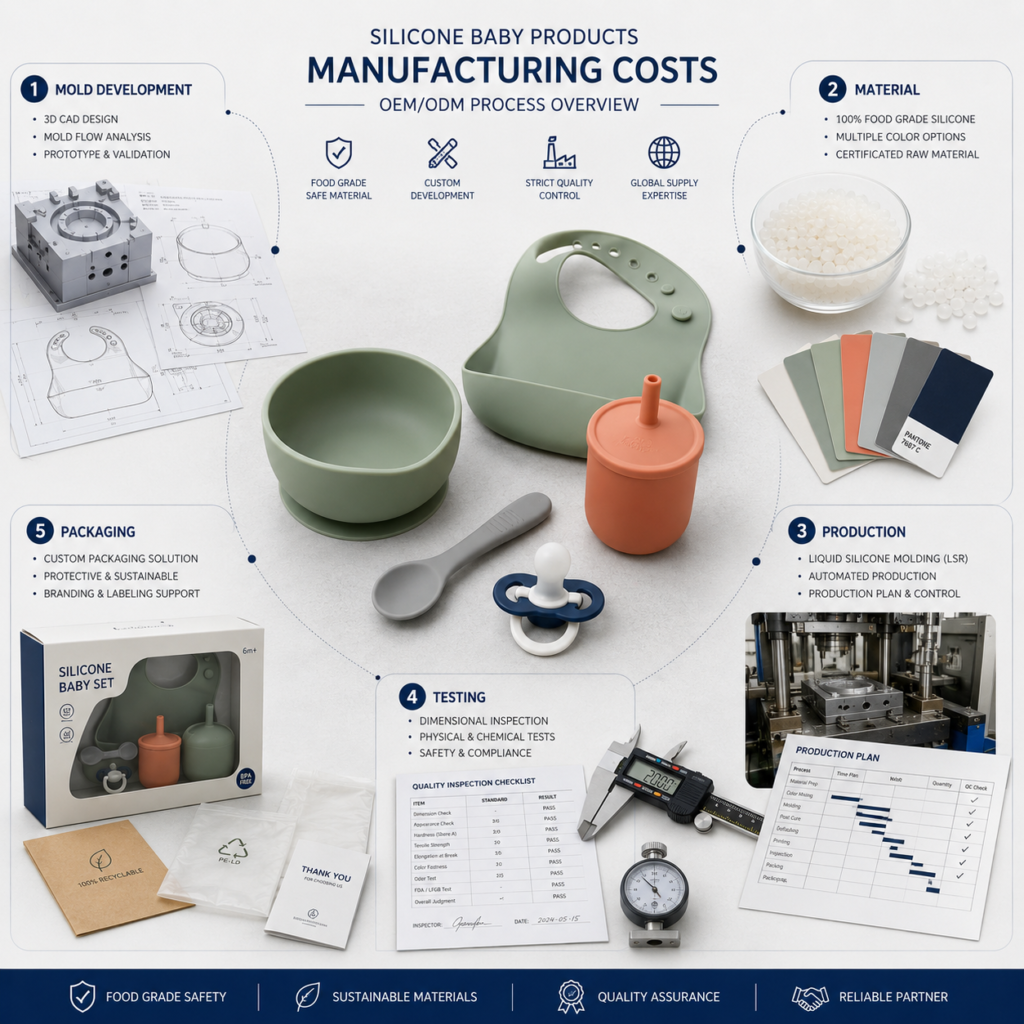
Custom Silicone Baby Product Cost Breakdown
A typical OEM project may include the following cost areas:
| Cost Category | Main Factors |
|---|---|
| Mold Development | Product structure, mold complexity, engineering |
| Material | Silicone grade, colors, hardness |
| Production | Quantity, labor, molding process |
| Quality Control | Inspection standards and product checks |
| Testing | Market requirements and laboratory evaluation |
| Packaging | Design, printing and packaging materials |
The final quotation depends on the complete project requirements.
Comparing only unit prices can be misleading because different suppliers may include different services.
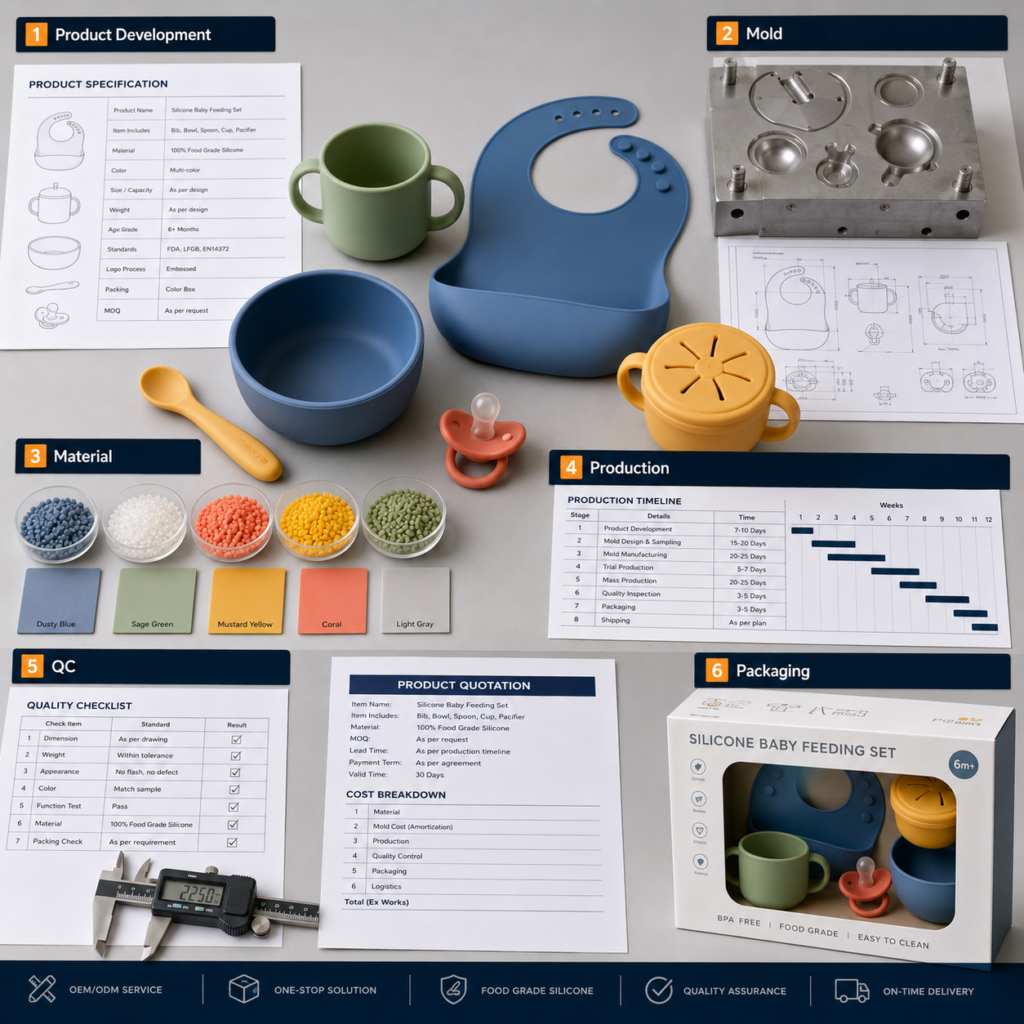
Example: Custom Silicone Feeding Set Development Cost Factors
A custom silicone feeding set may include:
- Silicone bib
- Silicone bowl
- Baby cup
- Spoon and fork set
The development process usually includes:
- Product concept review
- Design confirmation
- Mold development
- Sample production
- Sample approval
- Testing preparation
- Mass production
- Quality inspection
- Packaging and shipment
Each stage influences the final project investment.
For brands starting from an idea, read:
How to Start a Custom Silicone Baby Product Project with a Manufacturer
How to Reduce Custom Silicone Baby Products Cost
Reducing cost does not always mean choosing the cheapest supplier.
Better strategies include:
Optimize Product Structure
A practical design can reduce mold complexity and production difficulty.
Plan MOQ Carefully
A suitable order quantity helps balance unit cost and inventory risk.
Prepare Packaging Early
Late packaging changes may increase cost and delay production.
Work With an Experienced Factory
An experienced manufacturer can help identify unnecessary costs during product development.
Choosing the right supplier is especially important for brands planning multiple silicone baby products.
Why Choose a Silicone Baby Product Manufacturer in China?
China has a mature silicone manufacturing supply chain with experience in:
- Product development
- Mold production
- Silicone molding
- Quality inspection
- Packaging
- Export preparation
Working directly with a silicone baby products factory can improve communication and reduce unnecessary coordination costs.
When comparing suppliers, buyers should evaluate:
- Manufacturing capability
- Product experience
- Quality control system
- Communication efficiency
- OEM support
Read:
Silicone Baby Products Factory vs Trading Company: Key Differences Explained
to understand the differences between direct factories and trading companies.
How Baiya Silicone Supports Custom Silicone Baby Products
Dongguan Baiya Silicone Products Co., Ltd. is an OEM and ODM silicone manufacturer based in Dongguan, China.
We support global baby brands, importers, distributors and private label customers with:
- Silicone feeding products
- Baby bottles
- Teethers
- Pacifiers
- Baby accessories
- Custom silicone products
Our services include:
- Product development
- Mold design
- Material selection
- Custom colors
- Logo customization
- Packaging solutions
- Quality inspection
- Mass production
Through our OEM and ODM service, brands can develop silicone baby products from initial concepts to finished production.
Learn more about our:
OEM and ODM silicone baby product manufacturing
Final Thoughts
The real custom silicone baby products cost depends on much more than the factory unit price.
Mold development, silicone materials, production quantity, testing requirements, packaging and supplier capability all influence the final investment.
For brands planning new silicone baby products, working with an experienced silicone baby product manufacturer helps control development risks and create a more predictable production process.
If you are planning a custom silicone baby product project, contact Baiya Silicone with your product idea, reference images, target market and estimated quantity.
A clear understanding of custom silicone baby products cost helps brands make better OEM manufacturing decisions.
Our team can help review product feasibility, manufacturing options, cost structure and OEM solutions based on your project requirements.
 English
Comments are closed