
How We Ensure Quality Control in Silicone Baby Product Production
Quality control is one of the most important parts of silicone baby product manufacturing. For baby brands, importers, distributors and private label buyers, a good sample is only the beginning. Stable bulk production also requires clear inspection standards, process control, product-specific checks and packaging verification.
At Baiya Silicone, silicone baby product quality control is reviewed throughout the production process rather than only after the order is finished. Depending on the product, we check material preparation, molding condition, trimming, appearance, dimensions, function, assembly, packaging and shipment preparation.
This guide explains how we manage quality control in silicone baby product production, what buyers should confirm before production and why internal factory inspection and third-party compliance testing should be planned separately.
Silicone Baby Product Quality Control: What It Covers
Silicone baby product quality control is not one single inspection at the end of production. It is a series of checks carried out before, during and after manufacturing.
A complete QC plan may include:
- Project requirement review
- Approved sample confirmation
- Material and color preparation
- First-piece inspection
- In-process molding checks
- Trimming and finishing checks
- Dimension and appearance inspection
- Product-specific function checks
- Assembly inspection
- Packaging inspection
- Quantity and carton verification
- Final release before shipment
The exact inspection items depend on the product. A silicone bib, baby bottle nipple, teether, pacifier, feeding bowl and pacifier clip do not have the same structure or quality risks.
This is why buyers should provide clear product requirements before production begins. The article How to Start a Custom Silicone Baby Product Project with a Manufacturer explains what information helps a factory prepare a more practical development and quality plan.
Why Sample Approval Alone Is Not Enough
Sample approval is important, but one approved sample cannot represent every unit in a bulk order.
During mass production, variations may appear in:
- Product dimensions
- Silicone hardness
- Color
- Surface finish
- Trimming quality
- Logo position
- Assembly fit
- Product weight
- Packaging
- Carton quantity
A reliable quality process should use the approved sample, confirmed drawing, color reference, packaging artwork and product specifications as inspection references.
For silicone baby product quality control, the factory should also identify which characteristics are critical to the product’s function. For example, the wall thickness of a nipple, the suction base of a bowl, the edge finish of a teether and the fit of a cup lid may need different checks.
The article Silicone Baby Product OEM Process Explained: From Idea to Mass Production shows why requirement review, sampling and production confirmation should happen before bulk manufacturing.
Step 1: Confirming Product Requirements and Quality Standards
Quality control begins before the production line starts.
The buyer and factory should confirm:
- Product type
- Product drawing or approved sample
- Size and capacity
- Material requirement
- Silicone hardness
- Color reference
- Logo method and position
- Product structure
- Assembly requirements
- Packaging artwork
- Target market
- Testing requirements
- Order quantity
- Acceptable inspection criteria
Clear standards help reduce subjective decisions during inspection.
For example, the buyer may need to confirm whether a small color difference is acceptable, which dimensions are critical, how the product should be packed and whether each set needs a specific component combination.
When quality expectations are not documented, buyers and factories may judge the same product differently. A clear specification sheet makes silicone baby product quality control more consistent.
Step 2: Raw Material and Color Preparation
Material preparation affects the product’s final appearance, hardness and performance.
Before molding, the production team may review:
- Material type
- Batch information
- Required hardness
- Color formula or color sample
- Material quantity
- Cleanliness of the preparation area
- Product-specific material instructions
For custom colors, the approved color sample or Pantone reference should be confirmed before bulk production. Color evaluation should also consider lighting conditions and the natural visual differences between different product shapes and thicknesses.
A thin silicone spoon and a thick suction bowl may not appear exactly the same even when the same color formula is used. This should be discussed during sampling.
Material preparation is an important foundation for quality control in silicone baby product production because later inspection cannot fully correct a wrong material, hardness or color batch.
Step 3: First-Piece Inspection Before Full Production
Before continuing with full production, the first molded pieces should be checked against the approved requirements.
First-piece inspection may include:
- Overall shape
- Key dimensions
- Product weight
- Color
- Surface condition
- Logo position
- Mold parting line
- Flash or excess material
- Demolding condition
- Functional structure
If the first pieces do not match the approved sample or drawing, the process should be adjusted before producing a larger quantity.
This step helps prevent the same problem from being repeated across the whole batch.
For custom projects, first-piece inspection is especially important when the order includes a new mold, new color, structure adjustment or a different material hardness.
Step 4: In-Process Molding Inspection
Silicone baby product quality control should continue during molding.
Operators and QC staff may monitor:
- Product shape consistency
- Surface defects
- Incomplete molding
- Excess flash
- Air marks or visible defects
- Parting-line condition
- Color consistency
- Deformation
- Demolding quality
- Production stability
In-process inspection helps identify changes that may develop after the first-piece check.
For example, machine settings, material condition or mold temperature may affect product appearance and consistency during a long production run. When an abnormal condition is found, affected products should be separated for review instead of being mixed with accepted products.
Buyers can review our silicone manufacturing capability to understand how molding, trimming, quality inspection, packing and shipment preparation fit together.
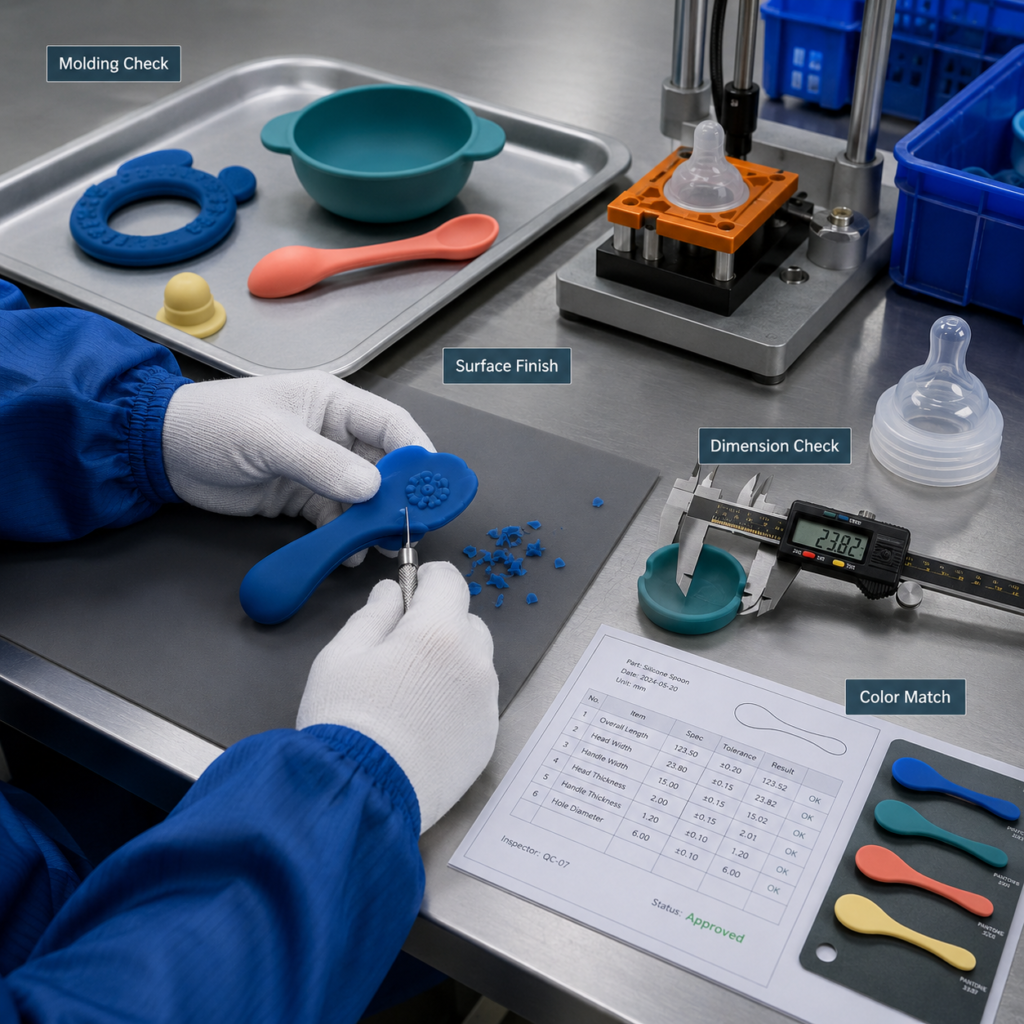
Step 5: Trimming, Finishing and Assembly Checks
After molding, many silicone products need trimming, finishing or assembly.
QC points may include:
- Excess edge removal
- Smooth surface finish
- Clean holes and openings
- No sharp or rough edges
- Correct component combination
- Assembly fit
- Logo condition
- Product cleanliness
- No visible contamination
Trimming standards depend on the product.
For a silicone teether, the chewing surface and edges need careful visual and touch inspection. For a bib, the neck buttons and pocket shape should be checked. For a pacifier or bottle component, the connection area and openings may need additional attention.
Assembled products require both component inspection and finished-product inspection. A correct individual part does not guarantee that the complete assembly will function as expected.
Step 6: Dimensions, Weight and Appearance Inspection
Dimensions and weight help confirm production consistency.
Depending on the product, inspection may cover:
- Length
- Width
- Height
- Diameter
- Wall thickness
- Capacity
- Product weight
- Hole size
- Component fit
Not every dimension needs the same level of control. The buyer and factory should identify critical dimensions that affect function, packaging or assembly.
Appearance inspection may include:
- Color consistency
- Surface finish
- Stains or marks
- Deformation
- Incomplete molding
- Flash
- Scratches
- Logo quality
- Parting-line appearance
- Cleanliness
Silicone baby product quality control should balance appearance standards with realistic production tolerances. Inspection criteria should be agreed before mass production whenever a specific cosmetic standard is important to the brand.
Step 7: Product-Specific Function Checks
Different baby products require different function checks.
Silicone Feeding Products
For bowls, plates, cups and spoon sets, checks may include:
- Shape stability
- Suction-base condition
- Lid or straw fit
- Handle condition
- Capacity
- Component combination
- Ease of assembly
- Packaging fit
Silicone Baby Bottles and Nipples
Depending on the design, checks may include:
- Nipple appearance
- Opening condition
- Component fit
- Bottle-body shape
- Lid and handle assembly
- Leakage-related review based on the agreed method
- Product dimensions
Silicone Teethers and Pacifiers
Checks may include:
- Edge smoothness
- Surface texture
- Product deformation
- Nipple or chewing-area condition
- Shield or ring structure
- Ventilation openings
- One-piece or assembled condition
Pacifier Clips and Other Assembled Accessories
Checks may include:
- Component count
- Total length
- Clip function
- Attachment loop
- Assembly condition
- Cord or strap appearance
- Packaging and warning information
Function checks should follow the approved product structure and agreed inspection method. A generic checklist is not enough for every product category.
Step 8: Color and Logo Consistency
Custom color and branding are important for private label projects.
Color inspection may compare the bulk product with:
- Approved color sample
- Pantone reference
- Buyer-confirmed photograph
- Previous approved production batch
The factory should also check whether different components in the same set appear coordinated.
Logo inspection may include:
- Position
- Size
- Clarity
- Orientation
- Color
- Surface condition
- Consistency across the batch
For molded logos, the mold structure affects the final result. For printed or marked logos, adhesion, clarity and placement may need additional review.
A clear approved sample helps make quality control in silicone baby product production more objective.
Step 9: Packaging and Set-Combination Inspection
Packaging quality affects both product protection and brand presentation.
Before shipment, packaging checks may include:
- Correct product
- Correct color
- Correct quantity
- Correct set combination
- Packaging size
- Product fit inside the box
- Barcode and label position
- Instruction card
- Warning information
- Carton mark
- Carton condition
For multi-item feeding sets, each package should contain the correct combination. Missing one spoon, lid, straw or accessory can create customer complaints even when the silicone products themselves are acceptable.
Packaging artwork should be confirmed early. Late changes may affect lead time and increase the risk of incorrect labels or printed information.
The article MOQ, Lead Time & Pricing Structure for Silicone Baby Product Manufacturing explains how packaging, testing samples and inspection requirements can affect project cost and schedule.
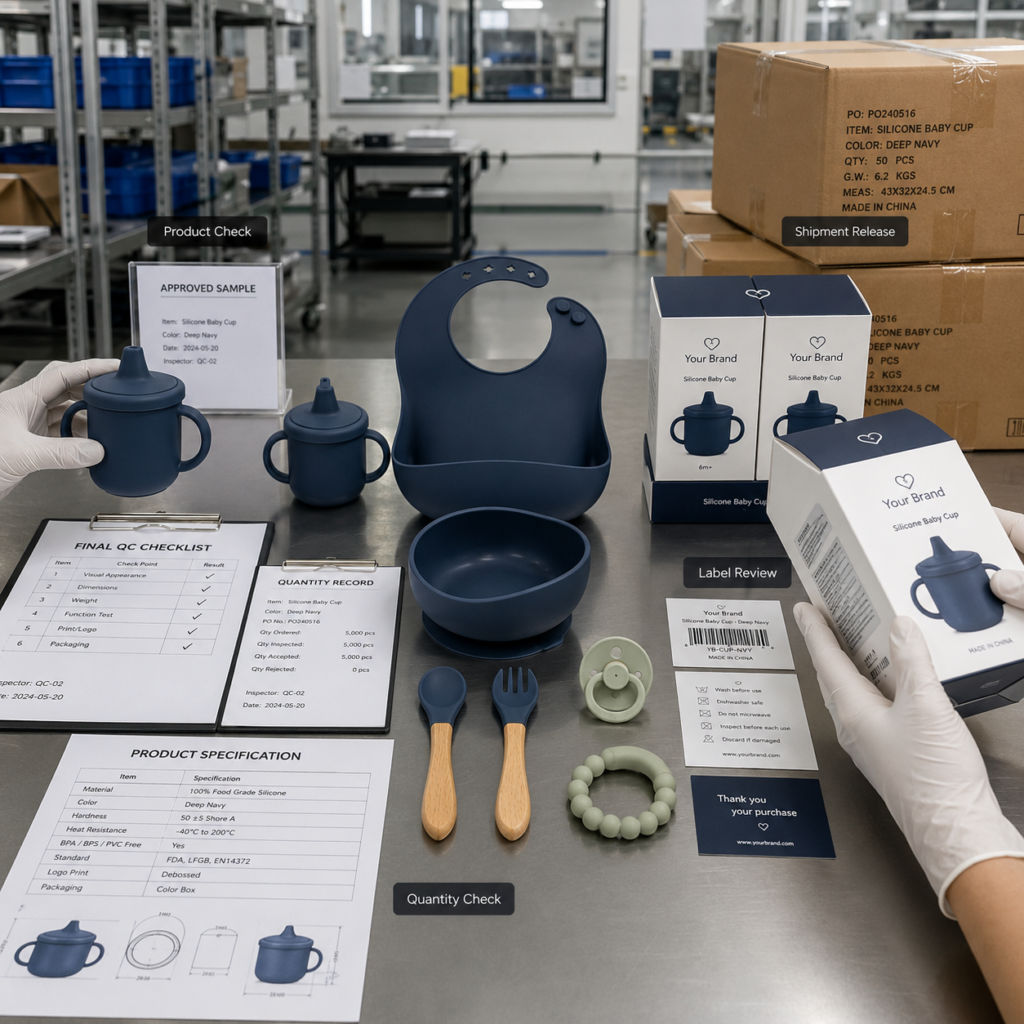
Step 10: Final Inspection and Shipment Release
Final inspection is the last internal review before the products are released for shipment.
The final check may confirm:
- Product appearance
- Key dimensions
- Function
- Quantity
- Color
- Logo
- Packaging
- Set combination
- Carton condition
- Shipping marks
If the buyer has a specific sampling requirement, inspection level or third-party inspection plan, it should be discussed before production.
Final inspection does not mean every possible issue can be detected by looking at finished products. It works together with material control, first-piece approval and in-process inspection.
This layered approach makes silicone baby product quality control more reliable than relying only on a final visual check.
Internal Factory QC vs Third-Party Testing
Internal factory inspection and compliance testing are related, but they are not the same.
Factory QC focuses on whether the produced goods match the approved product, specification, function, packaging and order requirements.
Third-party testing evaluates applicable safety or regulatory requirements based on the product type and target market.
For applicable U.S. children’s products, buyers can review the official CPSC Children’s Product Certificate guidance. CPSC explains that certification for applicable children’s products is based on testing by a CPSC-accepted third-party laboratory.
For food-contact feeding products, buyers can also review the FDA’s information about food contact substances.
Internal quality control cannot replace required laboratory testing, and a laboratory report cannot replace stable factory production control. Buyers should plan both based on the product and target market.
For a broader compliance overview, read Are Certifications Required for Silicone Baby Products? FDA, LFGB, CPC and EN14350 Explained.
How Buyers Can Define Their QC Requirements
Buyers can help the factory prepare a more effective QC plan by providing:
- Approved sample
- Product drawing
- Critical dimensions
- Material specification
- Hardness requirement
- Color reference
- Logo artwork
- Function expectations
- Packaging artwork
- Set-combination list
- Label and warning requirements
- Target market
- Testing plan
- Special inspection points
For high-priority characteristics, buyers should explain why the item matters.
For example:
- A lid dimension may affect leakage or fit.
- A suction base may affect product function.
- A nipple wall may affect product feel.
- A package label may affect market compliance.
- A color difference may affect the consistency of a full collection.
The clearer the requirements, the easier it is to build practical quality control in silicone baby product production.
Questions to Ask a Silicone Baby Product Supplier About QC
Before placing a bulk order, buyers can ask:
- Do you inspect raw material and color preparation?
- Do you perform first-piece inspection?
- What do you check during molding?
- How do you control trimming and surface finish?
- Which dimensions are checked?
- How do you inspect assembled products?
- Can you follow an approved sample and specification sheet?
- How do you check packaging and set combinations?
- Can you support third-party inspection?
- How are nonconforming products separated?
- Can you prepare samples for laboratory testing?
- What quality information should the buyer confirm before production?
Buyers can also read Silicone Baby Products Factory vs Trading Company: Key Differences Explained to understand why direct production communication can matter when quality issues require technical feedback.
How Baiya Silicone Manages Quality Control
Dongguan Baiya Silicone Products Co., Ltd. is a silicone OEM and ODM manufacturer based in Dongguan, China.
Through Baiya Baby, we support baby brands, importers, distributors, wholesalers and e-commerce sellers with product development and mass production.
Our quality workflow may include:
- Requirement and approved-sample review
- Material and color preparation
- First-piece confirmation
- In-process molding inspection
- Trimming and finishing checks
- Appearance and dimension inspection
- Product-specific function checks
- Assembly inspection
- Packaging and quantity checks
- Final inspection before shipment
Because different products have different structures, we review inspection points according to the specific project.
Silicone baby product quality control for a feeding set may focus on suction, set combination and packaging. A teether project may focus more on surface finish, edges, texture and shape. A bottle or pacifier project may require closer review of functional components and assembly relationships.
We also support OEM and ODM silicone baby product manufacturing for custom colors, logos, molds, samples, packaging and long-term product development.
Final Thoughts
Quality control in silicone baby product production should begin with clear requirements and continue through material preparation, molding, trimming, function checks, packaging and final shipment review.
A good sample is important, but stable bulk quality depends on process control and product-specific inspection.
Buyers should also remember that internal factory QC and third-party compliance testing serve different purposes. Both may be needed depending on the product and target market.
If you are preparing a silicone baby product project, contact Baiya Silicone with your product drawing, sample, quality requirements, packaging details, target market and estimated quantity.
Our team can help review product feasibility, mold options, sample planning, inspection points, MOQ, lead time, production solution and testing preparation based on your project requirements.
 English
Comments are closed