
Silicone Pacifier Manufacturer & Custom Pacifier Clip OEM Guide
Choosing a silicone pacifier manufacturer requires more than comparing product photos and unit prices.
Pacifiers and pacifier clips are small baby products, but they involve different structures, manufacturing processes and testing directions. A pacifier normally includes a nipple, shield and ring or handle. A pacifier clip is a separate holder that connects a pacifier to clothing or another intended attachment point.
For baby brands, importers, distributors and private label sellers, the first step is to separate these two products clearly. A silicone pacifier manufacturer should review pacifier material, nipple shape, shield structure, ventilation, ring design, mold feasibility and sample performance.
A custom pacifier clip OEM project should separately review the clip body, attachment loop, strap or cord structure, total length, small components, assembly strength, labeling and packaging.
This guide explains how to develop silicone pacifiers and custom pacifier clips, what buyers should prepare, how molds and samples are reviewed, and why testing plans should be confirmed before mass production.
What Does a Silicone Pacifier Manufacturer Do?
A silicone pacifier manufacturer develops and produces pacifiers based on buyer requirements, reference samples, drawings or existing molds.
Manufacturer support may include:
- Product idea review
- Nipple shape and softness review
- Shield and ventilation design
- Ring or handle structure
- Material selection
- Silicone hardness confirmation
- Existing mold customization
- New mold development
- Sample preparation
- Custom color
- Logo customization
- Testing preparation
- Private label packaging
- Mass production
- Quality inspection
- Shipment preparation
A professional silicone pacifier manufacturer should not treat the pacifier as a simple molded product. The nipple, shield, ventilation openings, protruding parts and structural integrity all need to be considered during design and sampling.
For buyers developing matching accessories, the manufacturer may also coordinate a custom pacifier clip OEM project. However, the clip should be reviewed as a separate product with its own structure, sample and testing plan.
Pacifier and Pacifier Clip Are Two Different Products
Pacifiers and pacifier clips are often sold in the same product collection, but they should not be treated as one product during development.
A pacifier is intended for sucking and may include:
- Silicone nipple
- Shield or guard
- Ventilation openings
- Ring or handle
- Logo area
- One-piece or assembled structure
A pacifier clip or soother holder may include:
- Clip body
- Silicone or textile connection section
- Attachment loop
- Cord or strap
- Silicone components or decorative parts
- Assembly parts
- Brand tag
- Packaging and warning information
This difference affects design review, mold development, testing preparation and packaging.
For the U.S. market, the CPSC Pacifiers Business Guidance states that pacifier clips do not fall under the regulatory definition of pacifiers and must meet separate children’s product safety requirements. It also explains that pacifiers cannot be sold or distributed with ribbons, strings, cords, chains or similar attachments. Buyers should therefore discuss the pacifier and clip as separate products and confirm the intended sales configuration before production.
What Buyers Should Prepare Before Contacting a Manufacturer
Before asking a silicone pacifier manufacturer for price, MOQ or sample time, buyers should prepare basic project information.
For the pacifier, useful information includes:
- Reference photo or physical sample
- Nipple shape
- Nipple dimensions
- Target age group
- Shield shape and dimensions
- Ventilation design
- Ring or handle structure
- Silicone material requirement
- Silicone hardness
- One-piece or assembled design
- Color requirement
- Logo position
- Target market
- Testing requirement
- Packaging style
- Estimated order quantity
For a custom pacifier clip OEM project, buyers should also prepare:
- Clip style
- Clip material
- Strap, cord or component structure
- Attachment loop design
- Total product length
- Number and size of components
- Assembly method
- Pull-strength expectation
- Target age group
- Target market
- Warning and labeling requirements
- Packaging style
- Estimated quantity
If drawings or 3D files are available, the factory can review feasibility more quickly. If the buyer only has a product idea or reference sample, the project can still begin with structure review and sample planning.
Buyers who are still organizing their requirements can first read How to Start a Custom Silicone Baby Product Project with a Manufacturer.
Safe Material Selection for Silicone Pacifiers
Material selection is one of the most important parts of pacifier development.
Buyers commonly review:
- Silicone grade
- Material consistency
- Nipple softness
- Odor control
- Color stability
- Heat resistance
- Surface finish
- Cleaning method
- Target market requirements
- Testing sample preparation
The correct material choice depends on product design, function and sales market. A soft nipple still needs to maintain the required structure, while the shield and ring need enough stability for the intended design.
A silicone pacifier manufacturer should confirm material and hardness before mold development or sample approval. Changing hardness later may affect nipple feel, wall thickness, demolding, appearance and sample performance.
Buyers should avoid relying only on general descriptions such as “food-grade silicone.” The project should define the material requirement, target market and intended testing direction more clearly.
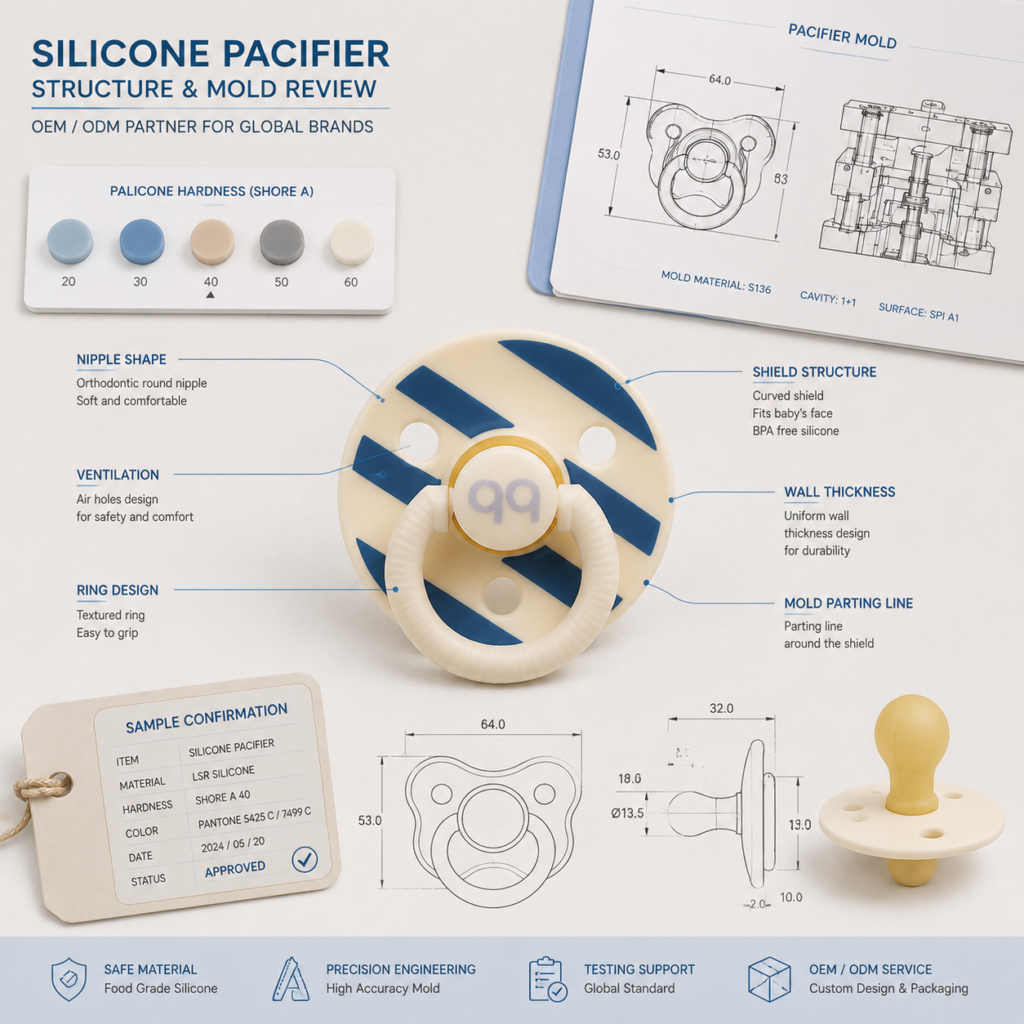
Nipple Shape, Hardness and Wall Thickness
The nipple is the central functional part of a pacifier.
Common design directions may include:
- Round nipple
- Symmetrical nipple
- Orthodontic-style nipple
- Flat or tapered nipple
- Different nipple sizes for different age groups
The final design should be reviewed together with silicone hardness and wall thickness.
If the nipple is too soft, it may not maintain the expected shape. If it is too firm, the product may not provide the intended feel. Uneven wall thickness can also affect molding consistency and sample performance.
During development, a silicone pacifier manufacturer should review:
- Nipple dimensions
- Nipple profile
- Wall thickness
- Silicone hardness
- Connection area
- Demolding direction
- Surface finish
- Mold parting line
- Sample consistency
The buyer should confirm the sample by checking both appearance and product feel. A good-looking sample is not enough if the nipple structure is inconsistent or the connection area needs adjustment.
Shield, Ventilation and Ring Design
The shield or guard is another important part of a pacifier.
The design should be reviewed for:
- Shield dimensions
- Shield curvature
- Ventilation openings
- Edge smoothness
- Skin-contact area
- Ring or handle position
- Logo area
- Protruding parts
- One-piece or assembled structure
- Cleaning accessibility
Official CPSC pacifier guidance explains that the guard or shield is intended to help prevent the whole pacifier from entering the child’s mouth. It also identifies ventilation, protrusion limitations and structural integrity as important parts of the pacifier requirements.
This means the shield should not be designed only for appearance. Its size, ventilation openings, edge treatment and relationship with the nipple and ring should be considered before opening a mold.
A reliable silicone pacifier manufacturer should review these details during the drawing and sample stages, not after mass production.
One-Piece Pacifier vs Assembled Pacifier
Pacifiers may use a one-piece design or an assembled structure.
One-Piece Silicone Pacifier
A one-piece design may combine the nipple, shield and handle into one molded silicone body.
Possible advantages include:
- Fewer assembled components
- Easier cleaning structure
- Reduced assembly work
- Simple product appearance
- Consistent color direction
However, a one-piece product still requires careful mold review. The factory should check wall thickness, demolding, venting, surface finish and product deformation.
Assembled Pacifier
An assembled pacifier may combine a silicone nipple with a separate shield, ring or decorative component.
Possible advantages include:
- More material combinations
- More color combinations
- Different ring and shield styles
- More visual design options
The assembly relationship needs to be reviewed carefully. Buyers should check connection strength, component fit, possible small parts, assembly consistency and cleaning structure.
The right option depends on brand positioning, product design, market requirements and manufacturing feasibility.
Why Mold Design Matters
Mold design affects the final shape, surface, dimensions and consistency of the pacifier.
For a new project, the silicone pacifier manufacturer may need to review:
- Mold cavity arrangement
- Nipple wall thickness
- Shield structure
- Ventilation openings
- Ring or handle design
- Parting line position
- Silicone flow
- Mold venting
- Demolding direction
- Surface texture
- Logo position
- Sample adjustment plan
A pacifier may look simple in a rendering, but small structural details can make the mold more difficult.
For example, thin nipple walls may require careful process control. Deep recesses may affect demolding. Complex ventilation openings may affect mold structure and trimming. A large logo area may affect appearance or cleaning.
The Silicone Baby Product OEM Process Explained: From Idea to Mass Production should therefore include structure review, mold development, sample confirmation and testing preparation before bulk production.
Custom Pacifier Clip OEM Structure Review
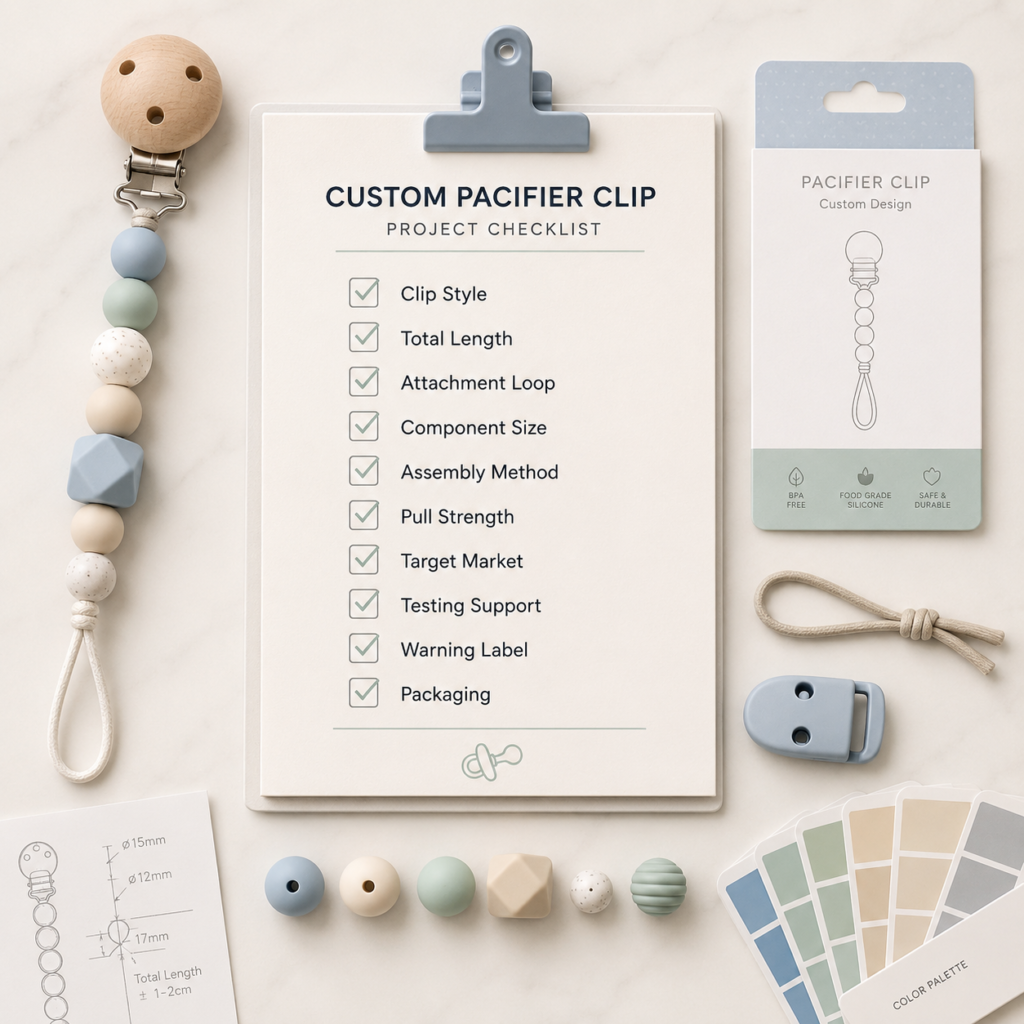
A custom pacifier clip OEM project needs a separate structure review.
The buyer and factory should confirm:
- Clip opening and closing method
- Clip material
- Clip contact area
- Attachment loop
- Strap or cord material
- Total length
- Decorative component size
- Component arrangement
- Knot or fastening method
- Assembly strength
- Possible small parts
- Cleaning instructions
- Warning information
- Packaging method
The product should not be designed only according to appearance or social media trends.
For U.S. projects, CPSC staff recommends that a pacifier clip be no longer than necessary for proper function and preferably no longer than seven to eight inches in total length. The same guidance identifies small-parts requirements and use-and-abuse testing as relevant considerations for pacifier clips.
For European projects, buyers commonly discuss EN 12586-related testing for soother holders. The European Commission guidance on soother holders also explains that these products may have different classifications depending on their design and whether they have play value. The final testing plan should therefore be confirmed with the buyer’s laboratory or compliance professional.
Silicone Components, Clips and Assembly Parts
Many private label pacifier clips use silicone components, a clip body, cord and attachment loop.
Each component should be reviewed separately.
Silicone Components
Buyers should confirm:
- Component size
- Component shape
- Hole dimensions
- Surface finish
- Silicone hardness
- Color consistency
- Logo or pattern
- Cleaning method
Clip Body
The clip body may use plastic, metal, wood or a combination of materials.
Buyers should review:
- Opening force
- Closing strength
- Edge treatment
- Surface finish or coating
- Accessible components
- Material information
- Corrosion concerns
- Brand logo position
Cord, Strap and Attachment Loop
The connection section should be reviewed for:
- Material
- Total length
- Knot or fastening method
- Loop size
- Pull strength
- Assembly consistency
- Fraying or wear
- Cleaning instructions
A custom pacifier clip OEM quotation should identify which parts are manufactured directly, which parts are sourced and how incoming components are checked before assembly.
Testing Direction for Pacifiers and Pacifier Clips
Testing requirements depend on product structure, material, age group, target market and sales configuration.
Pacifiers and clips should not automatically use the same test report.
U.S. Pacifier Projects
CPSC guidance states that pacifiers must comply with 16 CFR Part 1511 and applicable additional requirements. Manufacturers and importers must certify applicable compliance through a Children’s Product Certificate based on required third-party testing.
Project review may include:
- Pacifier regulation requirements
- Structural integrity
- Guard or shield review
- Ventilation
- Protrusion limitations
- Lead and phthalate requirements
- Applicable ASTM F963 sections
- Tracking labels
- Children’s Product Certificate preparation
U.S. Pacifier Clip Projects
Pacifier clips are separate children’s products.
Depending on the construction, project review may include:
- Small-parts requirements
- Use-and-abuse testing
- Lead and phthalate requirements
- Surface coating requirements
- Tracking labels
- Product labeling
- CPC preparation
- Intended sales configuration
European Projects
For European projects, buyers commonly discuss:
- EN 1400-related testing for soothers
- EN 12586-related testing for soother holders
- Mechanical and chemical requirements
- Product information
- Warning statements
- Traceability
- Packaging and labeling
The European Commission identifies EN 1400 as a relevant safety standard for soothers, while its guidance explains the role of EN 12586 for soother holders. The exact applicable edition and testing plan should be confirmed before production.
For a broader overview, buyers can read What Certifications and Testing Support Are Needed for Silicone Baby Products?
Sample Development and Confirmation
Samples should be reviewed before bulk production.
A silicone pacifier manufacturer may prepare:
- Existing mold sample
- Custom color sample
- Logo sample
- New mold sample
- Packaging sample
- Testing sample
For pacifiers, buyers should check:
- Nipple shape
- Nipple softness
- Shield size
- Ventilation openings
- Ring movement
- Surface finish
- Edge smoothness
- Product dimensions
- Color
- Logo
- Packaging fit
For custom pacifier clip OEM samples, buyers should check:
- Total length
- Clip function
- Loop structure
- Component arrangement
- Assembly strength
- Component finish
- Color consistency
- Warning information
- Packaging fit
Sample approval should be documented clearly. Photos, dimensions, color references and packaging artwork can help reduce misunderstandings before production.
MOQ, Lead Time and Pricing
MOQ and pricing depend on whether the project uses an existing mold or requires new development.
Factors may include:
- Existing mold or new mold
- Product structure
- Silicone weight
- Number of colors
- Logo method
- Assembly labor
- Clip and accessory sourcing
- Packaging MOQ
- Testing sample quantity
- Order quantity
- Production schedule
An existing pacifier mold may support faster sampling and a more flexible starting quantity. A new mold project requires mold cost, development time and sample confirmation.
A custom pacifier clip OEM project may also have separate MOQs for silicone components, clip bodies, cords, printed cards or color boxes.
For a detailed explanation, buyers can read MOQ, Lead Time & Pricing Structure for Silicone Baby Product Manufacturing.
A silicone pacifier manufacturer should explain what is included in the quotation, such as unit price, mold cost, sample cost, logo, packaging and testing sample support.
Quality Control During Mass Production
Quality control should cover raw materials, molding, assembly, appearance and packaging.
For pacifiers, QC may include:
- Material confirmation
- Color checking
- Product dimensions
- Nipple appearance
- Shield appearance
- Ventilation openings
- Ring or handle function
- Surface defects
- Assembly relationship
- Random sampling
- Packaging inspection
For pacifier clips, QC may include:
- Clip function
- Total length
- Component count
- Component arrangement
- Cord or strap condition
- Assembly strength
- Small-component inspection
- Color consistency
- Warning label
- Packaging inspection
A sample may be correct while bulk production still develops variations. This is why buyers should review the supplier’s silicone manufacturing capability, QC workflow and packing process before placing repeat orders.
Private Label Packaging
Packaging should be discussed early.
Pacifier packaging may include:
- Blister packaging
- Window box
- Color box
- Kraft box
- Storage case
- Instruction card
- Warning label
- Barcode label
- Age information
- Batch or traceability information
Pacifier clip packaging may include:
- Backing card
- Hanging card
- Kraft card
- Color box
- Warning card
- Barcode label
- Cleaning instructions
- Traceability information
The packaging should match the product, target market and sales channel.
A silicone pacifier manufacturer should confirm product dimensions and the packing method before the buyer finalizes artwork. This helps avoid packaging that is too tight, too loose or missing important information.
How to Choose the Right Supplier
Buyers should review more than catalog photos.
Useful questions include:
- Are you the direct manufacturer?
- Do you manufacture pacifiers, pacifier clips or both?
- Which components are made in-house?
- Can you review pacifier structure and mold feasibility?
- Can you support new mold development?
- Can you prepare testing samples?
- How do you inspect sourced clip components?
- Can you support custom colors, logos and packaging?
- How do you control assembly and bulk consistency?
- Can you explain testing directions for the target market?
- What are the MOQ, sample time and production lead time?
Buyers can also read Silicone Baby Products Factory vs Trading Company: Key Differences Explained before choosing a supplier for a technical OEM project.
The right supplier should communicate clearly about product structure, manufacturing responsibility, testing support and production limitations.
How Baiya Silicone Supports Pacifier and Clip Projects
Dongguan Baiya Silicone Products Co., Ltd. is a silicone OEM and ODM manufacturer based in Dongguan, China.
Through Baiya Baby, we support baby brands, importers, distributors, wholesalers and e-commerce sellers with pacifier and custom pacifier clip OEM development.
As a silicone pacifier manufacturer, Baiya Silicone can help review:
- Pacifier shape
- Nipple structure
- Silicone hardness
- Shield and ventilation design
- Ring or handle structure
- Existing mold options
- New mold development
- Custom color
- Logo customization
- Sample preparation
- Testing sample support
- Private label packaging
- Mass production
- Quality inspection
For custom pacifier clip OEM projects, we can also review product structure, silicone components, clip style, total length, assembly method, packaging and target market information.
We support OEM and ODM silicone baby product manufacturing from requirement review and mold development to sampling, quality control, packaging and shipment preparation.
Final Thoughts
Choosing a silicone pacifier manufacturer requires careful review of material, nipple shape, shield design, ventilation, ring structure, mold feasibility, sample performance, testing preparation and production quality.
Pacifier clips should be treated as separate children’s products. A custom pacifier clip OEM project needs its own structure review, length confirmation, component inspection, assembly plan, testing direction, warning information and packaging.
A reliable silicone pacifier manufacturer should help buyers understand both product development and manufacturing limitations before opening molds or placing bulk orders.
If you are developing a new pacifier or matching pacifier clip collection, contact Baiya Silicone and send us your reference sample, drawing, target market, packaging requirements and estimated quantity.
Our team can help review product feasibility, mold options, MOQ, sample plan, lead time, production solution and possible testing support based on your project needs.
 English
Comments are closed