
Silicone Baby Teether Manufacturer Guide: Safe Materials & Mold Design
Choosing a silicone baby teether manufacturer is an important decision for baby brands, importers, distributors and e-commerce sellers.
A baby teether is a small product, but it is not a simple product. It may be chewed, held, washed, dropped, packed for retail and sold in different markets. Buyers need to review material safety, product shape, softness, texture, mold design, testing support and production quality before starting an OEM project.
A reliable silicone baby teether manufacturer should help buyers review product feasibility before mold opening, sample confirmation and mass production.
This guide explains what buyers should check when developing custom silicone baby teethers, including safe materials, teether structure, mold design, testing support, quality control and packaging.
What Does a Silicone Baby Teether Manufacturer Do?
A silicone baby teether manufacturer develops and produces baby teether products based on buyer requirements.
OEM and ODM teether projects may include:
- Product idea review
- Teether shape design
- Material selection
- Silicone hardness confirmation
- Texture design
- Grip structure review
- Mold development
- Sample preparation
- Testing support
- Custom color
- Logo customization
- Private label packaging
- Mass production
- Quality inspection
- Shipment preparation
Compared with buying ready-made products, custom teether development gives buyers more control over product design, brand positioning, packaging and long-term product line planning.
For buyers still comparing suppliers, it is helpful to understand how to choose a silicone baby products manufacturer before starting a new teether project.
Why Silicone Baby Teether Projects Need Careful Review
Silicone baby teethers are designed for babies to hold and chew. This makes material selection, product structure and surface finish especially important.
A silicone baby teether manufacturer should not only check product appearance. The factory should also review the product shape, edge design, texture, grip area, silicone hardness, mold feasibility and target market requirements.
For example, buyers should consider:
- What age group is the teether designed for?
- Is the shape easy for babies to hold?
- Are the edges rounded and smooth?
- Is the texture too sharp or too shallow?
- What silicone hardness is suitable?
- Is the product one-piece or multi-part?
- Does the design include holes, rings or raised textures?
- Is custom color needed?
- Is private label packaging required?
- What testing support may be needed for the target market?
These details should be reviewed early because they may affect mold design, sample approval, testing preparation and bulk production.
What Buyers Should Check Before Starting a Silicone Baby Teether Project
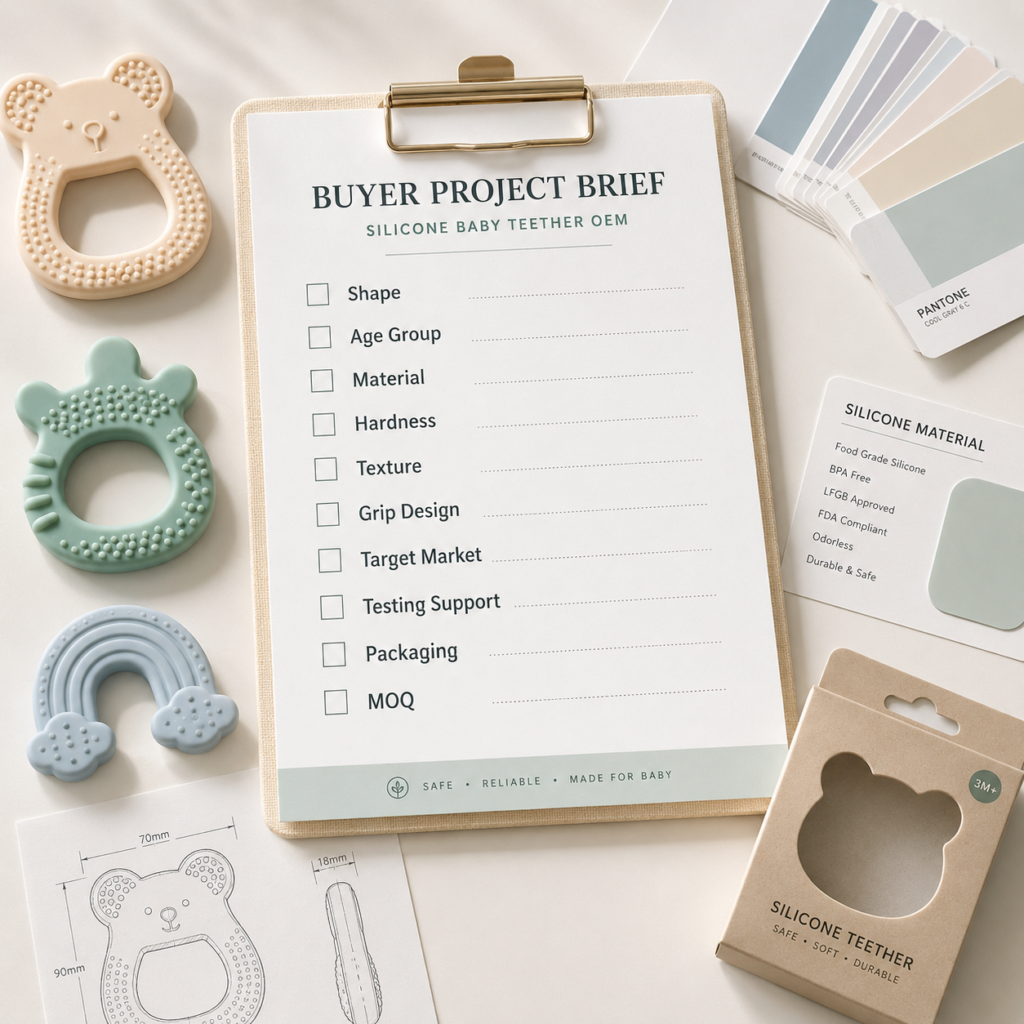
Before contacting a silicone baby teether manufacturer, buyers should prepare basic project information.
Useful information includes:
- Product reference photo or sample
- Teether shape
- Target age group
- Product size
- Material requirement
- Silicone hardness
- Texture requirement
- Grip design
- Color options
- Logo requirement
- Target market
- Testing needs
- Packaging style
- Estimated order quantity
- Expected launch timeline
If buyers already have drawings or 3D files, the factory can review mold feasibility more quickly.
If buyers only have a product idea or reference sample, the manufacturer can still help review possible development directions before mold opening.
A clear project brief helps both buyer and factory save time during the silicone baby teether manufacturer selection process.
Safe Material Selection for Silicone Baby Teethers
Material selection is one of the most important parts of silicone baby teether development.
For baby teethers, buyers usually care about:
- Food-grade silicone
- BPA-free material
- Soft touch
- Suitable hardness
- Odor control
- Heat resistance
- Easy cleaning
- Color stability
- Safe surface finish
Because teethers may contact the baby’s mouth, the selected silicone material should match the product function and target market requirements.
For U.S. food-contact or mouth-contact related discussions, buyers may review FDA’s official information about food contact substances when preparing material and testing requirements.
For European buyers, food-contact expectations may also involve EU food contact materials legislation or LFGB-related testing support depending on the product use and sales market.
A professional silicone baby teether manufacturer should help buyers review material, use scenario and target market before production starts.
Silicone Hardness and Texture Design
Silicone hardness affects the final user experience of a baby teether.
If the teether is too hard, it may not feel comfortable. If it is too soft, the product may not keep its shape or may not meet the buyer’s design expectation.
Buyers should review:
- Teether softness
- Bite feel
- Grip comfort
- Wall thickness
- Raised texture
- Product flexibility
- Surface smoothness
- Cleaning structure
Texture design also needs careful review.
A raised texture may help create a different product feel, but it should be reviewed for mold feasibility, surface finish and cleaning. Deep texture, sharp details or complicated small grooves may increase mold difficulty or inspection requirements.
This is why teether texture should be confirmed during the design and sampling stage, not after mass production.
Why Mold Design Matters for Silicone Baby Teethers
Mold design is a key part of custom teether development.
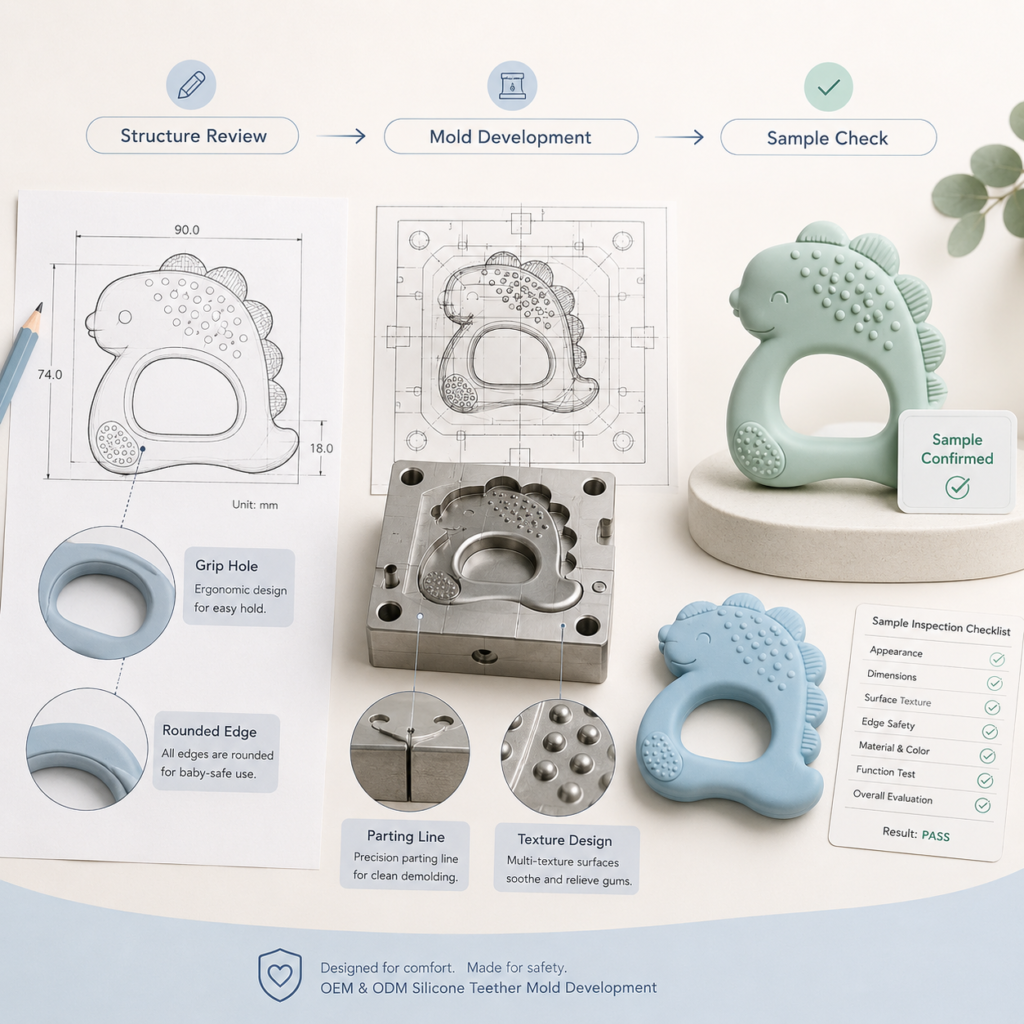
The mold affects product shape, parting line, texture detail, edge smoothness, surface finish, logo position and production consistency.
For silicone baby teethers, mold development may involve:
- Teether body mold
- Grip hole structure
- Rounded edge design
- Raised texture
- Logo position
- Parting line position
- Venting consideration
- Sample trial
- Mold adjustment
A good teether design should look attractive, but it also needs to be manufacturable.
Before mold opening, the silicone baby teether manufacturer should review whether the design can be molded consistently and whether the sample can meet the buyer’s expected function and appearance.
Opening a mold too early without structure review may create problems later during sampling, testing or production.
Safety Testing and Certifications
Safety testing should be discussed before mass production.
Silicone baby teethers may involve different testing support depending on product type, material, age group, function and target market.
For the U.S. market, silicone teethers are often reviewed as children’s products. Buyers can review CPSC Children’s Product Certificate guidance when preparing compliance documentation.
If the teether is toy-like or sold as a children’s toy product, buyers may also review CPSC toy safety guidance to understand applicable toy safety testing direction.
Testing support may include:
- Material testing
- Children’s product testing
- CPC-related support
- Toy safety testing direction
- EN71-related support
- Food-contact or mouth-contact material testing
- Market-specific testing review
Testing should not be treated as a last-minute step.
For more details, buyers can read our guide on silicone baby product certifications before confirming a testing plan.
How the Silicone Baby Teether OEM Process Works
A clear OEM process helps buyers reduce development risk.
The silicone baby product OEM process usually includes:
| OEM Step | What Buyers Should Confirm |
|---|---|
| Idea Review | Product reference, shape, target age group and market |
| Structure Review | Grip area, texture, rounded edge, logo and product size |
| Material Review | Silicone material, hardness, softness and color requirement |
| Mold Development | Mold feasibility, parting line, texture detail and sample plan |
| Sample Confirmation | Appearance, size, softness, texture and product feel |
| Testing Preparation | Product type, target market and possible testing support |
| Production | Material preparation, molding, trimming and inspection |
| Packaging | Private label box, labels, instructions and shipment preparation |
This process may change depending on product complexity, customization level and target market.
For buyers planning a broader OEM project, it is useful to review the full silicone baby product OEM process before starting mold development.
Quality Control for Silicone Baby Teethers
A reliable silicone baby teether manufacturer should control more than sample appearance.
During mass production, the factory should review:
- Raw material preparation
- Color consistency
- Silicone molding
- Trimming
- Surface finish
- Texture details
- Size consistency
- Appearance inspection
- Function checking
- Packaging inspection
- Random sampling before shipment
For silicone baby teethers, small changes may affect product feel, texture, grip comfort and final user experience.
Quality control should happen during production and before shipment.
A good sample is not enough. Bulk production should also remain consistent.
Packaging and Private Label Support
Packaging is another important part of silicone baby teether OEM projects.
Private label buyers may need:
- Color box
- Kraft box
- Window box
- Blister packaging
- Instruction card
- Barcode label
- Warning information
- Brand logo
- Retail packaging
- E-commerce packaging
Packaging should be reviewed early because it may affect product presentation, labeling requirements, customer trust and shipment cost.
For teether projects, packaging should match product size, product shape, target market and sales channel.
Baiya Silicone supports OEM and ODM silicone baby product manufacturing, including teether design review, mold development, sample preparation, packaging support and mass production planning for global buyers.
Common Mistakes Buyers Should Avoid
Many buyers make similar mistakes when developing silicone baby teethers.
Common mistakes include:
- Asking for price before confirming product structure
- Ignoring silicone hardness
- Choosing complicated textures without mold review
- Opening a mold before confirming product size
- Not checking edge smoothness
- Waiting until mass production to discuss testing
- Treating all teethers as the same testing category
- Ignoring packaging and labeling requirements
- Choosing a supplier only based on low unit price
- Not checking production and QC ability before placing bulk orders
A silicone baby teether manufacturer should help buyers avoid these risks through early product review and clear project communication.
How Baiya Silicone Supports Baby Teether OEM Projects
Dongguan Baiya Silicone Products Co., Ltd. is a silicone OEM and ODM manufacturer based in Dongguan, China.
Through our baby product division Baiya Baby, we support global baby brands, importers, distributors and e-commerce sellers with custom silicone baby product development.
For silicone baby teether OEM projects, we can help buyers review:
- Product shape
- Target age group
- Material selection
- Silicone hardness
- Texture design
- Mold feasibility
- Sample preparation
- Testing support
- Packaging requirements
- Mass production
- Quality inspection
For buyers who already have drawings or reference samples, we can help review manufacturing feasibility.
For buyers who only have a product idea, we can help discuss possible development directions before mold opening.
Final Thoughts
Choosing a silicone baby teether manufacturer requires more than comparing price.
Buyers should review safe materials, teether shape, silicone hardness, texture design, mold development, testing support, sample confirmation, production quality and packaging before starting an OEM project.
A reliable manufacturer can help reduce development risks and support long-term baby product lines.
If you are developing a new silicone baby teether or baby product project, contact Baiya Silicone and send us your product idea, reference sample, drawing, target market, packaging requirements and estimated order quantity.
Our team can help review product feasibility, MOQ, sample plan, lead time, production solution and possible testing support based on your project needs.
 English
Comments are closed